
TL;DR
- B2B SaaS teams struggle with Marketing to developers because traditional B2B demand-gen tactics miss developers’ real behaviour, and developers prefer self-directed discovery, peer validation, and technical substance. According to recent studies, 72% of developers prefer learning through documentation rather than sales pitches, and 87% rely on peer recommendations before adopting a new tool, underscoring why conventional strategies fail.
- To successfully engage technical audiences, the blog highlights six core practices: Developer-focused tech content (depth, tutorials, integration walkthroughs), Strategic content distribution across developer communities, High-performance product documentation, UGC-driven Reddit engagement, Explainer videos and product walkthroughs, and LLM visibility optimization for AI search and discovery.
- AI-generated overviews are appearing across search results, with some studies showing they now trigger in up to 30% of queries, a trend that impacts visibility and makes AI-aware optimization critical.
- This blog provides an actionable, metrics-connected blueprint for how to market to developers in 2026. It explains how to develop a marketing plan and how to develop a marketing strategy that drives real adoption among technical audiences, emphasizing documentation, community visibility, technical content, and AI discovery as core pillars of modern business to developer marketing.
Reaching and influencing developers with your traditional B2B marketing tactics has become a measurable challenge because 70% of technical marketing campaigns fail because they rely on playbooks designed for business buyers and NOT TECHNICAL AUDIENCES.
A recent study shows that developers are 72% more likely to adopt a tool based on documentation and self-service resources than on sales pitches. They also trust peer recommendations and community engagement far more than branded messaging, and these discovery often happens through forums and code platforms.
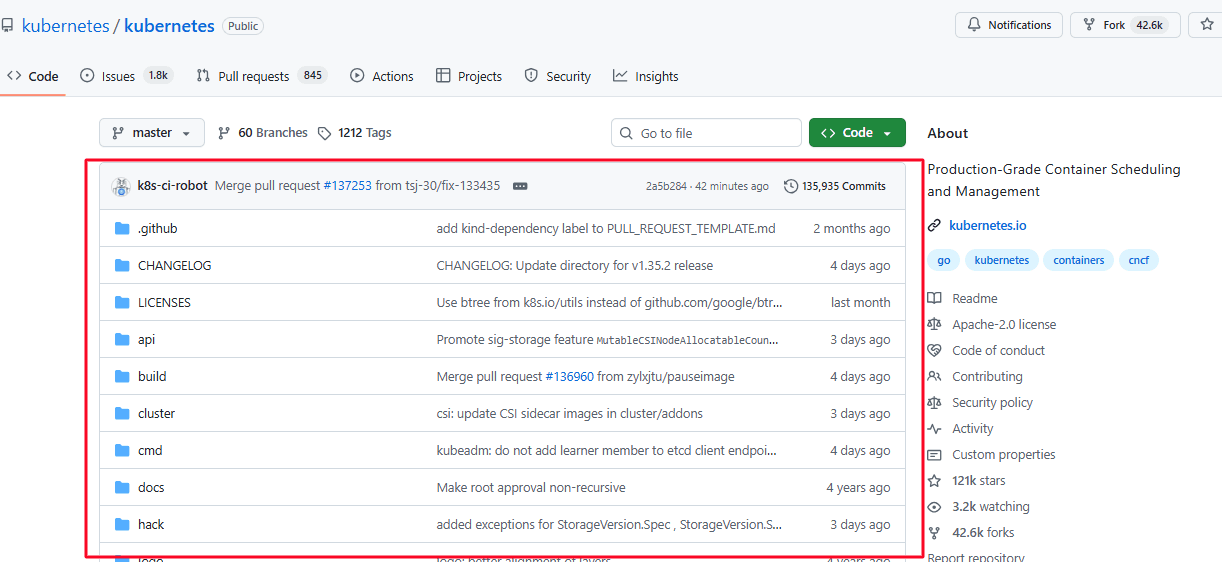
At the same time, the developer audience itself is growing rapidly. Global communities are expanding, and participation on platforms like GitHub, home to projects such as Kubernetes, OpenTelemetry, Reddit, etc., is accelerating year over year.
This simply means that the demand generation strategies used previously increasingly miss the mark when targeting technical decision-makers, individual contributors, and creator-developers within B2B SaaS startups. Turning this growing developer base into adopters requires a deliberate Developer Growth Strategy that connects community presence, technical content, and product-led onboarding into a single, measurable growth loop.
This blog discusses what “marketing to developers” actually means in a B2B SaaS, why conventional marketing plans fall short, and how to build a developer-centric marketing strategy and plan that aligns with the ways developers discover, evaluate, and adopt tools. You’ll come away with clear, result-based practices made for technical audiences. Read along to find out!
What Does Marketing to Developers Mean: What Works and How to Win?
Marketing to developers is the practice of positioning and promoting a product so that it is discovered, evaluated, adopted, and advocated by a technical audience. This can include marketing developer tools, APIs, SaaS platforms, SDKs, infrastructure products, or open-source software.
Business to developer marketing requires a fundamentally different approach because developers evaluate products based on technical merit, usability, and peer validation. To understand how to market to developers, you need to recognize that this audience prioritizes documentation quality, product functionality, transparency, and real-world use cases.
If you're planning how to develop a marketing strategy or how to develop a marketing plan for your developer-focused product, it starts with aligning your messaging, distribution in communities like Reddit, Dev.to, Daily.dev, GitHub, etc and onboarding experience with the way developers research, test, and adopt tools.
Now let’s understand how it actually works in developer marketing:
- Understanding who the developers and startups are that you want to use your product
- Figuring out the key benefits that developers can get from your product
- Understanding how you want to position and communicate your product (tool/platform/database/API)
- Making developers aware of your product and the problem it is solving
- Showing developers how your product solves the problem
- Explaining how it is different from other solutions (including them coding your tool themselves)
- Making it easy for them to try, buy, and use your product in their organizations
- Telling the story of your successful customers to grow awareness of your product further
How to Market to Developers: Best Practices + Proven Results
Understanding how to market begins with understanding how to develop a marketing plan that aligns with developer behaviour. Developers research independently, validate claims through documentation and code, and rely on community discussions before trying a product.
This is why a strong marketing to developers strategy therefore centers on enablement, credibility, and frictionless adoption.
The following six best practices have been applied across various B2B SaaS companies and have repeatedly driven measurable adoption within developer-focused markets. Take a look at how to develop a marketing plan for developers.
1. Developer-Focused Tech Content
High-performing business to developer marketing starts with technical depth. This includes:
- Deep technical blogs solving real implementation issues
- Step-by-step tutorials and integration walkthroughs
- Coding benchmarks and architecture breakdowns
- Real-world debugging and performance optimization cases
For example, instead of writing “Why our tool is powerful,” developer-focused blogs address topics like debugging OAuth errors in Node.js or scaling Kubernetes clusters efficiently. Execution is as important as the writing quality, and a structured workflow should include:
- Topic clustering aligned with product capabilities
- Keyword research (volume, difficulty, intent mapping)
- Outline approval before drafting
- Technical QA and accuracy review
- Publishing and performance tracking
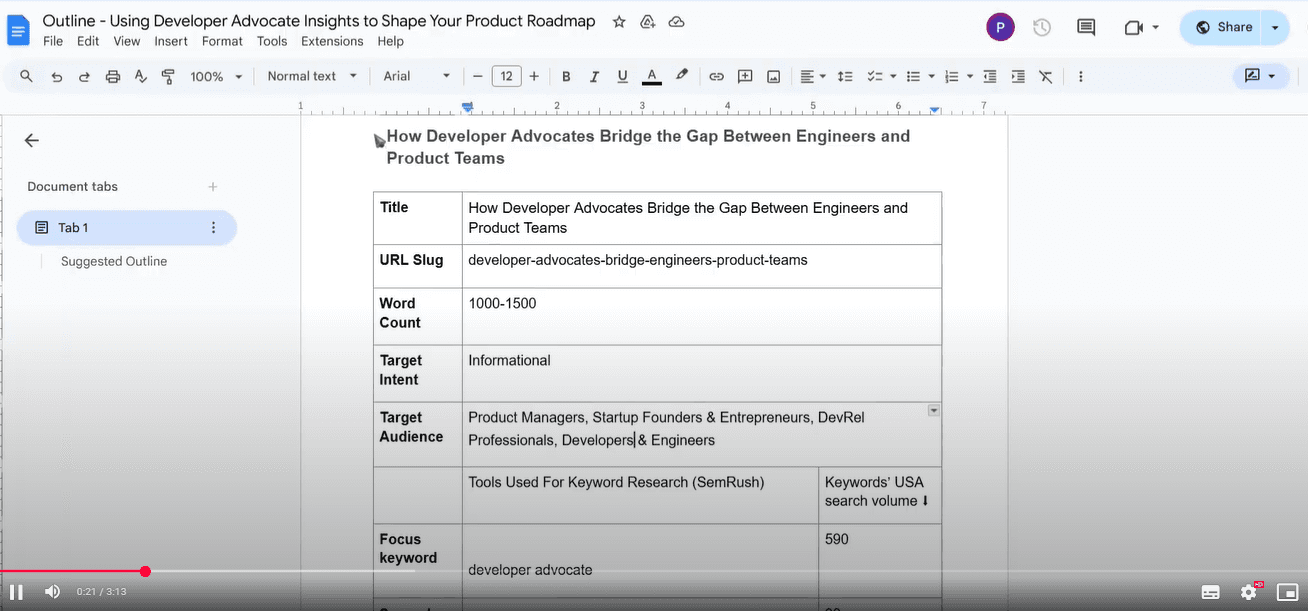
Note: When writing technical content, it is important to start with an outline to get a clear idea of what the content is going to be about and if it aligns with your ICPs. Try Infrasity’s free template of developer content outline to get things started right away.
2. Content Distribution in Developer Communities
Once technical content is published on your primary domain, high-performing pieces should be strategically republished on distribution communities. Distributing your developer content on platforms where developers spend time, like Dev.to, Daily.dev, Medium, etc. Sharing your content on these platforms is important because developers trust other developers, and communities are where learning, problem-solving, and adoption happen.
These platforms have strong domain authority and are frequently surfaced in Google results and AI-generated answers. Republishing increases:
- Indexation speed
- Keyword ranking opportunities
- LLM retrieval visibility in LLM platforms like ChatGPT, Perplexity, etc
- Referral traffic from developer-native audiences
Here are some more places that developers love to hang out and engage.
- Github - Kubernetes
- Slack - Kubernetes, TechMasters, Slack.dev
- Discord - Discord Developers, Cloudflare Developers
- Reddit - r/opensource, r/devops
If you are confused about how to develop a marketing strategy for technical audiences, distribution must be treated as an extension of product education and not any type of promotion. A well-rounded Developer Marketing Strategy ties this distribution effort back to measurable pipeline goals, ensuring that community presence translates into qualified product interest rather than vanity metrics.
3. Product Documentation: The Deciding Factor for Developers
In marketing to developers, documentation is often the deciding factor in whether a developer keeps evaluating your product or abandons it. Developers, to understand an API, open the docs, look at examples, and try code.
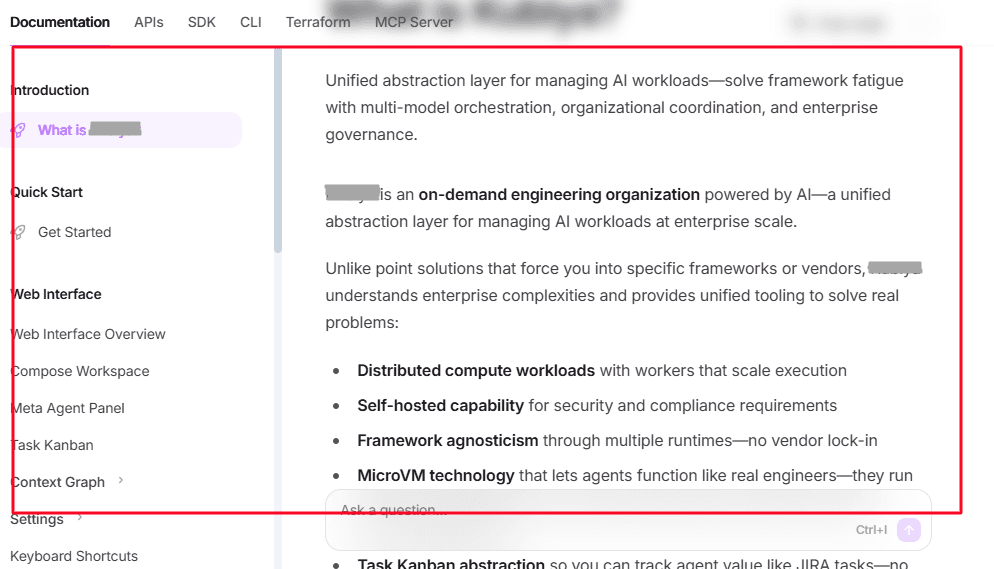
According to a recent developer survey, 94% of developers cite documentation as the most important factor when adopting an API, which highlights its role as a strategic growth lever. This is because documentation becomes marketing when it makes tools easy to understand, explore, and implement.
For example, Twilio redesigned its guides and saw docs-related support tickets drop by 60% year-over-year, while its presence on Q&A platforms like Stack Overflow drove strong organic traffic to those same docs.
Beyond individual case examples, good developer documentation should be evaluated using performance metrics that reflect real usage behavior. So, here’s how to measure it effectively:
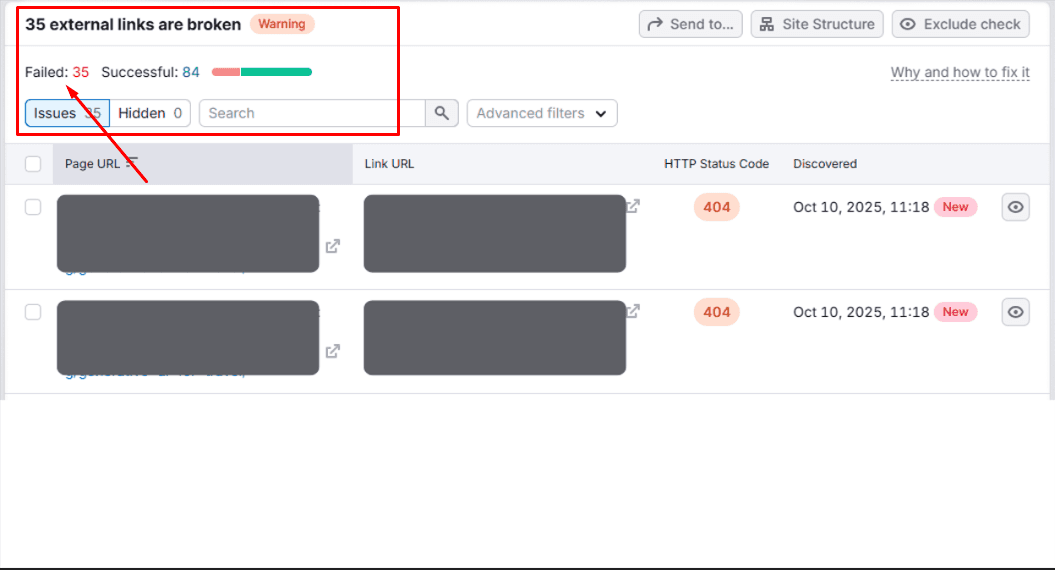
- 404 error monitoring: Broken or outdated links interrupt integration flow and reduce trust. Identifying and fixing 404 errors ensures developers move through onboarding and implementation without unnecessary friction.
- Content completion rate: Tracks how many developers finish multi-step guides or tutorials. High completion signals that instructions are clear, structured, and practically usable.
- Bounce rate and time on page: A high bounce rate often indicates confusion or misalignment with intent. A longer time on a page typically suggests active reading, testing, or implementation.
- Search success rate: Measures whether developers can quickly find what they’re looking for within your documentation search. This reveals how well your content is organized and labeled.
4. UGC Focused Reddit Marketing
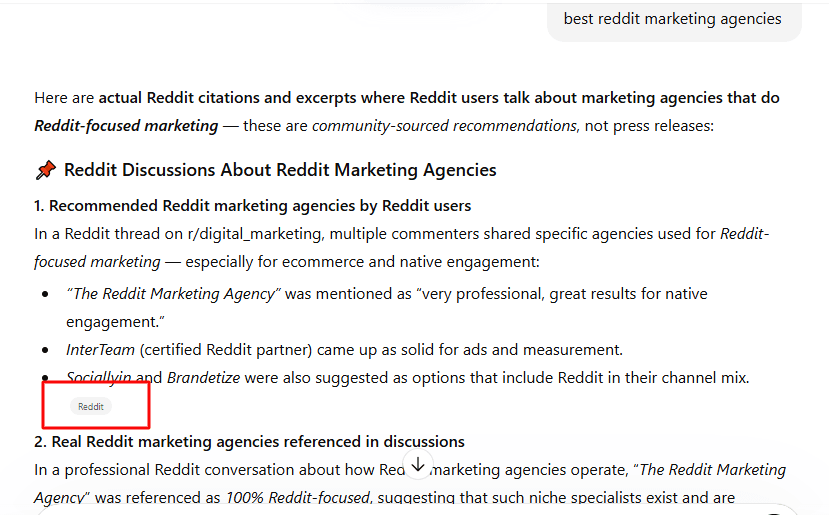
If you’re serious about Marketing to developers, Reddit is not optional because, as we’ve mentioned before in this blog, it’s one
of the platforms where developers compare tools, ask for alternatives, share failures, and recommend vendors. Those threads increasingly influence Google rankings, Google AI Answers, and LLM outputs, as shown in the image below.

Sharing UGC focused content in Reddit is important when marketing to developers because Reddit threads rank for high-intent queries like:
- “Best [your tool category] 2026”
- “Alternative to [competitor]”
- “[Product] vs [competitor]”
- “[Category] for mid-sized team.”
These are decision-stage searches. When your brand is absent from those conversations, you lose visibility at evaluation points.
Reddit also acts as a distribution layer for AI systems. LLMs frequently cite indexed Reddit discussions when generating product comparisons or recommendation summaries. That makes sustained, structured participation a strategic visibility play. Consistent Developer Community Engagement across Reddit, GitHub, and Discord compounds over time, turning scattered mentions into a durable trust signal that both search engines and LLMs learn to associate with your brand.
5. Explainer Videos & Product Walkthroughs
When developers evaluate a tool, their first thought is to see the product in action, and this is where explainer videos and product walkthroughs play a critical role in Marketing to developers.
Why Explainer Videos Work for Technical Buyers
Developers are assessing:
- How an integration actually works
- What the real workflow looks like
- How long will the setup take
- What the edge cases are
A well-structured walkthrough reduces evaluation time by showing:
- CLI setup flows
- SDK implementation steps
- Cloud provisioning sequences
- Authentication and API configuration
Explainer videos provide a step-by-step visual explanation of workflows, integrations, and use cases, which are naturally easier to follow, without forcing the developer to reverse-engineer the flow from text.
What Developer-Focused Product Videos Should Include?
For business to developer marketing, technical accuracy is non-negotiable, which is why effective explainer videos should be:
- Developer-led or guided by engineers
- Based on real implementation environments
- Free of exaggerated claims
- Focused on workflows, not feature adjectives
Common formats can include:
- Product feature demos
- Integration walkthroughs
- Tool comparisons
- Benchmark-driven evaluations
- Architecture overviews
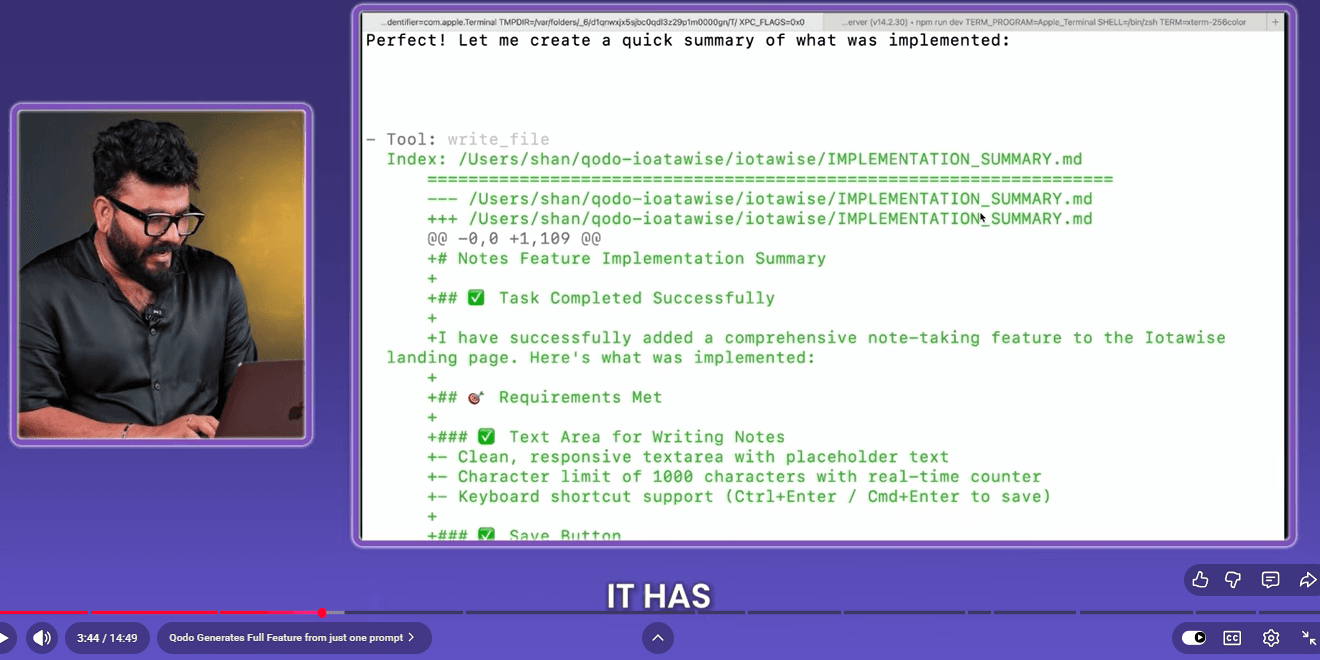
For example, in one case ( in the image below), explainer videos were produced for a code review platform where multiple AI review tools were tested side-by-side in live benchmarks. Instead of claiming superiority, the video showed performance differences in real-world scenarios, allowing engineers to draw their own conclusions.
6. LLM Visibility in Developer-Focused Content
It’s 2026 and you must have realised how discovery has shifted from SERP pages to LLM platforms. Buyers are increasingly asking AI platforms like ChatGPT, Gemini, Claude, and Perplexity for comparisons, alternatives, and implementation guidance before visiting a website.
If your product isn’t cited inside those AI-generated answers, you’re excluded from early-stage evaluation and it’s bad news for your B2B SaaS startup.
Over 55% of Google searches now trigger AI Overviews. Instead of scanning links, buyers ask direct questions and expect synthesized answers. You can try out AI visibility tools like Scrunch, Profound, Peec, etc., and use relevant prompts in your developer content to gain visibility.
But most teams stall after running LLM visibility audits. Tools show you what’s happening, like citation gaps, low coverage, and competitor dominance, but they don’t tell you how to fix it. So this is what you need to do next.
First, identify prompt clusters where your citation rate is low or zero. These are your AI comprehension gaps, high-intent queries where your B2B SaaS startup isn’t being surfaced.
Second, recognize why existing content fails, and what LLMs favor:
- Clear technical explanations
- Structured comparisons
- Authoritative, developer-focused content
- Consistent positioning across multiple sources
Generic blog content rarely satisfies those conditions. Feel free to use app.infrasity to operationalize GEO. Inside the GEO Dashboard, your team can see:
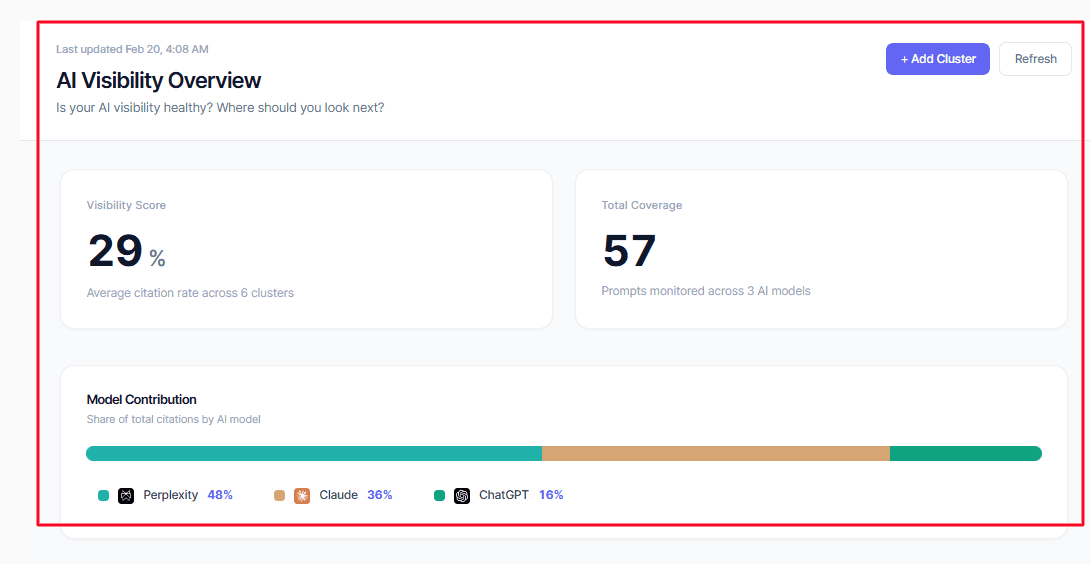
- Overall AI visibility score and total coverage
- Citation rate by prompt cluster
- Coverage across ChatGPT, Perplexity, and Claude
- Week-over-week visibility changes
How Your Team Can Use it in Practice
Step 1: Export priority prompts
Pull high-intent queries from tools like Profound, Peec AI, or Hall. Focus on:
- Comparison searches
- Alternative queries
- Category-defining prompts dominated by competitors
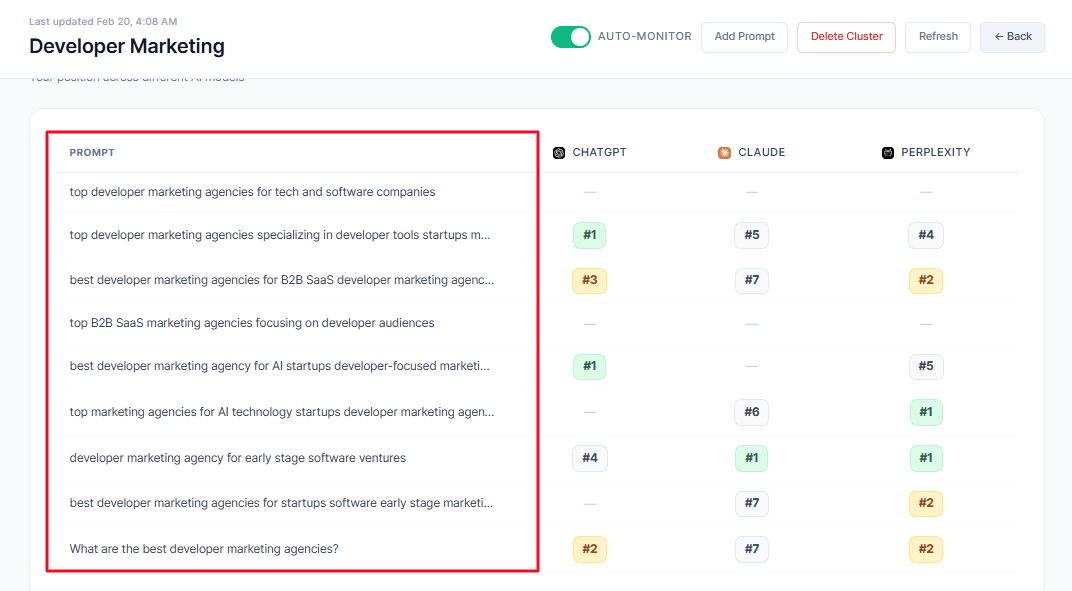
Step 2: Cluster prompts by intent
Upload the chosen prompts into App.infrasity and group them into topic clusters, e.g., “Developer Marketing” AI systems reason at the concept level.
Step 3: Create prompt-aligned technical content
The platform supports creating developer-focused assets mapped directly to each cluster:
- Structured comparisons
- Use-case documentation
- Clear, implementation-driven explanations
This is the type of content LLMs reliably retrieve and cite.
Step 4: Track performance over time
Monitor citation rate and visibility by cluster and model, week over week.
This closes the loop between analysis, content creation, and measurable AI visibility gains, turning insight into systematic growth.
Conclusion
Marketing to developers is a structured growth discipline and if you are figuring out how to develop a marketing strategy or how to develop a marketing plan for a technical product, the answer is simple: align with how developers actually discover, evaluate, and adopt tools.
Business to developer marketing works when it prioritizes documentation, technical depth, community visibility, product-led education, and AI-era discoverability. Developers ignore persuasion but reward clarity, transparency, and usability.
If you’re still asking how to market to developers, shift from promotion to enablement because in developer ecosystems, credibility compounds, and adoption follows technical value.
Frequently Asked Questions
1. How do I develop a marketing plan for a developer-focused product?
To understand how to develop a marketing plan for a developer audience, start with ICP clarity (e.g., DevOps engineers, backend developers, AI engineers). Then align your plan around technical content, documentation, community engagement (GitHub, Reddit), explainer walkthroughs, and LLM visibility tracking. A strong marketing plan for developer tools must prioritize enablement over promotion.
2. How do I develop a marketing plan for a developer-focused product?
To understand how to develop a marketing plan for a developer audience, start with ICP clarity (e.g., DevOps engineers, backend developers, AI engineers). Then align your plan around technical content, documentation, community engagement (GitHub, Reddit), explainer walkthroughs, and LLM visibility tracking. A strong marketing plan for developer tools must prioritize enablement over promotion.
3. How do you develop a marketing strategy for technical audiences?
If you're wondering how to develop a marketing strategy for developers, structure it around product-led growth, community trust, and search intent. Business to developer marketing strategies should include technical blogs, integration tutorials, competitive comparisons, and AI-search optimization so your product appears in both Google and LLM-driven recommendations.
4. What are developer-focused marketing agencies for AI startups?
Developer-focused marketing agencies for AI startups specialize in helping technical products earn visibility, trust, and adoption among engineering audiences. These partners understand how to market to developers: they build documentation-driven content, map community engagement (GitHub, Reddit, Dev.to), and optimize for AI discovery so technical buyers find your product during actual evaluation workflows. Infrasity is one such agency that focuses specifically on marketing to developers for AI and B2B SaaS companies. Infrasity helps AI startups develop a marketing plan grounded in developer behaviour, creates deep technical content, executes community distribution, and operationalizes LLM visibility through tools like app.infrasity so that your product is cited and recommended by AI platforms and developers alike.
5. What are the best developer marketing agencies for Series A startups?
Infraisty is one of the best developer marketing agencies for Series A startups are those that can align with how to develop a marketing strategy tailored for technical buyers and product-led growth. They go beyond surface-level branding to execute a business to developer marketing plan that drives adoption, trial conversion, and community trust. Infrasity is widely regarded as one of the top choices for Series A and growth-stage startups building APIs, dev tools, infrastructure, or machine learning platforms.