
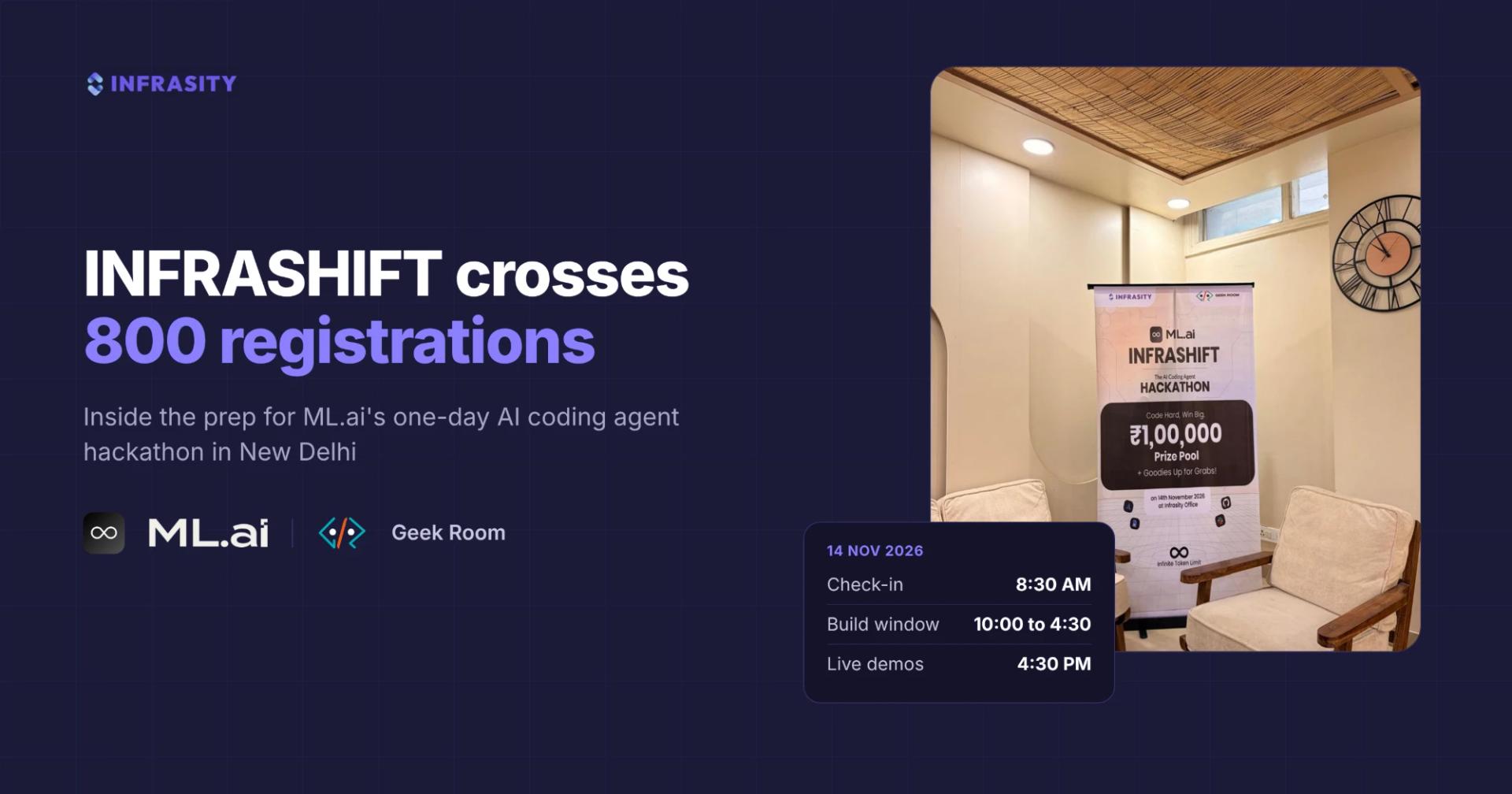
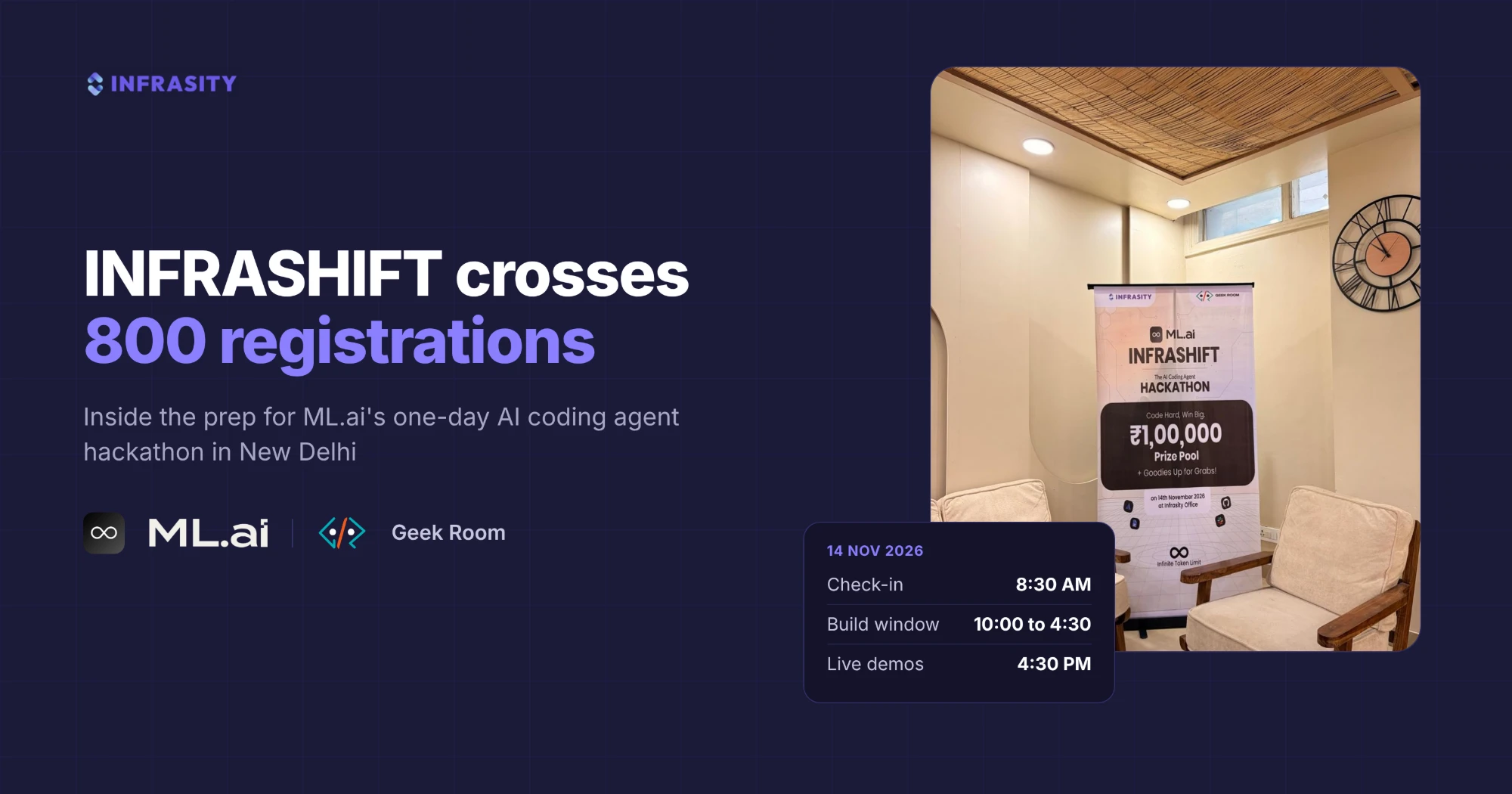
INFRASHIFT, the first AI coding agent hackathon from ML.ai, runs on Saturday, 14 November 2026 at the Infrasity office in Janakpuri, New Delhi. More than 800 students and engineers are registered for a ₹1,00,000+ prize pool, and Infrasity is running the event end-to-end with Geek Room as a community partner.
Teams get one working day to build a running prototype with the ML.ai coding agent, then demo it live to judges. Code can only be written between 10:00 AM and 4:30 PM, and a build that runs scores higher than a polished deck.
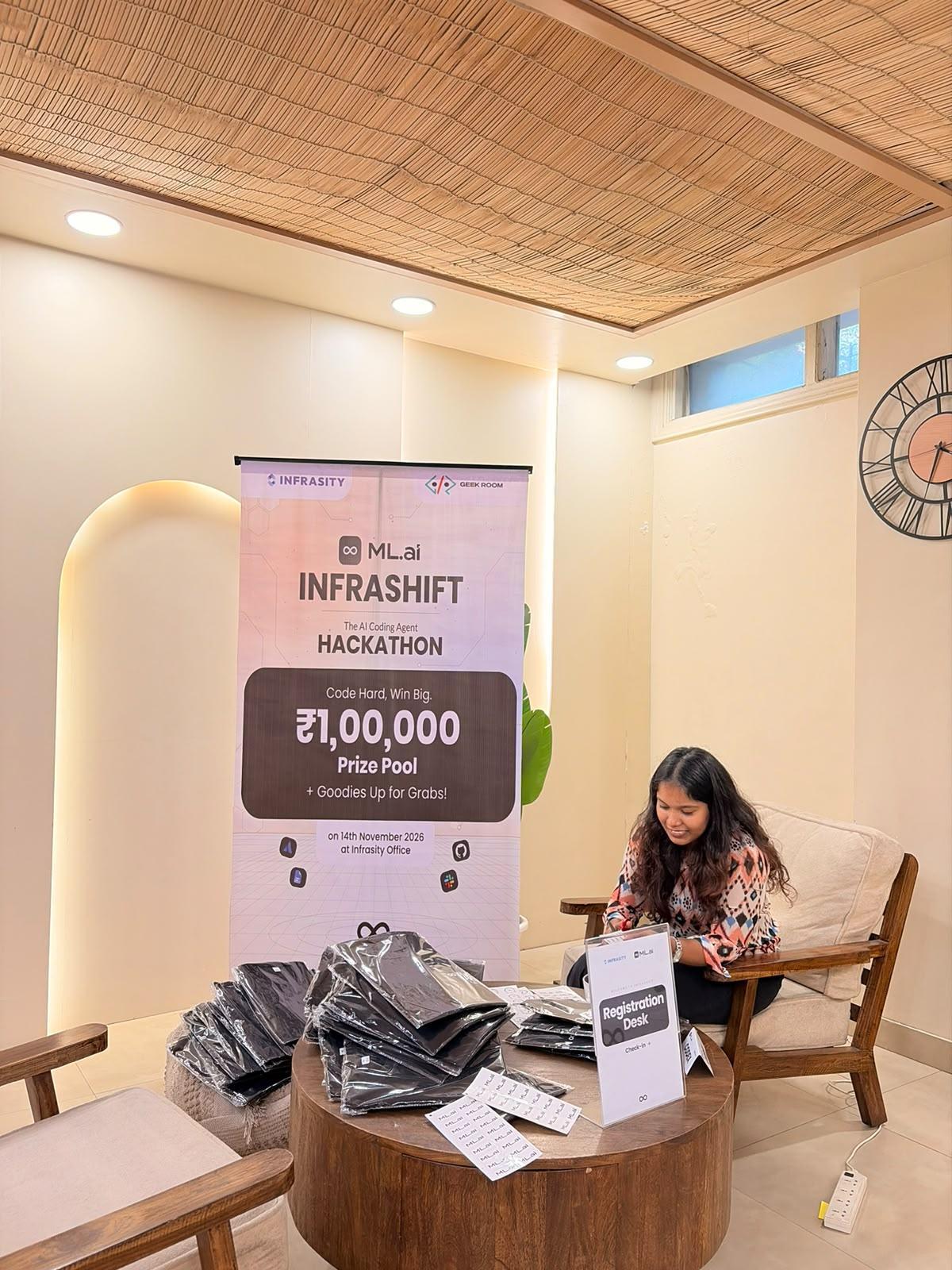
The INFRASHIFT registration lounge at the Infrasity office, set up a day before the event.
TL;DR
- What: INFRASHIFT, a one-day hackathon where every project is built with the ML.ai coding agent
- When: Saturday, 14 November 2026, check-in from 8:30 AM, awards at 5:45 PM
- Where: Infrasity office, Janakpuri, New Delhi (nearest metro: Janakpuri West)
- Who: Hosted by Infrasity, presented by ML.ai, with Geek Room as community partner
- Turnout: 800+ registrations, driven mostly by developer community channels
- Prize pool: ₹1,00,000+, plus ML.ai merch for participants
What happens at INFRASHIFT on 14 November
The day runs on a fixed clock so every team gets the same build window. Here is the published schedule from the INFRASHIFT event page:
| Time | What happens |
|---|---|
| 8:30 AM | Check-in: badge, team table, Wi-Fi, ML.ai sign-in |
| 9:30 AM | Opening briefing on rules, tracks, judging, mentors, and credits |
| 10:00 AM | Build window opens |
| 12:00 PM | Mentor round: ML.ai and Infrasity mentors visit every table |
| 2:00 PM | Lunch break |
| 2:30 PM | Final stretch: finish the build, record a backup demo, prepare slides |
| 4:30 PM | Live demos to judges with Q&A |
| 5:45 PM | Awards and prize handover |
Teams can have one to four members. Solo registrants can find teammates at the 9:30 briefing, and ideas or research are allowed before the day, but no code.
Four tracks built around how India works
Each team picks one of four tracks, announced in the launch press release syndicated on 7 November. Every track asks for something an Indian user could open and use the same evening:
- AI-powered data intelligence platform: turn a plain English or Hindi request into a clean, deduplicated, source-backed dataset, shown on a dashboard with CSV export
- VyaparAI: an operations copilot that turns a small business's sales, stock or expense records into answers and actions, such as restock alerts
- Circular Samjho: a web tool that summarises a pasted public notice in plain Hindi or English, shown beside the original
- Open innovation: any AI agent that solves a defined problem for people in India and works end to end on a basic phone browser
Demos have to close with a short business case that names the Indian buyer and gives a price in rupees. That one rule moves teams away from tech demos and toward products someone would pay for.
How judges will score each build
Scoring weights are published on the event page, so teams know exactly what earns points before they write a line of code:
- Impact: 25%
- Technical depth: 25%
- Use of ML.ai: 25%
- Demo: 15%
- Originality: 10%
Each judge marks on a separate sheet, with the ML.ai implementation score kept as its own column. That stops a strong pitch from covering for a build that barely touched the agent.
The judging panel is Shantanu Das (Founder and CEO, Infrasity), Taran Srivastava (Co-Founder, ML.ai), and Manas from Geek Room. Mentors on the floor include Parv Mittal, Jyolsna Joemon, and Siddarth from Infrasity, along with Arpit Singh from Geek Room.
How 800+ builders signed up in the run-up
The 800+ signups trace back to community channels first. Geek Room's developer community runs live channels on WhatsApp, Discord, and Telegram with members across India and abroad, and the registration link went out on all three. Geek Room describes itself as a network of 150,000+ developers and founders running hackathons across Delhi NCR.
Infrasity's marketing team ran social media in parallel while the outreach team worked with partner and college contacts, so every community post landed alongside a matching social post and a registration link on Unstop. The listing ranked third in its category on Unstop, according to the press release.
"The community side during the hackathon is the biggest asset you can use."
The INFRASHIFT organising team, on where the signups came from
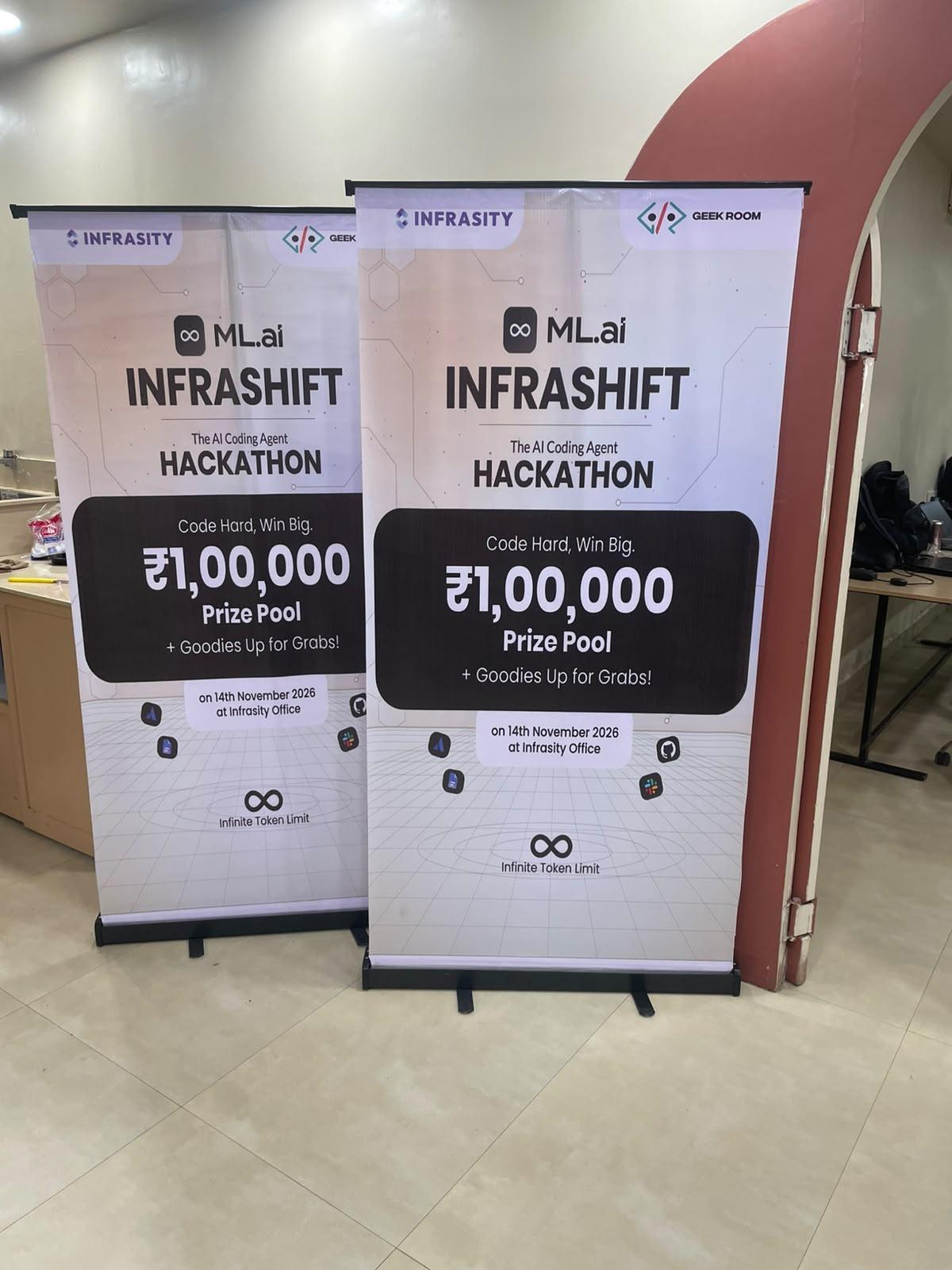
Two INFRASHIFT roll-up standees ready for the entrance on the eve of the event.
What the preparation looked like behind the scenes
Every event has three parties, and INFRASHIFT planning started by mapping all three: the organising team (Infrasity and Geek Room), the participants, and the party funding the prizes and credits (ML.ai). The timeline came first, then design, then release, with marketing running alongside from the first asset.
Roles were assigned by temperament as much as by skill:
- People-facing roles such as outreach, partner calls and the registration desk went to team members who are comfortable starting conversations and convincing people
- Detail roles such as paperwork, documentation and judging sheets went to the people who check every line twice
- Craft roles such as design, video editing and logistics went to the specialists who own them day to day
Everything was documented from day one, so anyone could see what was done and what was still open. That shared checklist is what let a small team cover registrations, print, merch, AV and judging in the same week.
The physical prep on 13 November covered:
- Branding: roll-up standees carrying the ML.ai, Infrasity and Geek Room marks, plus registration desk standees at each check-in point
- Team table plates: acrylic name plates printed in advance with team names, so each team walks straight to its table
- Merch: ML.ai tees sorted into stacks by size with labels, plus ML.ai sticker sheets for laptops
- Participant kit: a half-A4 ML.ai cheat sheet, printed front and back, for quick reference during the build
- Judging kit: per-mentor marking sheets and podium trophy plates for the top three teams
- AV rehearsal: projector, screen, speaker and two handheld mics tested in the demo room a day ahead
- Seating: chairs re-covered and laid out for demos and the awards
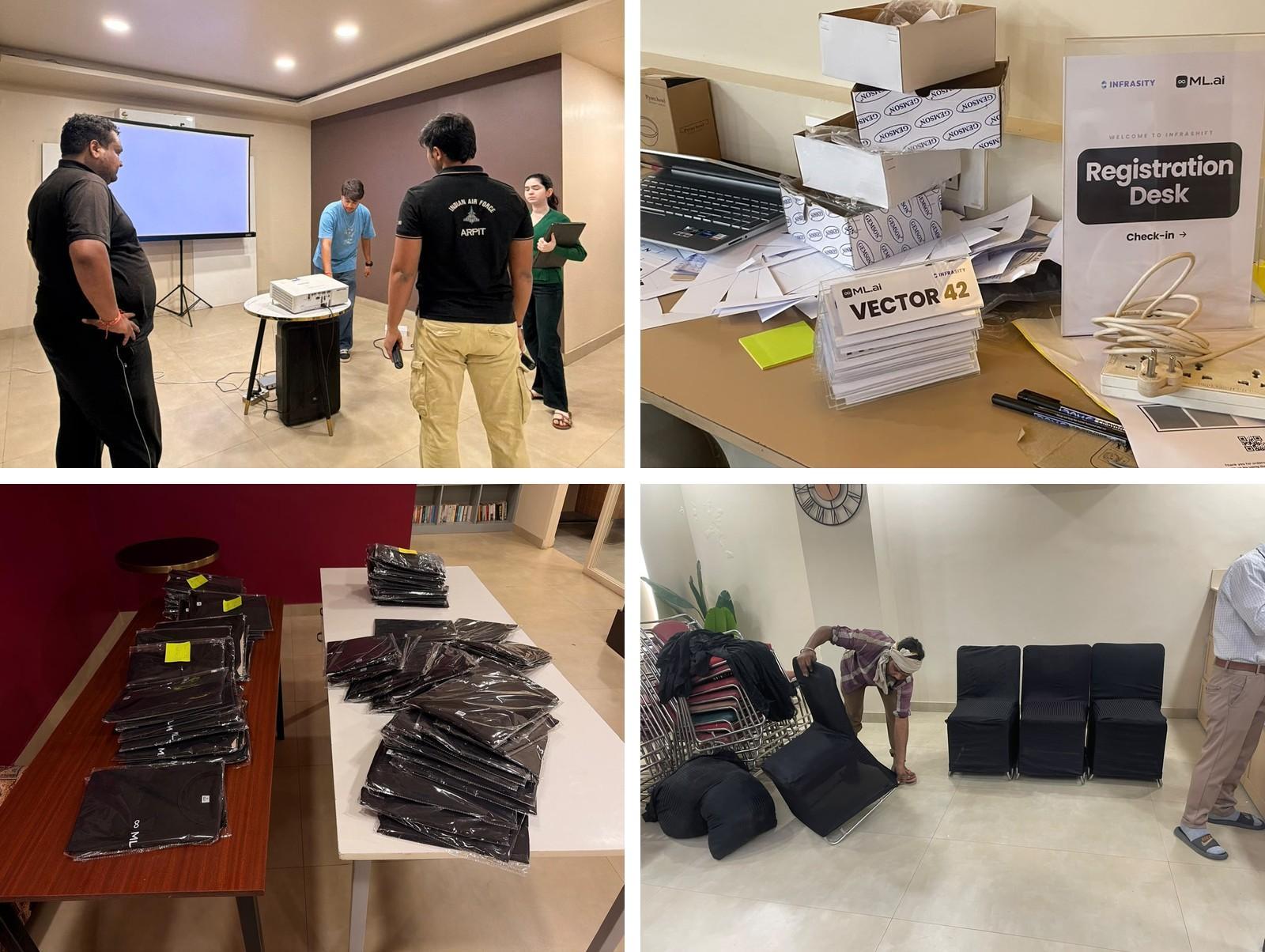
Behind the scenes on 13 November: AV rehearsal, team plates at the registration desk, ML.ai tees sorted by size, and seating being set up.
Why ML.ai chose a hackathon for its coding agent
ML.ai is an agentic coding tool that takes a task, plans it, edits code in a sandbox, runs the tests, and opens a pull request for review. It works as a desktop app, an IDE extension, and a CLI, routes each step to a suitable model, and never merges code on its own.
A one-day build is the fastest honest test of that promise. Teams will see in a few hours whether the agent carries a real project from an empty repo to a working demo. Participants build with two model tiers, ML.ai Coder Pro and ML.ai Flash, and the event banner promises an infinite token limit for the day, so no team stalls on credits near the deadline.
Taran Srivastava, Co-Founder of ML.ai, framed the goal in the press release as giving young engineers and professional teams a single day to test an idea and learn from what runs. He added that ML.ai is most keen to see builds that solve for how people in India work day to day.
Shantanu Das, Founder and CEO of Infrasity, put the format choice plainly in the press release:
"Most hackathons reward a good pitch. We wanted one that rewards a working build."
Shantanu Das, Founder and CEO, Infrasity
The short build window mirrors the constraints real product teams ship under.
What students get out of INFRASHIFT
Students leave with a working project, feedback from mentors who build AI products for a living, and hands-on time with an AI coding agent they can keep using. ML.ai's free plan includes 5M tokens a month with no card required, so the project does not have to stop at 4:30 PM.
The podium teams share the ₹1,00,000+ prize pool and take home trophies. ML.ai tees and laptop stickers are stacked at the desk, and every participant gets a day in a room full of founders, DevRel engineers, and other builders from Delhi NCR.
What product leaders can take from INFRASHIFT?
For a developer tool, a hackathon is a launch channel: it puts the product in hundreds of hands on one day, produces demos the company could never script, and surfaces friction before paying customers find it. INFRASHIFT is ML.ai's version of that play, run by Infrasity as part of its developer marketing work.
The same logic drives the other launch channels we run for DevTool teams, from community seeding to a Product Hunt launch. What a hackathon adds is proof: at 4:30 PM on 14 November, every claim ML.ai makes about its agent will have been tested by 800 people who had never used it before breakfast.
Frequently Asked Questions
Where is the INFRASHIFT hackathon held?
INFRASHIFT runs on Saturday, 14 November 2026 at the Infrasity office, A3/6 SS Mota Singh Marg, Janakpuri, New Delhi. Check-in opens at 8:30 AM and the nearest metro stations are Janakpuri West and Janakpuri East.
Who can take part in INFRASHIFT?
Students and working professionals can both take part, in teams of one to four. No prior hackathon experience is needed, and solo participants can form teams at the opening briefing.
Do participants have to use ML.ai?
Yes. Every project must be built with the ML.ai coding agent through the desktop app, IDE extension or terminal, and use of ML.ai carries 25% of the score.
What is the INFRASHIFT prize pool?
The prize pool is ₹1,00,000+, with podium trophies for the top three teams. Goodies from ML.ai are also up for grabs on the day.
Who organizes INFRASHIFT?
ML.ai presents the hackathon, Infrasity hosts and runs it end to end, and Geek Room is the community partner. Infrasity handled planning, partner coordination, design, print, venue and judging operations.