

You cannot run a Sponsored Agent. OpenAI's own help documentation says the format is in a limited alpha with selected US advertisers and that it is not accepting early-access requests. There is no waitlist. Across the eight advertisers OpenAI and its pilot partners have publicly named for ChatGPT Ads, including Wayfair, Angi, Newegg, Best Buy, Lowe's, VistaPrint, Williams-Sonoma and Expedia, every single one sells to consumers. None sells developer tooling or B2B software.
Here is the part worth your attention. OpenAI published three weeks before the announcement, a sponsored agent is assembled out of your website content, your business logic and your sales scripts. The same assets feed the free answer that every ChatGPT user already gets. One of those two destinations is for sale. The other has been open the whole time, and for a developer tool it is the only one that reaches your buyer.
This post covers what actually shipped and the five changes worth making before the quarter ends.
TL;DR
- ChatGPT ads only show on free tiers, meaning your technical B2B buyers on Pro or Enterprise accounts are completely excluded from seeing them by design.
- Sponsored Agents aren't written by ad creatives; they are automatically compiled directly from your website's existing docs, pricing, and business logic.
- You cannot pay to influence ChatGPT's organic recommendations, as OpenAI strictly walls off paid ads into entirely separate, labeled chat threads.
- Technical buyers actively distrust AI sales bots, meaning a vendor-controlled sponsored agent starts with a massive credibility deficit compared to organic discovery.
- The real B2B strategy is treating your MCP plugin metadata, tool names, endpoint descriptions, and schemas, as highly optimized product copy to drive organic retrieval.
- Your immediate priority must be checking your firewall and robots.txt to ensure OpenAI can actually crawl your site, and rewriting pricing pages with concrete data instead of marketing fluff.
What OpenAI actually shipped on 16 September 2026
OpenAI announced four things at once, and the headline feature is the smallest of them in practical terms.
Sponsored Agents
After a user clicks an ad in ChatGPT, they can open a labelled conversation with an agent funded by that advertiser. OpenAI's framing is a shopper who sees a dining table and wants to know whether it seats six. The conversation runs in its own lane, separate from ChatGPT's independent answer and separate from the thread the user started. When the user is ready, they follow a link out to the advertiser's site.
Angi confirmed the same day that it is one of the pilot brands, with Wayfair also named. Angi's release contains the most useful detail in the whole news cycle, and almost nobody picked it up. Angi already had an app inside ChatGPT that homeowners chose to add. The sponsored agent is the paid version of a placement the company had already earned. Two doors into the same room, one of them bought.
Ads Manager inside ChatGPT
Advertisers can now build, edit and analyse campaigns through natural-language prompts using an Ads Manager plugin, turning a website or a brief into a live campaign without touching the interface.
AI-generated creative
When drafting an ad, advertisers receive suggested copy and imagery generated from their own landing page and campaign objective. There is also an opt-in setting that rewrites headlines and descriptions to fit the context of the conversation the ad lands in, and translates them into the reader's language.
HubSpot and Shopify integrations
HubSpot is the first CRM partner and Shopify the first ecommerce partner. US Shopify merchants got the app on launch day, with international markets following on 23 September.
Read those four together and the shape is clear. Three of the four are about compiling an advertiser's existing content into ad units automatically. That is the actual product direction, and it is the part that applies to you whether or not you ever get access to an agent.
Who can see a Sponsored Agent, and why that decides everything
A Sponsored Agent is an ad. It inherits every restriction that applies to ads, and the most important one has held since the pilot's first day.
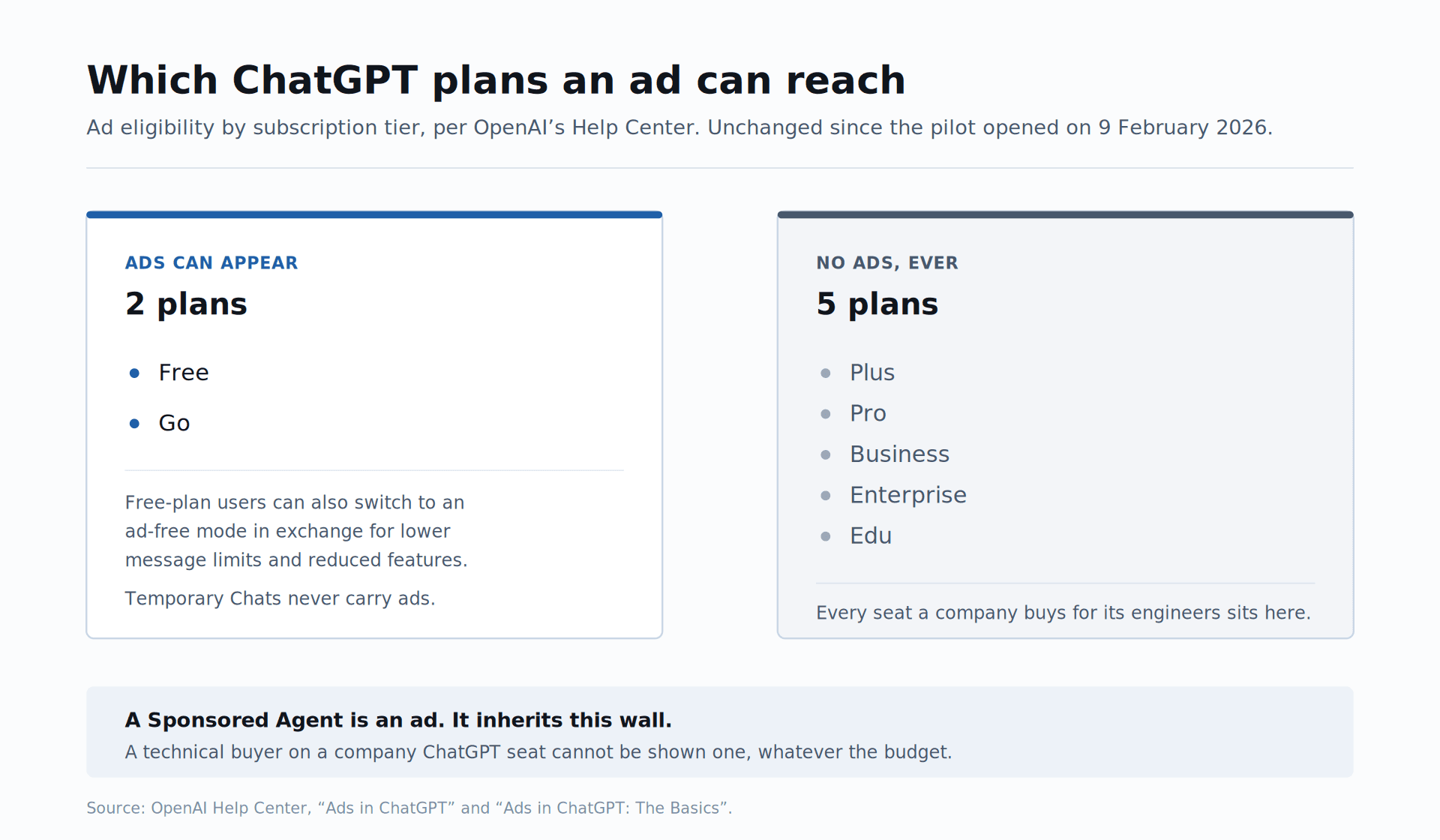
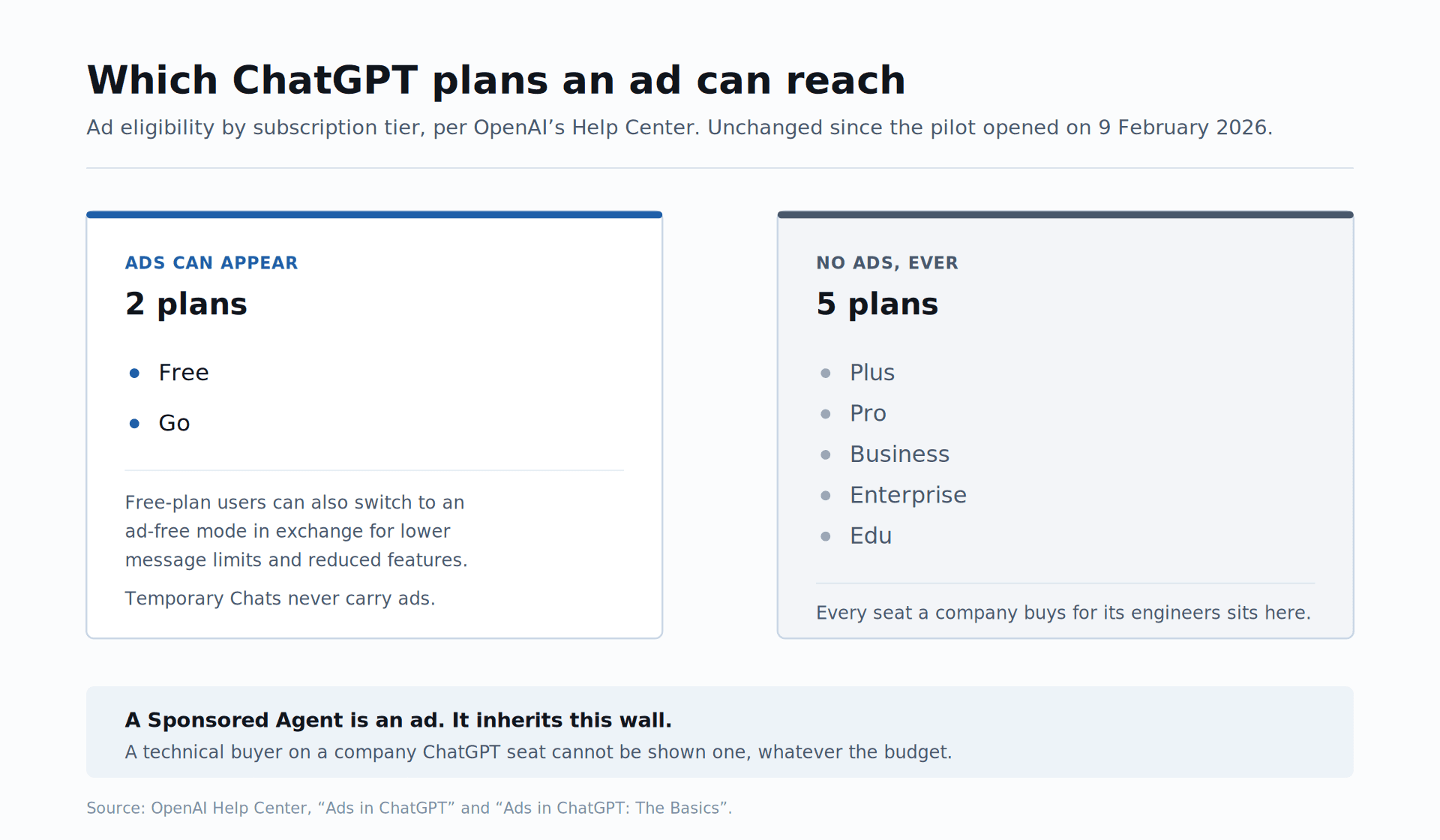
 Ad eligibility by ChatGPT plan, per OpenAI's published help documentation.
OpenAI's help documentation is unambiguous: ads may appear for users on the Free and Go plans, and Plus, Pro, Business, Enterprise and Edu accounts will not have ads. Temporary Chats carry no ads either. Free-plan users can also opt into an ad-free mode in exchange for tighter message limits.
Now put your buyer against that list. OpenAI has reported more than 50 million consumer subscribers and more than 9 million paying business users. Every one of those accounts is on a plan that cannot be shown an ad. A staff engineer evaluating your observability platform on a company ChatGPT seat is unreachable by this format, and will stay unreachable, no matter what the media plan says.
For a home services marketplace, that exclusion costs very little. Homeowners researching a bathroom remodel sit overwhelmingly on Free and Go. For a company selling a CLI tool, an SDK or a Kubernetes cost platform, the exclusion removes most of the addressable audience before the auction starts.
This is the structural point that generic AI-advertising coverage keeps missing. The channel is not weak for B2B. It is closed to a large share of B2B buyers by design, and the design has not moved in seven months.
What the terms say a sponsored agent is actually made of
OpenAI published its Ad Tools Terms on 24 August 2026, twenty-three days before the Sponsored Agents announcement. The document already defined the format and already assigned liability for it. Section 4 deems the advertiser the builder of the agent and holds them responsible for its content, configuration, actions and output as if they had created it themselves.
The definition that matters more sits in the glossary. "Ad Materials" covers the inputs OpenAI may use to create and operate an ad tool, and the list includes website content, business logic, sales or support scripts, alongside pricing, availability, brand guidelines, prompts and instructions.
 The inputs are taken from the definition of Ad Materials in OpenAI's Ad Tools Terms.
Read that back slowly, because it changes what a content team is actually building. A sponsored agent is not written by a creative team. It is compiled from the artefacts your company already publishes and already uses internally. A hedging pricing page produces a hedging agent. Where your docs contradict your comparison page, the agent inherits the contradiction, and you carry the liability for whatever it says next.
The help documentation for advertisers adds the other half. OpenAI's ad system selects and delivers ads using multiple signals including the context of the conversation, advertiser-provided context hints, and the ad's landing page. The landing page is not merely the destination. It is an input to the matching decision. A thin page reduces the number of conversations you are eligible for, before anyone sees a headline.
The same mechanism decides whether a model names you in an unpaid answer. Which brings us to the assumptions this announcement settles.
Three assumptions this announcement settles
Three assumptions that just got a lot harder to believe.
It kills the idea that you will eventually buy your way into the answer
The most common question in every B2B marketing meeting since February has been some version of "when can we pay to be the recommendation?" The answer is now visible in the architecture rather than the messaging.
OpenAI had a choice about where to put a brand's agent. It built an entirely separate conversation, in its own lane, with its own label, rather than allowing an advertiser to shape the answer already on screen. Building a second thread is expensive and awkward. They did it because the alternative was touching the organic answer, and answer independence is stated in the ads principles, restated in the advertiser documentation, and restated again in the user-facing help article. Three separate documents, one position: advertisers have no ability to shape, rank or alter what ChatGPT says.
You can argue about whether that holds in 2028. You cannot plan Q4 around it breaking.
It kills the idea that ChatGPT ads will reach a technical buyer
Covered above, and worth stating as a budget decision rather than an observation. When your ICP is engineers, platform teams or technical decision-makers inside companies that buy seats, the paid surface excludes most of them. Spend tested against that audience will underperform for a reason no creative iteration can fix.
It validates that your published content is the product
Three of the four launch items generate ad assets from an advertiser's own pages. The Ad Materials definition names website content and business logic as raw inputs. The landing page is a ranking signal. Taken together, OpenAI has stated plainly that the quality of your published material determines the quality of both the paid unit and the free one.
Teams that have treated documentation and comparison pages as a cost centre are about to find out that those pages are the asset the whole system reads.
Who is buying ChatGPT ads, and what that tells a software vendor
The channel is real. ChatGPT Ads reached a $1 billion annualised revenue run rate in under 200 days, a figure Digiday derived from roughly $83 million of monthly revenue. Treat it as momentum rather than booked income.
More useful than the total is who is spending it.
 Share of total US ad spend on ChatGPT by advertiser category, Sensor Tower panel estimates.
Sensor Tower's analysis, reported by PPC Land, tracked the mix from April to August 2026. Shopping and retail fell from 37% to 21% of US spend. Financial services climbed from 2% to 13%, going from a single company in the top 100 spenders to four of the top ten. Travel doubled. Health and wellness went from 1% to 5%.
Software moved from 13% to 16%.
Three points, the smallest gain of any category that grew at all, during the exact window when the platform added a self-serve Ads Manager, CPC bidding, a conversions API, custom audiences and a server-to-server measurement path through LiveRamp. Every piece of infrastructure a software marketer would ask for arrived, and software barely moved.
The category that moved fastest was the one with the highest customer lifetime value and the shortest evaluation cycle. Loans, cards, insurance and tax software can justify testing a channel on a hunch and read the result inside a quarter. A platform with a 90-day technical evaluation and a procurement review cannot.
Why measurement in this channel is not yet trustworthy
Before anyone puts a number in a forecast, look at what the published measurements actually say.
 Four published readings of how often a ChatGPT answer carries an ad.
Adthena measured 4.47% of US queries carrying an ad across a March to May window, with an average of 1.06 ad items per ad-bearing answer. The same firm counted 24.7% US ad frequency during a single week in July. In June its own monitoring recorded zero paid placements across 169,560 United Kingdom scrapes. Similarweb, using a different panel, published 26% in August.
Four readings of roughly the same metric, spanning 0.00% to 26%, two of them from the same vendor four months apart and never reconciled. There is no third-party measurement standard for conversational ad surfaces, and the firms producing these numbers use different denominators, windows and geographies.
Separately, eMarketer reported that agency executives had not observed measurable business outcomes from ChatGPT ads, and cited SE Ranking data finding that roughly one in seven placements were off-topic relative to the user's prompt.
None of this means the channel fails. It means anyone forecasting your impression volume is picking one of four incompatible numbers, and you should ask which one before you believe the model.
Why developer marketing needs a different approach here
Three things make technical audiences behave differently in this environment, and all three point the same way.
Your buyers are in ChatGPT and they do not trust it
Stack Overflow's developer survey, covering more than 49,000 respondents across 177 countries, found 84% of developers using or planning to use AI tools, with ChatGPT the most-used at 82% among those using AI tools. Trust went the other way. Only 29% said they trust the accuracy of AI output, 46% actively distrust it, and 3% report highly trusting it, falling to 2.6% among experienced developers.
That is your audience. Present in enormous numbers, and the least credulous group in software. An advertiser-authored agent starts that conversation below zero. On Hacker News, where the announcement drew 176 comments, one commenter put the UX objection more plainly than any analyst has: "Where is the incentive to continue your conversation with the sponsored agent" when the user already has a neutral one open. Several others asked why a buyer would trust a sales bot's account of its own product's limits.
For a consumer buying a dining table, a brand agent that knows the catalogue is genuinely useful. For an engineer asking whether your tool handles multi-region failover, a vendor-controlled answer is exactly the source they were trying to route around.
The purchase does not happen in the chat
An agentic ad format is built around compressing discovery into a single conversation that ends in a transaction. Angi's flow takes a homeowner from describing a leak to entering a service request. Wayfair's takes a shopper from a dining table to a checkout.
A developer tool has no equivalent. The path runs through docs, a quickstart, a free tier, a proof of concept, a security review and a procurement cycle. The most a conversational surface can do is get your name into the shortlist and send the reader to a page. Which means the page, and whether your name is in the list at all, is the entire game.
The unit of copy has changed
This is the part almost nobody is writing about, and it is the most actionable thing in this article.
If a developer tool wants presence inside ChatGPT, the realistic route is the plugin directory, built on MCP servers through the Apps SDK. Submission is free. OpenAI's own metadata guidance tells builders to "treat metadata like product copy".
It then describes a workflow any content strategist will recognise instantly. Assemble a labelled set of direct prompts, indirect prompts and negative prompts. Run them. Measure precision and recall. Change one field at a time and keep a revision log. Replay the set after every change, review tool-call analytics weekly, and watch for metadata drift.
Read that back as a job description and it is content strategy, published in an engineering document. Your tool names, tool descriptions, parameter documentation and MCP server instructions decide whether the model calls you when a user describes a problem in their own words. Positioning work, written to a character budget, evaluated against a prompt set.
It also ships like software. The submission documentation is explicit that tool names, descriptions, schemas, annotations and server instructions form a versioned contract. Changing a description means deploying the change, rescanning the endpoint, submitting for review and republishing after approval. Your marketing copy is release-gated behind a review queue with no published turnaround time.
For teams standing up an MCP server, our MCP tutorials walk through the server side, and the metadata pass is the part we handle as technical content work rather than as an engineering afterthought. The two jobs are genuinely different, and the people who write your docs are usually better at it than the people who write your handlers.
Placement is not for sale on any of the three routes
Here is the finding that reframes the whole week.
 Three routes a developer tool has into ChatGPT, and how open each one is today.
The Sponsored Agent is closed. The organic answer cannot be bought, by stated policy. And the plugin directory, the one route that is genuinely open to any developer tool today, is not purchasable either. OpenAI's submission documentation states that plugins appear on the directory's main pages only if OpenAI selects them for enhanced distribution, that few plugins receive it at publication, and that "There is no process by which to request this."
Absent that selection, users find your plugin two ways: through a direct link you give them, or by searching its exact publication name.
Sit with that for a moment. The only reliable discovery mechanism for your ChatGPT presence is somebody already knowing your name and typing it. Which is produced by content, community, documentation and citations, and by nothing you can buy inside the platform.
None of that is a consolation prize. It is the same conclusion arrived at from three independent directions.
Five things to change this quarter
Five shifts to make this quarter before the new ad system becomes someone else's problem.
1. Stop scoping a Sponsored Agent and check whether you can run a plain ad at all
The agent is unavailable and there is no queue to join. The cheaper question is whether your site would even pass ad review.
OpenAI's ad system crawls your landing page as part of matching, and reviews fail on specific technical grounds: a robots.txt that disallows OAI-AdsBot, a WAF or bot-mitigation rule returning 403, a broken page, a PDF where an HTML page was expected, or a missing favicon. Plenty of infrastructure and security teams block aggressive crawlers as policy and have never checked which bots that catches. Run the audit now. It takes an afternoon, and it affects unpaid retrieval too.
2. Rewrite the pages the agent would have been compiled from
The Ad Materials definition tells you which pages matter: the ones carrying product behaviour, limits, pricing and comparison. Those same pages are what the free answer reads. You get the benefit whether or not the paid format ever opens to you. This is the core of AEO and GEO work, and our GEO playbook covers the page-level mechanics.
3. Move tool and MCP metadata onto the content roadmap
Build the golden prompt set OpenAI describes. Direct prompts naming your product, indirect prompts describing the problem in a user's own words, and negative prompts where a different tool should win. Measure which tool fires. Then treat the descriptions as copy, because they are, and remember every revision goes through review.
4. Replace click-through rate with the measurement the platform actually gives you
CTR is the wrong headline metric on a surface where the user already got their answer before the ad appeared, and where published frequency estimates disagree by a factor of five. Ads Manager reports impressions, clicks, spend, CTR, average CPC, average CPM and conversions, and supports a pixel, a conversions API and UTM parameters. Build the assisted-conversion view and the branded-search lift view instead, and track AI referrals as their own channel in GA4 rather than letting them land in direct.
5. Own the two discovery paths that remain
Your exact name, and citations in the sources a model reads. For technical products that means documentation that answers questions in the words practitioners use, comparison pages that concede real trade-offs, and presence in the communities where evaluations actually happen. Our Reddit engagement work exists for that second half, because forum threads are disproportionately what gets retrieved when someone asks which tool to use.
The three pages to rewrite first
If you change nothing else, change these.
Your pricing page: Ad Materials names pricing and availability as compiled inputs, and a model asked "what does X cost" will quote whatever it can find. A pricing page that routes everything to a sales call gives retrieval nothing to work with, so the model quotes a competitor who published numbers, or a third-party page with numbers three years stale. Publish tiers, publish limits, publish what changes at each one.
Your comparison and alternatives pages: These are what a buyer's question actually maps to. A page that claims you win on every axis reads as marketing and gets treated as marketing. A page that says where a competitor is genuinely stronger is more likely to be quoted, because it is more useful, and it survives contact with an engineer who already knows the answer.
Your quickstart: The first page a developer lands on after the model names you. If time-to-first-result is six steps when it could be two, the referral is wasted. Time it yourself and write down the number.
Where this leaves you
You now know that the format everyone wrote about this week is closed to you, that it would exclude most of your buyers even if it opened, and that the three routes into ChatGPT all resolve to the same work: pages specific enough to be retrieved, quoted and acted on.
Start with the crawler audit in change one. It takes a couple of hours, it tells you whether your site is even legible to the systems making these decisions, and it usually turns up something broken.
If you want that audit run properly, alongside the page rewrites and the MCP metadata pass, that is exactly what our developer marketing engagements cover. You can see what it has produced for other DevTool and infrastructure teams in our case studies.
Frequently Asked Questions
Can I sign up for ChatGPT Sponsored Agents?
No. OpenAI's help documentation states that Sponsored Agents are available only to selected advertisers in a limited alpha test, and that it is not accepting early access requests at this time. The company says it will announce details about wider availability when it is ready to expand.
Do Sponsored Agents appear on paid ChatGPT plans?
No. Sponsored Agents are an ad format, and ads appear only on the Free and Go plans. OpenAI states that Plus, Pro, Business, Enterprise and Edu accounts will not have ads, and that Temporary Chats carry no ads either.
Does advertising on ChatGPT influence the answers ChatGPT gives?
OpenAI states that it does not. The company says ads run on separate systems from the chat model, that advertisers cannot shape, rank or alter responses, and that ads are separate and clearly labelled. Sponsored Agent conversations run in their own thread, distinct from ChatGPT's independent answers.
What does an advertiser see from a Sponsored Agent conversation?
Advertisers receive aggregated, non-identifying reporting such as total views and clicks, and do not get access to chats, chat history, memories or personal details. OpenAI's help documentation notes that if a user messages an advertiser through an ad, that advertiser sees the messages the user sends them directly.
Is B2B software eligible to advertise on ChatGPT?
Software is an eligible category and accounted for 16% of US ChatGPT ad spend in August 2026 per Sensor Tower panel estimates. Eligibility depends on your specific product and creative passing OpenAI's ad policies, and review also reads your landing page, so a blocked crawler or a broken page can fail a campaign that is otherwise compliant.
What is the alternative for a developer tool that cannot run a Sponsored Agent?
Publishing a plugin built on an MCP server through the Apps SDK, and earning organic citations. Submission is free, but OpenAI selects which plugins get directory placement and provides no process for requesting it, so discovery still depends on people knowing your name and on your content being retrievable.