


Andrej Karpathy launched HackerTube on October 31, 2026, a YouTube-style site built only from videos that Hacker News commenters recommend. He says Claude Opus 5.5 built and deployed it in about two hours, turning 39,834 HN comments into a catalog of 6,454 videos, according to his blog post.
The launch drew 2,640 points on Hacker News, the second-highest score of any story in the past 30 days. Let's jump to see how it can help your devtool campaign.
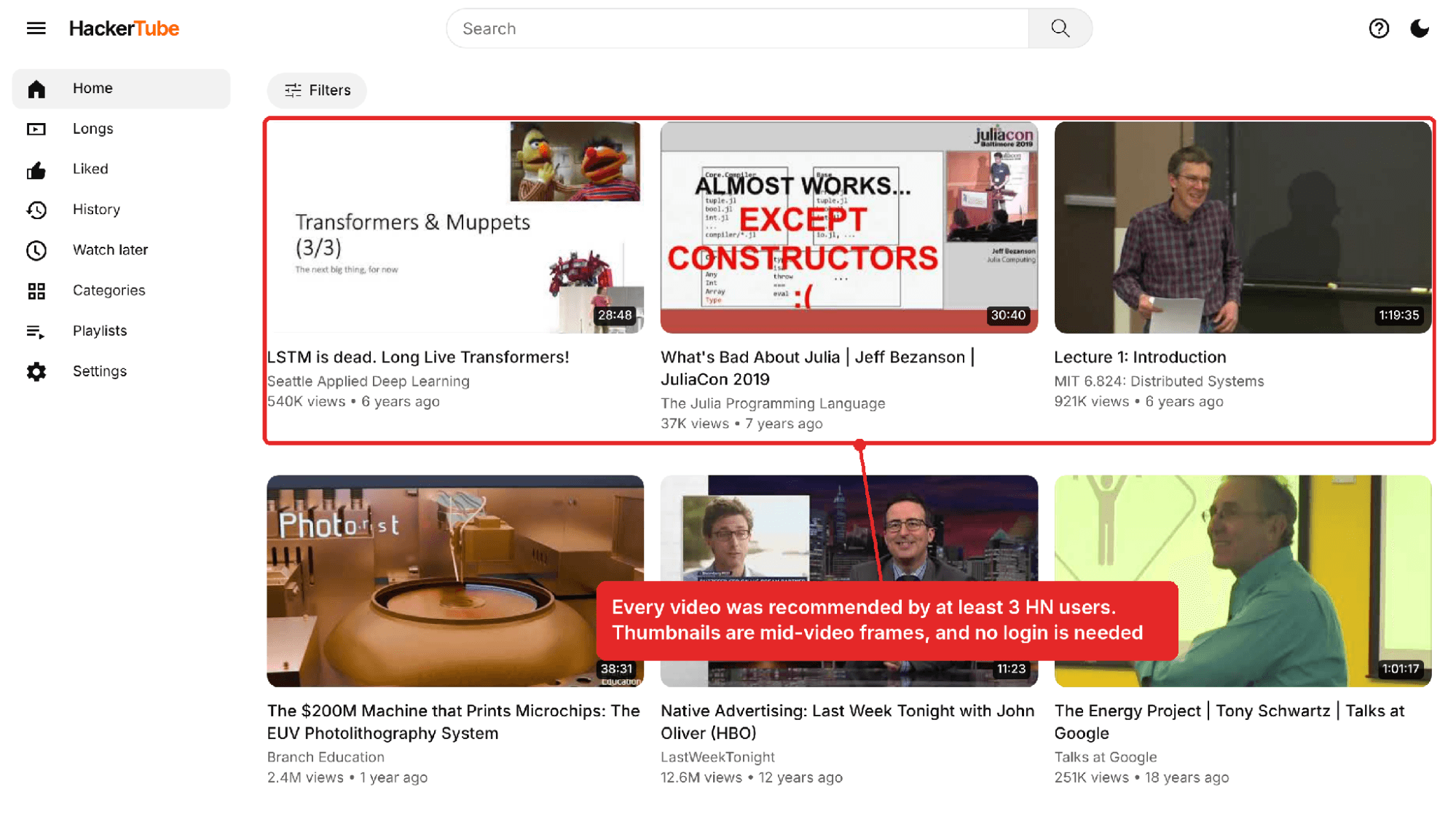
The homepage above shows how HackerTube works: every video earned repeated HN recommendations, and every thumbnail is a frame from the middle of the video.
TL;DR
- What launched: HackerTube, 6,454 videos across 150 topics, drawn from HN comments posted between 2007 and 2026.
- How it was built: Claude Code with Opus 5.5 ran the build, while Sonnet labeled the comments. Karpathy did three manual steps.
- How it spread: 2,640 points on HN. Five earlier projects with the same idea scored 43 points combined.
- What developers recommend: In developer topics, lectures and talks score more than twice as high as product demos.
What Karpathy built in two hours on October 31
Karpathy says he opened YouTube late on a Friday, found a feed he called "an enshittified wall of slop," and asked Claude for a YouTube clone built from HN recommendations the next morning.
The build ran in Claude Code on his Mac, with Opus 5.5 on medium effort as the default model.
- Data: Claude scanned every HN comment from 2007 to 2026 and kept YouTube links that at least 3 people mentioned in at least 3 different months.
- Labeling: Claude Sonnet read each comment and tagged it as a recommendation, a neutral reference, a joke or a criticism.
- Ranking: A video's score is the number of months HN recommended it, with extra weight for strong recommendations.
- Manual work: Karpathy created a YouTube API key, booted a server and bought the domain. Claude handled deployment, security hardening and optimization.
The pipeline used about 504 million input tokens, 90% of them cached, and 7.6 million output tokens, NewsBytes reports. Sonnet's labeling made up over 90% of that, while building and deploying the site took about one million Opus tokens.
Does AI-built software work in production?
For a scoped project like this, yes. The site is live, and ships features most weekend projects skip, including semantic search, playlists, and a downloadable dataset.
It still needed a human in the loop. On launch day, commenters pointed out the newest video was months old, and Karpathy added a recency sort and filters inside the same thread. The project's own data notes say LLM-written labels carry "a few percent of noise."
Why a two-hour build became the month's biggest launch
HackerTube outscored every non-obituary HN story of the past 30 days as of November 2, including the Mistral Large 4 launch and Anthropic's S-1 filing. The code took two hours, but the audience behind it took years to build.
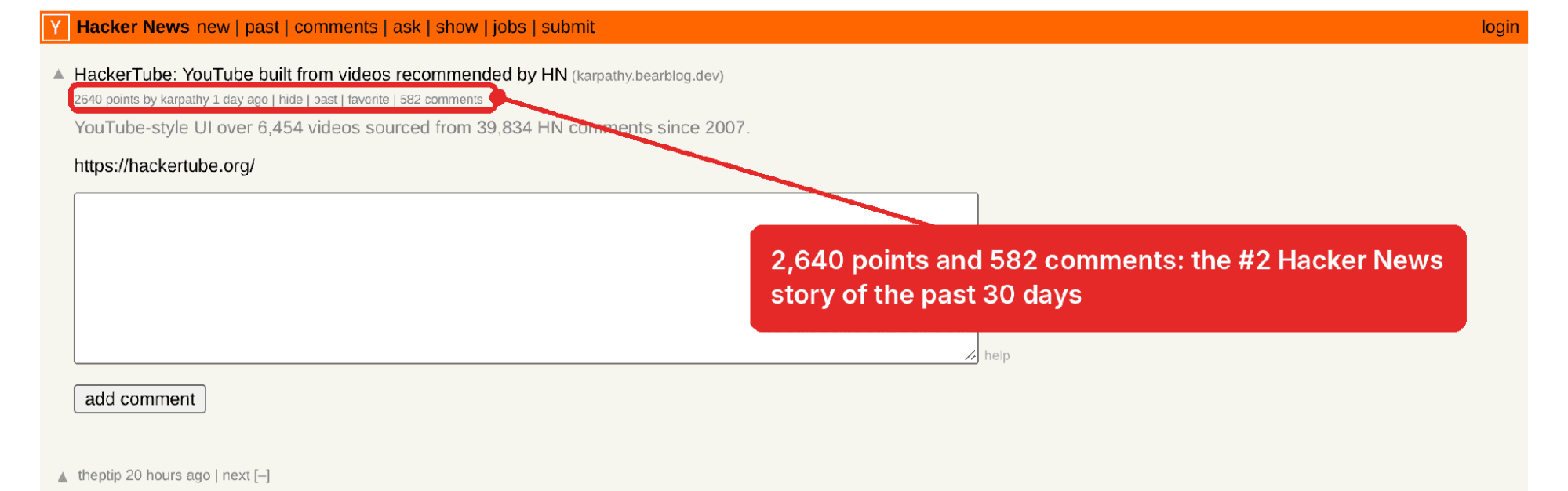
The thread above shows the score that HN's own front-page data puts second only to an obituary for the month.
The idea was not new. We found five earlier HN posts with the same concept, from dev-videos.com in 2017 to an HN video stats page in March 2026, and together they scored 43 points.
Three things carried this launch instead:
- A known builder: Karpathy has years of trust with the HN crowd, and commenters noted he joined Anthropic, maker of Claude, in May 2026.
- A build story: The post explained the exact setup, so readers came for the product and stayed to debate the method.
- An open dataset: Anyone could download the data and build their own version, which invited follow-up projects.
The fastest follow-up proves the point. HackerBooks, a version for books that launched with "HackerTube, but for books" in its title, scored 1,495 points within 20 hours of the original.
What 39,834 HN comments say developers recommend
Karpathy released the full dataset under an open license, so we analyzed it. We filtered to the 1,537 videos whose main category is software engineering, systems and security, or AI and data.
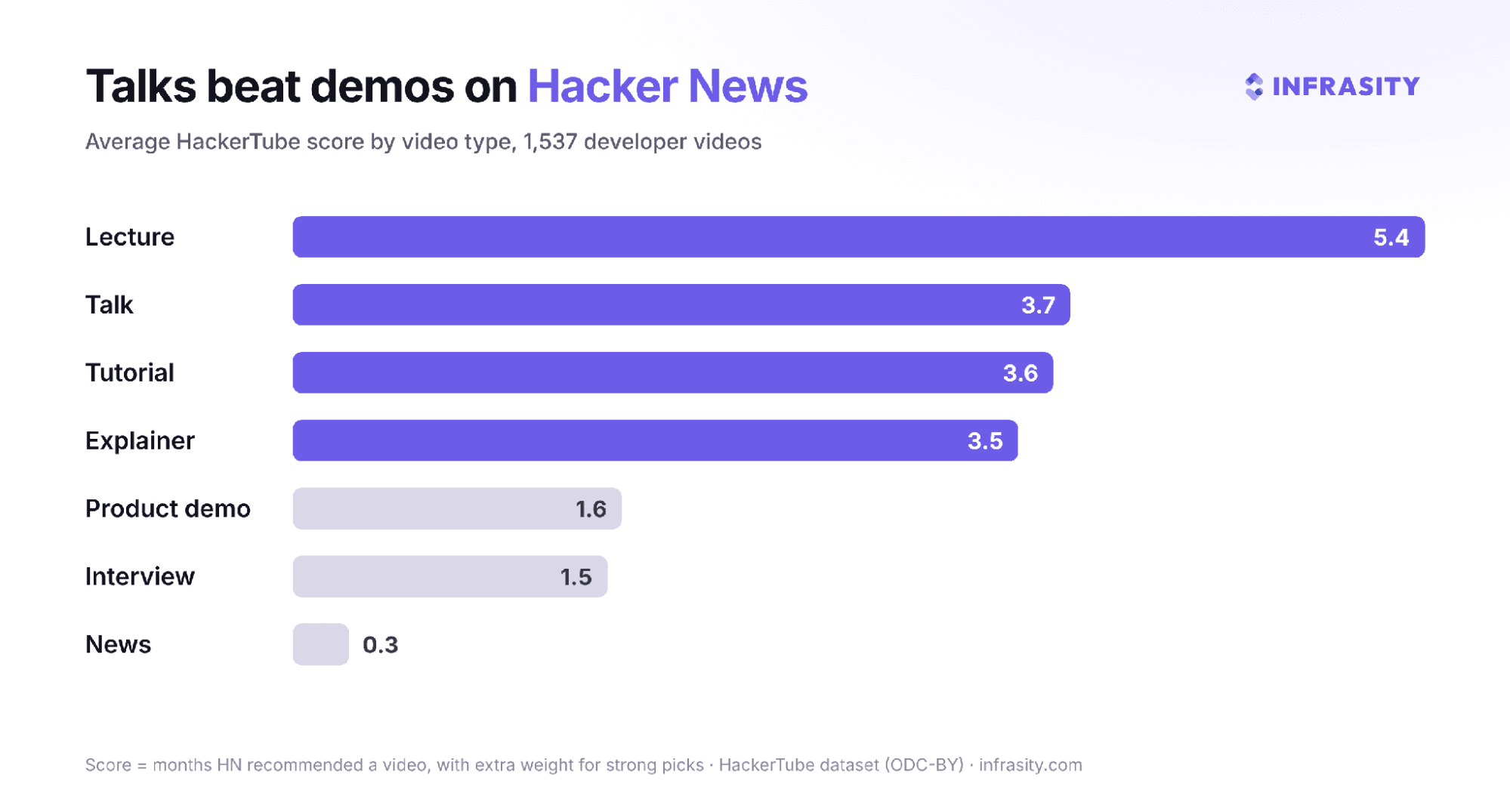
The chart above shows the gap. Lectures average a score of 5.4 and talks 3.7, while product demos average 1.6.
- Talks dominate: 875 of the 1,537 developer videos are conference talks, or 57%. Tutorials make up only 46.
- Demos draw more doubt: 25% of mentions of developer demos are recommendations, against 49% for talks. Critical mentions run 8.6% for demos and 2.3% for talks.
- Recommendations last years: The median video keeps getting recommended for 4 years. Rich Hickey's 2011 talk "Simple Made Easy" was still being recommended in 2026.
- Vendor channels are rare: Google TechTalks has 31 developer videos, Google for Developers 16 and AWS 11. Most top picks are engineers explaining ideas at conferences.
What DevTools teams should take from HackerTube?
AI made the build extremely cheap, and HackerTube is a great example. What developers and AI engines reward is clear explanation, independent write-ups, and easy reuse.
This shows what developers want, and here are other insights to help you build a great marketing campaign for your devtool.
- Lead with explainers over demos: Talks that teach a concept earn more than twice the recommendation score of product demos, and keep earning for years.
- Seed the third-party layer early: Get a DEV post, a short video, and an explainer page live within 48 hours of a launch, because that is when AI answers lock in their sources. A free AEO audit shows which pages engines currently cite for your category.
- Ride the news wave fast: HackerBooks scored 1,495 points by attaching itself to HackerTube within a day. A sharp take on industry news inside 24 hours can earn attention a standalone launch cannot.
- Write docs for agents: Add a plain-language guide for AI agents to your docs, SDKs, and datasets, covering what the files are, how they join, and what to watch for.
- Treat community mentions as assets: One good HN or Reddit recommendation keeps resurfacing for years, so earn them with substance.
Building the explainer for your DevTool? Infrasity's technical content team writes the talks, tutorials, and community posts developers recommend, and AI engines cite.
Frequently Asked Questions
What is HackerTube?
HackerTube is a YouTube-style site at hackertube.org that shows only videos Hacker News commenters have recommended. It holds 6,454 videos across 150 topics, needs no account and stores your history in the browser.
How long did it take Karpathy to build HackerTube?
Karpathy says it took about two hours using Claude Code with Opus 5.5. His only manual steps were creating a YouTube API key, starting a server and buying the domain.
How does HackerTube rank videos?
Each video's score counts the distinct months in which HN users recommended it, with extra weight for strong recommendations. A video needs at least 3 different people mentioning it in at least 3 different months to be included.
Can I use the HackerTube data?
Yes. The full dataset, including 39,834 labeled comments, is free to download from hackertube.org/data under an open license, with a guide written for AI agents.
Why didn't AI search cite Karpathy's own post?
In our November 2 test, Google, ChatGPT, and Perplexity preferred third-party explainers and news pages that restated the facts. AI engines often cite pages that summarize a launch cleanly over the original source, which is why early coverage shapes AI answers.