
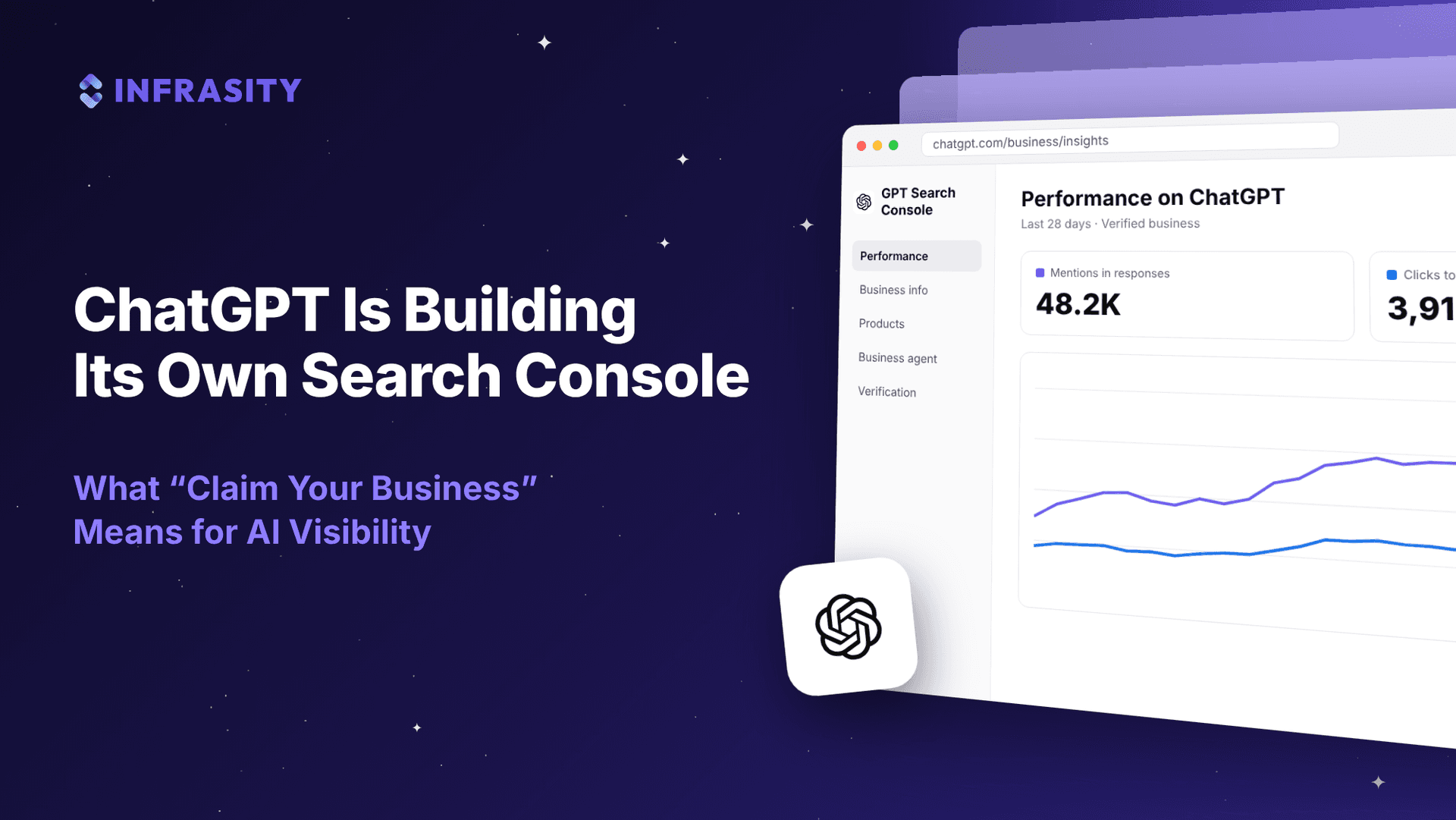
OpenAI is building a Search Console-style dashboard inside ChatGPT that lets a verified business see how many times ChatGPT mentioned it in answers and how many clicks those mentions sent to its website, charted day by day. The feature sits inside a wider "Business Hub", is marked unreleased beta, and was reported on November 6 after e-commerce analyst Juozas Kaziukėnas spotted a "Claim your business in ChatGPT" page.
If it ships as shown, it will be the only first-party AI visibility report from a major platform that includes clicks. Google's AI reports in Search Console show impressions only, and Bing's AI Performance report shows citations only. OpenAI has not commented, and there is no launch date.
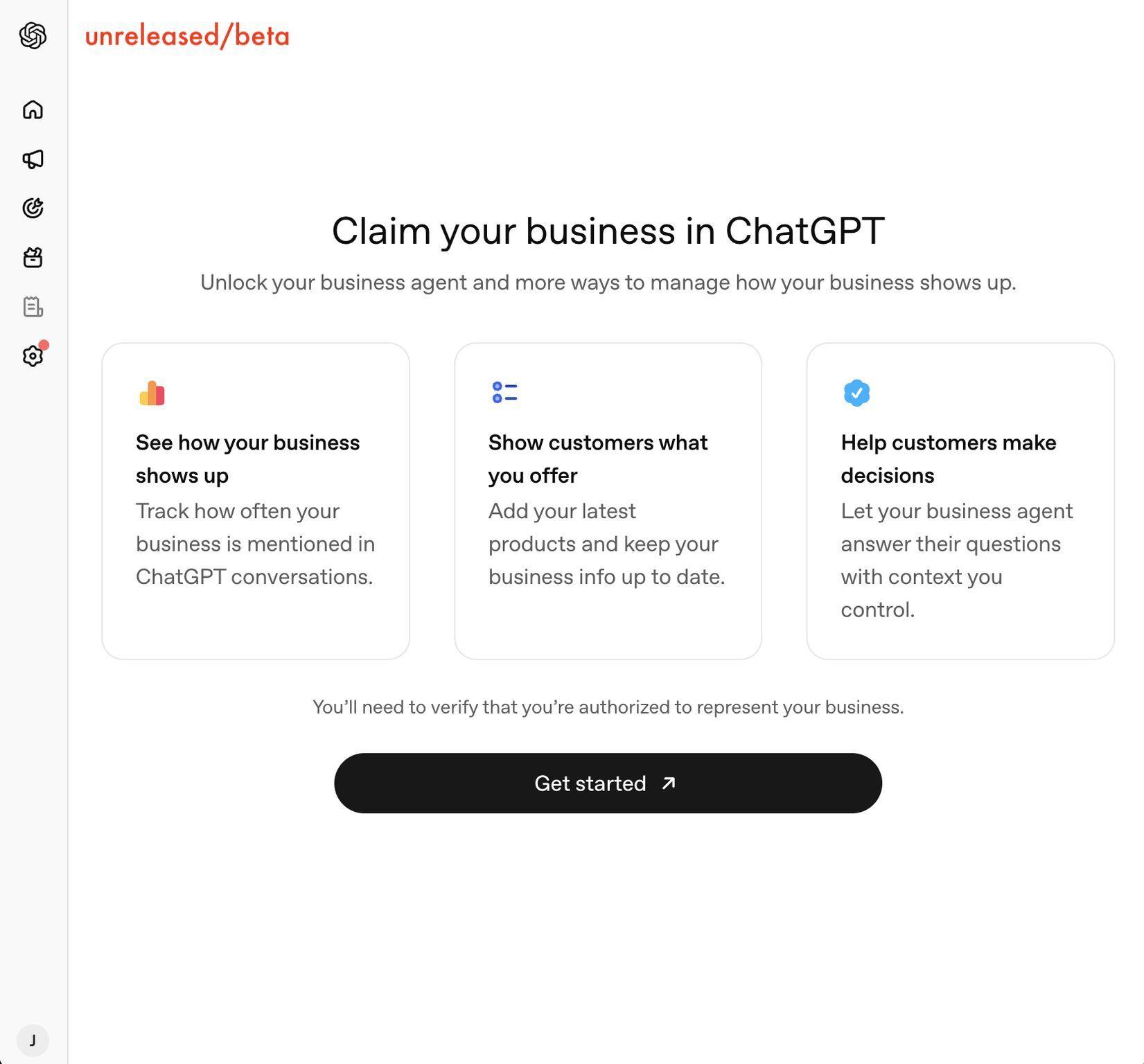
The screenshot Kaziukėnas shared shows the hub's three promises: mention tracking, an editable product and business profile, and a business agent that answers customer questions.
TL;DR
- What it is: A "Claim your business in ChatGPT" page, part of a larger Business Hub, still marked as unreleased beta.
- What it tracks: Impressions (times your business appeared in ChatGPT responses) and clicks to your site, shown daily as a chart.
- What it hides: No prompts, no user data, no competitor benchmark and no ranking.
- Who gets in: Businesses that verify ownership, with a connected Shopify store as the first example. App strings also point to identity checks through Persona.
- Why it stands out: ChatGPT has 1.2 billion weekly users, and marketers have had no first-party way to see how often it mentions them.
- What to do now: Fix your brand facts, start a prompt-tracking baseline and separate ChatGPT referrals in analytics so the new numbers have context on day one.
What OpenAI's "Claim your business" page promises
Kaziukėnas, founder of Marketplace Pulse, says he saw the first pieces of this in August and that the page he saw on November 6 suggests launch is getting close. It lays out three jobs, one per card.
- See how your business shows up: Track how often your business is mentioned in ChatGPT conversations. Kaziukėnas says this covers impressions and clicks to your website, tracked daily.
- Show customers what you offer: Add your latest products and keep your business information current.
- Help customers make decisions: A "business agent" answers customer questions using context the business controls.
Access depends on proving you represent the business. A connected Shopify store is the example given, which fits OpenAI's merchant program, where Shopify and Etsy catalogs are already integrated and shopping is live for US users only.
What the October app strings add to the picture
The November screenshot was not the first sign. On October 21, a tipster found strings in ChatGPT desktop build 26.1016.51333 for a "Claim {name} on ChatGPT" flow, according to The Tech Outlook.
- Verification: Shopify sign-in and Persona identity checks, which hints at a route for businesses without a store.
- Profile fields: A business category picker, photos, logos, and cover images marked "coming soon".
- Catalog: Connected product feeds and product listings.
- Ownership: A notice when a profile "is managed by another account".
Put together with the screenshot, this looks like a Google Business Profile for ChatGPT with Search Console-style reporting attached.
The data this dashboard leaves out
The tool does not show the prompts that triggered a mention, any user data, or how you compare with competitors. Kaziukėnas put the limit plainly in his post:
"It won't help understanding why mentions/clicks are increasing or decreasing."
Juozas Kaziukėnas, founder of Marketplace Pulse, on LinkedIn
His view is that the value comes from pairing it with outside prompt trackers. OpenAI's numbers confirm whether GEO and AEO work is moving anything, and the trackers explain why.
How the GPT Search Console compares with Google's AI reporting
Until now, every AI visibility number a marketer reported came from Google, Bing, or a third-party tool that samples prompts. We lined up what each one gives you against what has been reported about ChatGPT's hub.
| What you can see | Google Search Console AI reports | Bing Webmaster Tools AI Performance | Third-party trackers (Ahrefs, Semrush, Profound) | ChatGPT Business Hub (reported) |
|---|---|---|---|---|
| Appearances in AI answers | Impressions | Citations | Modeled estimates | Impressions (mentions) |
| Clicks from AI answers | No | No | No | Yes, daily |
| Queries or prompts | No | Sampled grounding queries | Yes, synthetic prompts | No |
| Competitor comparison | No | Citation share per query | Yes | No |
| Data source | First-party | First-party | Sampled from public interfaces | First-party |
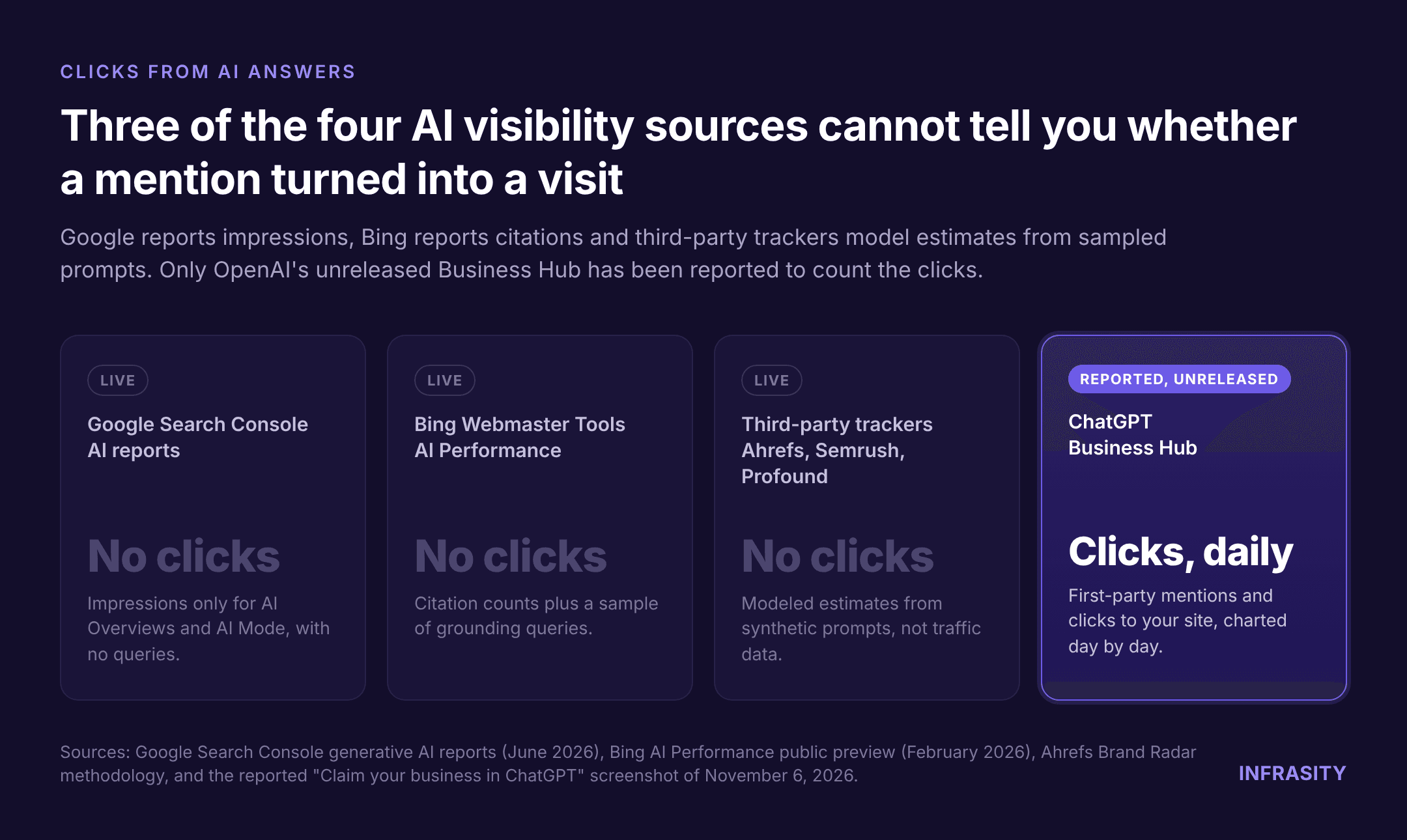
Read across the clicks row above, and the gap is obvious. Of the four sources, ChatGPT's hub is the only one reported to show clicks from AI answers.
- Google: Search Console added generative AI performance reports for AI Overviews and AI Mode in June 2026 and opened them to all sites on August 31. They report impressions without clicks or queries, and on November 2 Google's Gary Illyes said the team wants to share more data but has nothing to announce yet.
- Bing: Microsoft's AI Performance report, launched February 10, 2026, counts citations in Copilot and Bing AI answers plus a sample of grounding queries. Microsoft says it does not indicate ranking or placement, and it carries no click data.
- Third-party tools: Ahrefs describes Brand Radar as not an audience or traffic measurement tool, and Semrush calls its AI visibility figures directional signals. Both run large sets of synthetic prompts and model the volume.
ChatGPT's version is thinner than Search Console on diagnosis, yet it would be the only one of the four that tells you whether an AI mention turned into a visit.
Why first-party ChatGPT data fixes a real reporting gap
ChatGPT has grown into a discovery channel marketers cannot see into. OpenAI's Adam Fry said this week that ChatGPT has 1.2 billion weekly users and that its volume of search-like queries is now about one-fifth of Google's, a figure OpenAI has not backed with a methodology.
Today the only first-party signal is the click. ChatGPT adds utm_source=chatgpt.com to outbound links, so visits show up in analytics, but even that broke for about a week in October when the tags went missing from most answers. Impressions have never been visible at all, so a brand named in a thousand answers that nobody clicks shows nothing in its reports.
That blind spot is wide because AI answers send few clicks. ChatGPT drove 0.32% of worldwide referral traffic in May 2026 across 101,574 sites tracked by SE Ranking, so a channel judged only on clicks will always look small, even while it shapes shortlists.
What SEOs are saying about ChatGPT's search console
The reaction split three ways within hours: relief that data is coming, frustration at what is missing, and doubt about whether one screenshot proves anything.
- Relief: Lily Ray shared the screenshots on X, asking whether this is "the first iteration of a ChatGPT Search Console". Aleyda Solis replied that it was long overdue.
- What's missing: Founder Ben Zipkin compared the tool to Search Console with its most useful column removed, and others asked whether data will separate logged-in from logged-out users.
- Doubt: Content strategist Joe Manna asked for "any other evidence this is real", since the feature rests on one person's screenshot.
- Tracking vendors: A viral post claimed ChatGPT would kill AEO tracking tools. Most replies argued the opposite, pointing out that Search Console never killed Ahrefs and that first-party numbers give trackers a way to validate their estimates.
"Search Console with the queries column deleted."
Ben Zipkin, founder, on what the reported dashboard amounts to
Two YouTube creators went deeper. SEO podcaster Edward Sturm, in his video on the leak, warned that a self-serve business tool could work like Google's disavow tool once did, with brands reporting data that helps the platform spot spam.
"It'll tell you how many; it won't tell you why."
Kasra Dash, SEO consultant, in his breakdown
Dash suggests using the numbers for client reporting, for before-and-after checks after publishing a brand page or landing a listicle placement, and for spotting a drop in mentions the next day instead of months later.
What the Business Hub means for B2B and DevTool marketers
This section is our analysis of the signals so far, not something OpenAI has confirmed. None of the coverage we reviewed has yet addressed how software companies get in, so that is where we start.
Commerce brands get it first; B2B software likely waits
Shopify verification points the first release at merchants. A SaaS or DevTool company has no store to connect, so the Persona identity route in the October strings is the likely door for software vendors, and it may open later, the same order OpenAI followed with shopping and ads.
Your business profile becomes a source the agent quotes
The second card lets you keep business information current, and the third card's agent answers buyer questions from that context. Whatever you enter is likely to be repeated to buyers, so contradictions between your profile, pricing page and docs turn into wrong answers. A single, accurate fact sheet about your product is worth writing before you ever see the form.
Impressions will dwarf clicks, so report on both
Expect a low click-through rate when the numbers arrive. A leaked OpenAI partner report covered by MarTech in 2025 showed a top page with 610,775 link impressions and a 0.69% click-through rate. Teams that judge the channel on clicks alone will undervalue it, so put mentions at the top of AI visibility reports.
A free scoreboard will sit next to a paid one
ChatGPT advertisers already get impressions and clicks in Ads Manager, and an organic view with the same two metrics makes comparison easy. Several commentators expect an ad prompt beside it later, so treat the hub as measurement first and keep organic results separate from any paid test.
What to set up before the Business Hub opens
- Check that ChatGPT can reach your site: Allow OAI-SearchBot in robots.txt and confirm your firewall does not block it, since that crawler decides whether you can appear in ChatGPT search.
- Split ChatGPT out in analytics: Create a channel group for chatgpt.com referrals in GA4 so clicks stop landing in direct or referral, and annotate October 8 to 16 as a tagging gap.
- Fix your brand facts: Make your homepage, pricing, docs and comparison pages say the same thing about what you sell, who it is for and what it costs.
- Start a prompt baseline now: Track 30 to 50 prompts your buyers ask, so you have a before picture when first-party mentions appear. A free AEO audit shows which pages AI engines cite for your category today.
- Get your catalog into ChatGPT if you sell products: Shopify and Etsy stores are already connected, and other merchants can apply through OpenAI's merchant page.
- Claim the profile the day it opens: Verify your own brand and any client accounts you manage.
The page-level work that decides whether ChatGPT mentions you at all is covered step by step in our GEO playbook. If you would rather hand that work to a team, Infrasity's AI visibility practice builds the pages, docs, and community coverage that AI engines cite, so the first numbers you see in the Business Hub are worth reading.
Frequently Asked Questions
Is ChatGPT launching a search console?
OpenAI is testing one. A "Claim your business in ChatGPT" page, marked as unreleased beta, shows businesses how often ChatGPT mentions them and how many clicks those mentions send. OpenAI has not announced it or given a launch date.
What data will ChatGPT's business dashboard show?
Based on the reported screenshot, it shows daily impressions (times your business appeared in ChatGPT responses) and clicks to your website. It does not show prompts, user data, competitor benchmarks or rankings.
How do you claim your business in ChatGPT?
You will need to verify that you are authorized to represent the business. Connecting a Shopify store is the reported example, and app strings from October also mention Persona identity verification, which may cover businesses without a store.
Does Google Search Console show clicks from AI Overviews?
Not separately. Google's generative AI performance reports, live for all sites since August 31, 2026, show impressions for AI Overviews and AI Mode without clicks or queries, and Google says it has nothing new to announce.
Will claiming your business improve your visibility in ChatGPT?
Nothing suggests it will boost visibility directly. It gives you first-party data and more control over how your business is described, while mentions still depend on what ChatGPT finds about you across the web.