
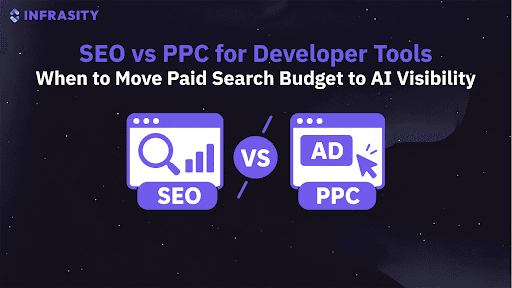
For a developer tool, PPC (pay-per-click ads) buys clicks today, while SEO and AI visibility earn the answers developers read before they ever click. Paid search stops converting when three things stack up on the same keyword cluster: rising cost per click, an AI Overview sitting above your ad, and AI assistants naming your competitors for the category. When all three show up, that cluster’s budget should move to AI visibility work.
The cost side is already extreme for DevTools. Across 16 DevTools buying keywords we pulled from Google Ads data in November 2026, the median cost per click was $31.79, which is 5.9 times the $5.42 all-industry average. Meanwhile, one report found paid CTR fell 68% on informational queries that show an AI Overview.
This blog gives you the decision model, the math, a 90-day reallocation plan, and the measurement setup, built specifically for DevTool teams.
Key Takeaways
DevTool keywords are now super expensive; for instance, 14 of the 16 buying keywords we checked cost more than three times the average Google Ads click.
AI Overviews cut paid CTR on informational queries from 19.7% to 6.34% in Seer’s dataset, and lead-gen advertisers are paying 11% more per click year over year.
Developers now split their first search between Google (83%) and AI agents (70%), per the Stack Overflow 2026 survey.
AI engines lean on community sources. Reddit holds 46.7% of Perplexity’s top-10 citation share.
Paid search still wins on brand terms, competitor terms, launches, and queries with no AI Overview. Keep those.
Move budget per keyword cluster, never per account, and only after AI visibility is measured on a fixed prompt set.
Four search terms every DevTool marketer should define first
Before comparing channels, it helps to pin down what each one buys. Teams mix these up constantly, and the mix-up leads to the wrong budget conversation.
PPC (pay-per-click): Ads on Google or Bing where you pay each time someone clicks. Traffic starts the day you launch and stops the day you stop paying.
SEO (search engine optimization): Earning unpaid rankings in Google’s organic results. It compounds, but it takes months.
AEO (answer engine optimization): Shaping content so it becomes the direct answer in Google’s featured snippets, “People also ask” boxes, and AI Overviews.
GEO (generative engine optimization): Getting your product named and cited inside answers from ChatGPT, Perplexity, Claude, Gemini, and Google AI Mode.
An AI Overview is the AI-written summary Google places above the regular results. When we say “AI visibility” in this guide, we mean AEO and GEO together: how often AI systems mention or cite your product when a buyer asks about your category.
One mental model helps here. A YouTube breakdown from Von Media, built on roughly $2 million of Google Ads spend across 16 accounts, frames PPC as rent and SEO as equity. AI visibility adds a third column: reputation, meaning what other sources say about you when you are not in the room.
Why DevTool search behaves differently from generic SaaS
Most SEO vs PPC advice is written for ecommerce or local services. DevTools break those assumptions in at least four ways, and each one changes how paid search performs.
Developers research before they ever see a sales page
A developer evaluating an observability tool or an API gateway reads docs, GitHub issues, Reddit threads, and benchmark posts long before booking a demo. The ad click usually lands on a landing page they do not trust yet. That is why the cheapest DevTool conversions tend to come from organic docs and comparison pages, which match how engineers already research.
The conversion that predicts revenue is product activation
For a self-serve DevTool, the event that predicts revenue is a created workspace, a generated API key, or a first successful deploy. Google Ads optimizes toward whatever conversion you feed it, so if you feed it demo forms, it finds people who fill forms. Paid search often looks healthy on cost per lead while cost per activated user quietly climbs.
Buying happens in a committee
A DevTool purchase usually involves an engineer who tries it, a manager who approves it, and a security reviewer who checks it. Each one searches differently. The engineer asks “how do I instrument a Go service,” the manager asks “Datadog alternatives,” and the security reviewer asks about SOC 2. One ad campaign rarely serves all three.
Community proof carries more weight than ad copy
Developers trust peers over vendors. AI engines mirror this, which is why Reddit, Hacker News, GitHub, and YouTube show up so often in AI answers for DevTool queries. We come back to this with data below.
What a DevTool click costs in 2026
We pulled current Google Ads data (US, November 2026) for 17 DevTool buying keywords across security, observability, CI/CD, IaC, AI infrastructure, and developer platforms, plus seven “what is” educational keywords in the same categories. Sixteen of the buying keywords returned a cost per click.
The headline: the median DevTool buying keyword costs $31.79 per click, and 14 of the 16 cost more than three times the cross-industry average.

The same pull showed a second pattern worth noting. Nine of the 12 buying keywords that report a yearly trend lost search volume year over year (for example, observability platform fell 63% and api testing tools fell 62%), while five of the six “what is” keywords with a yearly trend grew (what is kubernetes rose 83%, what is ci cd rose 50%). Google Ads volumes are bucketed estimates, so treat this as a direction rather than a precise measurement.
Still, the direction fits what the rest of this guide shows: developers keep learning, but the shortlisting step is moving into AI answers.
The break-even math every DevTool CMO should run
Von Media’s video offers a simple formula: divide your monthly SEO spend by your cost per click. The result is the number of organic clicks SEO must earn each month to beat renting the same traffic.
Run it with DevTool numbers and the case changes fast:
At the $5.42 average CPC, a $6,000 monthly content budget must earn 1,107 organic clicks to break even.
At the $31.79 DevTool median, the same budget only needs 189 clicks.
At $82.02 for datadog alternatives, it needs 73 clicks a month.
Expensive clicks are the strongest argument for owned channels. The catch is that clicks themselves are shrinking, which is where AI visibility enters the math.
How AI Overviews changed the return on paid clicks
Seer Interactive tracked 3,119 informational queries across 42 client organizations from June 2024 to September 2025. On queries with AI Overviews, organic CTR dropped from 1.76% to 0.61% and paid CTR fell from 19.7% to 6.34%. Paid took the bigger hit.

The fresh account data points the same way. In a Search Engine Land roundup of 29 PPC experts published November 23, 2026, Optmyzr data on the same advertiser accounts showed lead-gen advertisers paying 11% more per click and 6% more per acquisition than a year earlier, while clicks fell 3%. Ecommerce advertisers fared better, with clicks up 9% and CPA down 1%.
DevTools sit in the lead-gen bucket. Danny Gavin of Optidge put the B2B side in the same piece: “CPCs on niche B2B and healthcare lead gen are up 60% to 200%.”
Being cited makes your ads work better
Here is the finding most “SEO vs PPC” articles miss. In Seer’s Q3 2025 cut, paid CTR was 7.89% when the brand was cited in the AI Overview and 4.14% when it was not. That is close to double the paid CTR for the same query type.
On the same SERP, AI visibility and PPC reinforce each other: getting cited keeps your remaining paid spend efficient.
Where developers look for answers in 2026
The Stack Overflow 2026 Developer Survey asked where technologists look first when they hit a problem. Search online still leads at 83%, but asking an AI agent is right behind at 70%.

Source: Stack Overflow Developer Survey 2026, 16,664 respondents for this question.
Most developers now do both. If your DevTool shows up in Google results but not in the AI answer, you are visible for roughly half of the research moment.
What AI engines cite for DevTool queries
AI answers are built from sources, and those sources are not your ads. Profound analyzed 680 million citations from August 2024 to June 2025 and found Reddit holds 46.7% of Perplexity’s top-10 citation share, while Reddit and YouTube together account for nearly 40% of Google AI Overviews’ top-10 share.

Source: Profound, AI Platform Citation Patterns, 680 million citations.
We checked this against a live DevTool query. The Google AI Overview for datadog alternatives, a keyword that costs $82.02 per click, pulled its sources from an r/devops thread, an “Ask HN” thread on Hacker News, Gartner Peer Insights, YouTube reviews, and two vendor pages. A buyer reading that answer has formed a shortlist before seeing a single ad.
This lines up with academic work too. A September 2025 arXiv paper on AI search found a systematic bias toward earned media, meaning third-party sources over brand-owned pages.
Five signals that paid search has stopped converting for your DevTool
Paid search rarely fails all at once. It degrades cluster by cluster, which is why account-level dashboards hide the problem. Check each non-brand cluster against these five signals:
CPC up 30% or more in 12 months. Von Media uses this as its “rent review” trigger. Pull it from Auction Insights or Keyword Planner per cluster.
An AI Overview sits above your ads. Check the live SERP in an incognito window. If the answer is written for the buyer above your ad, expect Seer-style CTR losses.
Cost per lead looks fine, but cost per activated user is rising. Join ad click IDs to product events (workspace_created, api_key_generated) to see this.
AI assistants name competitors for your category prompts. If ChatGPT and Perplexity shortlist three rivals for “best feature flag tool for startups,” the buyer arrives pre-sold.
Sales hears “I found you on ChatGPT” more than “I saw your ad.” Add a free-text How did you hear about us? field to signup. Self-reported source catches what click attribution misses.
Two or more signals on the same cluster is enough to start testing a shift. The flowchart below is how we run that call for DevTool clients.

The order of the questions is deliberate. Cost tells you whether to look, the SERP tells you whether ads can still be seen, and AI answers tell you whether the buyer has already decided.
Where paid search still earns its place in a DevTool budget
Cutting PPC entirely is the wrong lesson. Seer’s data shows paid CTR on queries with no AI Overview held at 13.88%, more than three times the CTR on AI Overview queries where the brand was not cited. Paid search keeps working in specific places:
Brand terms: Competitors bid on your name. Brand clicks are cheap, convert well, and protect the bottom of the funnel.
Competitor terms: [competitor] alternatives and [competitor] pricing searches come from people actively switching. Expensive, but often worth it.
Launches: A new SDK, a pricing change, or a Product Hunt day needs traffic in week one, before any content can rank or get cited.
Transactional queries with no AI Overview: Terms like [category] pricing or [category] free tier often still show classic results.
Retargeting doc readers: Developers who read three doc pages and left are worth a paid nudge on LinkedIn or Google.
The 10Fold survey of 400 B2B tech marketing leaders shows the industry is already moving this way. AI discovery averages 10% of planned budgets, 74% plan to increase that spend in 2027, and 46% say their AI discovery programs beat expectations, the highest share of any program surveyed.
A comparison of the three channels for DevTools
| PPC | SEO | AI visibility (AEO + GEO) | |
|---|---|---|---|
| Time to first result | Days | 3 to 12 months | Weeks for placements, months for stable share |
| Cost model | Per click, forever | Content and links, compounding | Content, distribution, community |
| What it buys | Position on a SERP | Rankings and clicks | Mentions and citations inside answers |
| Where it fails for DevTools | AI Overview queries, rising lead-gen CPCs | Informational queries losing clicks | Volatile answers, hard attribution |
| Best metric | Cost per activated user | Non-brand organic signups | Share of voice on a fixed prompt set |
What AI visibility work looks like in practice
AI visibility work is mostly familiar marketing aimed at a new reader. The difference is where you publish and how you structure it, because engines pull from specific source types.
Build comparison pages engines can lift
Category listicles and “alternatives” pages are the most cited DevTool format we track. On our OX Security program, 29 of OX’s top 50 AI Overview citations came from pages Infrasity wrote, and 22 of those were tools listicles. We cover the outreach side in our guide to getting your brand into the lists AI engines cite.
Make docs answer-first
Engines quote passages. Open each docs section with a one-sentence answer, add real parameter names, limits and error codes, and publish an llms.txt file listing your key pages. Specific details win, since a vague “supports high throughput” gives an engine nothing to quote.
Earn mentions where engines read
Given Reddit’s share of Perplexity citations, genuine participation in r/devops, r/kubernetes or r/selfhosted carries real weight. The same goes for Hacker News, YouTube walkthroughs, dev.to and Medium posts.
Placement beats volume here. A Fudan University study covered by Search Engine Journal found 8 of 10 AI tools cited a made-up concept within a week when it was posted on sites those tools already cite, while 40 posts on a self-hosted WordPress site got zero references in seven days. Henkel saw a similar effect in a conference talk: placing content on one third-party domain that had never been cited for their 143 tracked prompts produced about 800 citations in five days.
Treat that as much a warning as a tactic. Google has clarified that its spam policies cover attempts to manipulate generative AI answers, so the work has to be real content from real practitioners.
What the results look like when it works
For OX Security, an AppSec platform, the program lifted top-3 Google rankings from 89 to 509 keywords. DataForSEO puts the paid-search equivalent of OX’s organic footprint at about $124,000 a month, which is what it would cost to rent the same traffic through Google Ads.

Source: Infrasity OX Security case study, AI visibility tracked in app.infrasity.com.
On a separate program, a confidential AI gateway got named by ChatGPT, Claude, Perplexity, and Google AI Overview for “best confidential AI gateway,” with ChatGPT listing it in row one of its comparison table. Neither result came from ad spend.
If your category prompts already name competitors, Infrasity’s AEO and GEO services start with exactly this audit.
How to move budget over 90 days without losing pipeline
The safest reallocation cuts paid spend only after the replacement channel is measurable. Here is the sequence we use with DevTool clients.
Weeks 1 to 2: split paid spend by intent
Export your search terms report and tag every converting query as brand, competitor, category, or how-to. Then flag which ones show an AI Overview today. Most DevTool accounts find that how-to and broad category clusters eat a large share of spend while producing the fewest activated users.
Weeks 3 to 4: baseline AI visibility
Write 50 to 100 buyer prompts the way a developer would type them, such as “best secrets manager for a Kubernetes startup.” Run each prompt on ChatGPT, Perplexity, Gemini, Claude, and Google AI Overviews several times, because answers vary run to run. Log brand mentions and cited URLs as separate columns.
You can use app.infrasity.com to track all in one place.

Weeks 5 to 8: build what engines cite
Use the cited-URL column as your content brief. If engines keep citing a Reddit thread and two listicles, those are your targets: publish a stronger comparison page, get included in the listicles, and contribute to the threads. Fix docs pages that rank but never get quoted.
Weeks 9 to 12: cut first, then measure
Pause the how-to and broad category ad groups first, since those face the heaviest AI Overview losses. Keep brand and competitor campaigns running. Track activated users from organic and self-reported AI sources against the spend you removed.
How to measure AI visibility so the CFO accepts it
AI visibility has a measurement problem, and pretending otherwise loses budget debates. A July 2026 survey of 45 GEO studies concluded that no reviewed technique shows a stable, cross-platform causal effect over time. Answers shift between runs, models update, and citations come and go.
The answer is disciplined measurement. Three practices hold up in front of finance:
Use a fixed prompt set: Same prompts, same engines, repeated on a schedule. Our guide on calculating AI share of voice walks through the formula: your brand’s mentions divided by mentions of all tracked brands, times 100.
Report mentions and citations separately: A mention is your name in the answer text. A citation is a linked URL. They move independently and need different fixes.
Pair visibility with self-reported source: The signup field from the signals section turns “we think AI helps” into a monthly count of activated teams that named an AI assistant.
app.infrasity.com tracks prompt-level citations across ChatGPT, Claude, Gemini, and Perplexity, so the weekly report shows which pages earn citations and which prompts still name competitors.

How Infrasity runs SEO, PPC, AEO, GEO together for DevTool teams
Most agencies sell one channel and defend it. We run paid search, SEO, and AI visibility for DevTool and B2B SaaS clients as one budget, because the data above shows each channel changes the return on the others.
In practice, that means:
Paid search management focused on brand, competitor, and launch campaigns, with conversions tied to product activation instead of form fills.
Technical SEO and content written by engineers, including docs audits, comparison pages, and listicles.
AEO and GEO with prompt tracking in app.infrasity.com, listicle outreach and distribution across dev.to, Medium and YouTube.
Reddit marketing in the subreddits your buyers read, since that is where Perplexity looks first.
If you want to know which of your keyword clusters still earn their CPC and which should move to AI visibility, talk to our team. We start with the cluster audit from the 90-day plan.
Frequently Asked Questions
Is SEO or PPC better for a developer tool?
For most DevTools, SEO and AI visibility deliver lower cost per activated user over 12 months because DevTool clicks are expensive, often $30 or more. PPC is better for launches, brand defense, and competitor terms. The best split depends on each keyword cluster’s CPC and whether an AI Overview appears above the ads.
How do I know when paid search has stopped converting?
Look for CPC rising 30% or more in a year, an AI Overview above your ads, a rising cost per activated user, and AI assistants naming competitors in your category. Two or more signals on the same keyword cluster justify testing a budget shift.
Do AI Overviews reduce Google Ads clicks?
Yes. Seer Interactive found paid CTR on informational queries with AI Overviews fell 68%, from 19.7% to 6.34%, between mid-2024 and September 2025. Brands cited inside the AI Overview saw notably higher paid CTR than brands that were not cited.
How does AEO differ from GEO?
AEO (answer engine optimization) targets direct answers in Google features like featured snippets and AI Overviews. GEO (generative engine optimization) targets mentions and citations in AI assistants like ChatGPT, Perplexity, and Claude. Both rest on solid SEO foundations.
Which sources do AI engines cite for DevTool queries?
Community and third-party sources dominate. Reddit holds 46.7% of Perplexity’s top-10 citation share, and AI Overviews for DevTool queries like “Datadog alternatives” cite r/devops, Hacker News, Gartner Peer Insights, and YouTube.
How much budget should a DevTool startup move from PPC to AI visibility?
Start with the clusters that fail the signals test, usually how-to and broad category terms, and keep brand and competitor campaigns running. Move budget in stages over about 90 days, and only cut paid spend once AI visibility is tracked on a fixed prompt set.
How long does AI visibility take to show results?
Placements on already-cited sites can show up within days, as the Fudan and Henkel examples show. Stable share of voice across engines usually takes several months of consistent content, docs work, and community participation.