


HumanX Amsterdam 2026 is the first European edition of HumanX, the executive AI conference that started in Las Vegas in 2025. It runs from 22 to 24 September at RAI Amsterdam, with 2,500-plus attendees, most of them VP-level or above, and no paid speaking slots. I am in Amsterdam tonight, hours before the doors open, and this is what I expect from it.
We have done the developer conference circuit for a while now. KubeCon, WeAreDevelopers in Berlin, KubeAuto Day. HumanX is a different kind of room, and I want to write down why before the keynotes start and the noise takes over.
A quick, honest note up front: nothing has happened yet. Badges get picked up tomorrow. So treat this as a set of expectations and bets. I will come back after the event and grade them.
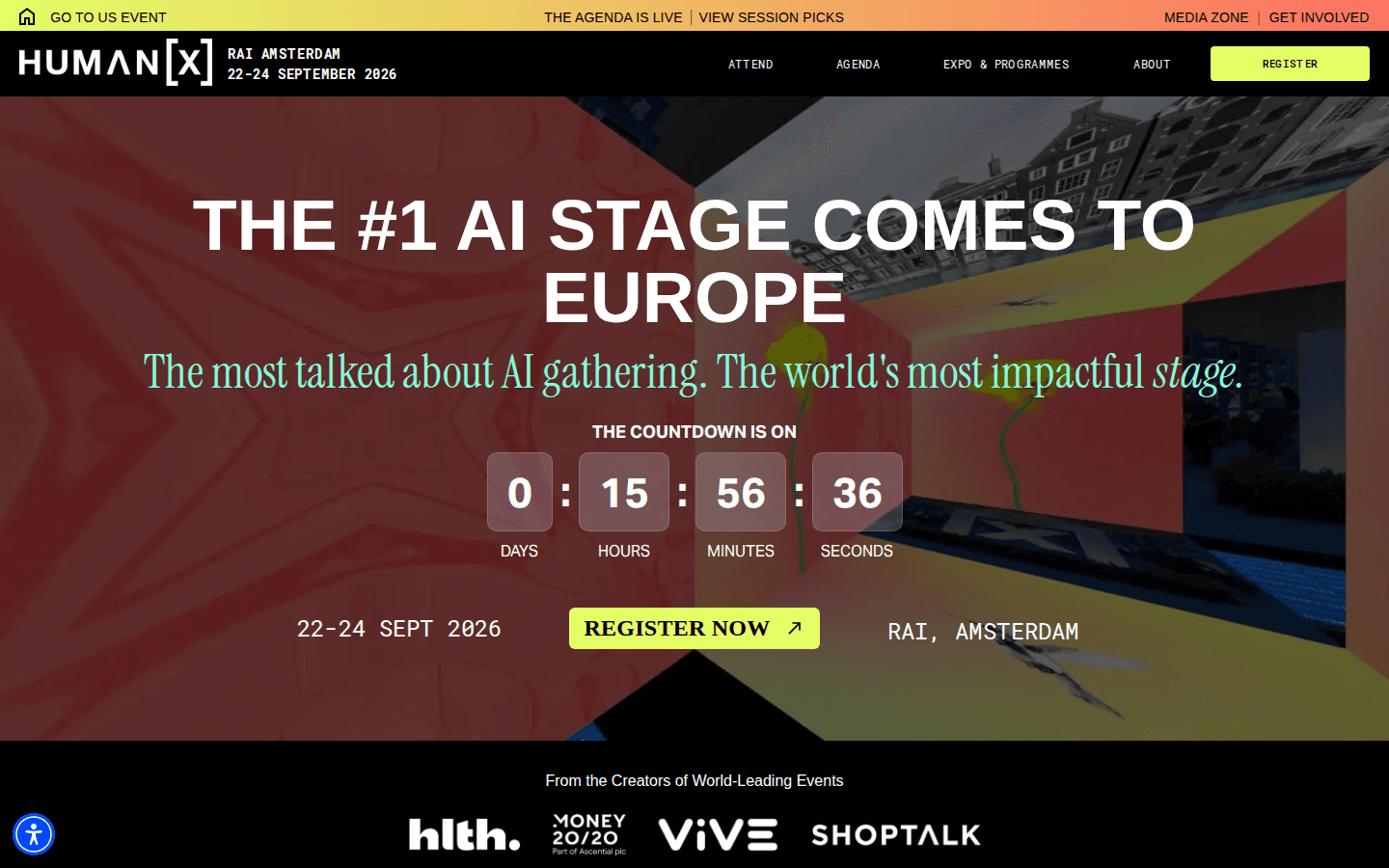
The HumanX Europe homepage on Monday evening, countdown under 16 hours. Source: humanx.co/europe
TL;DR
- HumanX Amsterdam is built for people who decide on AI spend: enterprise leaders, founders and investors. Developers are welcome, but the program is organized around job functions.
- The format is unusual. No one-day passes, no pay-to-play stages, role-based tracks and pre-booked matchmaking. You plan it like a working trip.
- I expect four conversations to dominate: European sovereignty, risk after OpenAI's Astra launch, AI cost governance after TypeSafe's Jev, and whether AI investment pays back.
- The last conference we attended was all about cutting tokens per task. Here I expect the same topic seen from the CFO's chair: why the total bill keeps going up anyway.
- For DevTool and AI startups, the value is access to buyers and their exact words. That only pays off if you follow up and turn what you hear into content.
What is HumanX, and why does the Amsterdam edition matter?
HumanX is a conference series for executives who build and adopt AI in business. It was founded in 2024 by Stefan Weitz and Jonathan Weiner. Jonathan's earlier brands include Money20/20, Shoptalk and HLTH, which tell you a lot about how HumanX is run: brand first, community second, trade floor a distant third.
The first edition ran in Las Vegas in 2025, the second in San Francisco in April 2026, and the next US flagship returns to Las Vegas in March 2027. Amsterdam is the first time the brand has crossed the Atlantic.
Why Europe, and why now
The pitch from the organizers is simple. Europe is having its AI moment, and it deserves a senior, international stage of its own. Most European AI events are either technical or regional. There was no place where the best of European AI could share a stage and a coffee line with Silicon Valley leadership.
Zach Butler, who runs HumanX in EMEA, made this case in a C-Suite Podcast interview published today. One detail from it stayed with me: when US tech giants speak at HumanX Amsterdam, they send corporate leadership from headquarters. European general managers are what you usually get at events on this side of the Atlantic. For a European audience, that is rare, and it changes the quality of the answers you get.
What "the right room" means here
HumanX publishes that 60% of its Amsterdam audience is VP and above. The organizers talk about the audience the way a sales team talks about an ideal customer profile. They build journeys through the event for specific roles and track how many attendees work at companies their sponsors actually want to meet.
This is the part I find most interesting as someone who runs a marketing company. HumanX treats attendance as a matching problem. Most conferences treat it as a headcount problem.
How is HumanX built differently from the developer conferences we attend?
HumanX is built for decisions. KubeCon is built for depth on one stack, and WeAreDevelopers is built for hands-on breadth. That single difference explains almost every design choice below.
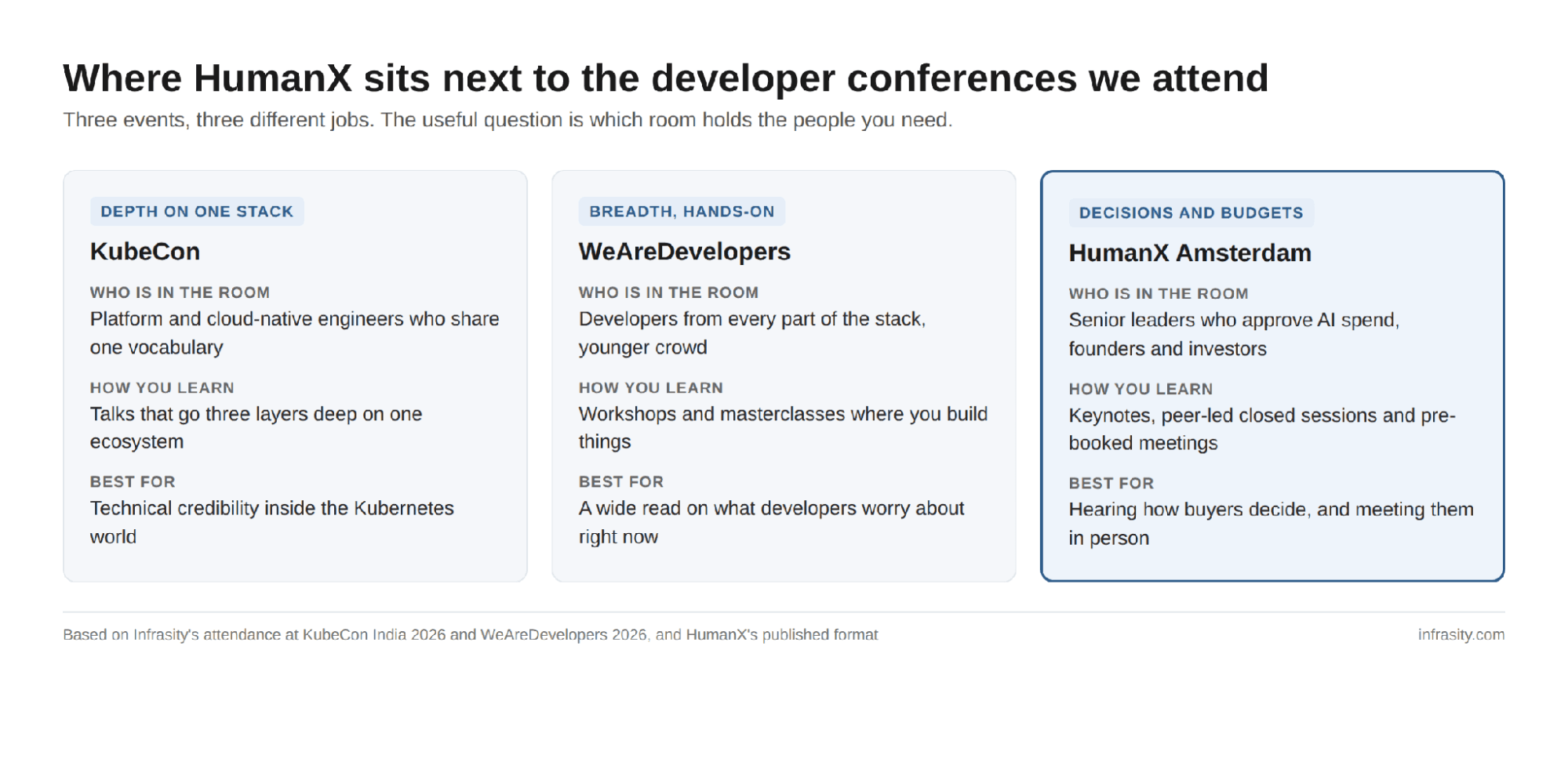
Three events, three jobs. We picked each one for a different reason.
When we attended KubeCon India, the value was density of expertise. You could go three layers deep on GPU scheduling with a stranger at the coffee bar. In Berlin at WeAreDevelopers Day 0, the value was a wide, younger crowd that came to build things in workshops.
HumanX makes four choices those events don't.
There are no one-day passes
This surprised me at first. The reason is that the program is threaded by role. A CMO might get keynote framing on one day and then a small, one-to-one masterclass on the next. If you only come for one of those, you get half the story. The organizers would rather you skip it entirely than attend one day.
My read: this is the right call for the attendee, and a hard sell for a first-year event in a cautious market. It means you commit three days or nothing.
No sponsor buys a speaking slot
HumanX runs a strict no pay-to-play policy. Sponsorship packages do not include stage time, and the speaker program is editorially driven. The organizers openly admit they could make more money if they sold stages.
This matters more than it sounds. Most enterprise AI talks at vendor-funded events are product demos with a keynote title. If HumanX holds this line, the talks should contain decisions and trade-offs, which is the thing senior people actually travel for.
HumanX matches meetings in advance through three programs
There are three matchmaking programs. SolutionBridge pairs enterprise buyers with vetted vendors against their AI mandate. VentureConnect pairs founders with investors. Peer [X]change puts people in role-based peer groups, CIOs with CIOs, so they can talk about implementation without a vendor in the room. The organizers describe the goal as no exhibit-floor roulette.
For a startup, SolutionBridge is the program to understand. For an enterprise leader, Peer [X]change is probably the most honest room in the building.
The event runs like a media company
HumanX expects around 200 journalists in Amsterdam, and it has a process to get content from the stage to the press within about 20 minutes of a session ending. Big-name speakers go from keynote to a small Q&A stage to a press slot within the hour.
I think this is the smartest thing about the whole format, and it is a lesson for any DevTool founder. A well-run event keeps producing content for weeks after the hall empties. HumanX also records, transcribes, and makes every session searchable, powered by Granola, so what is said on stage keeps being reused after everyone flies home.
What does the three-day HumanX Amsterdam agenda look like?
The three days work as a sequence: big picture on Tuesday, implementation on Wednesday, depth and follow-ups on Thursday.
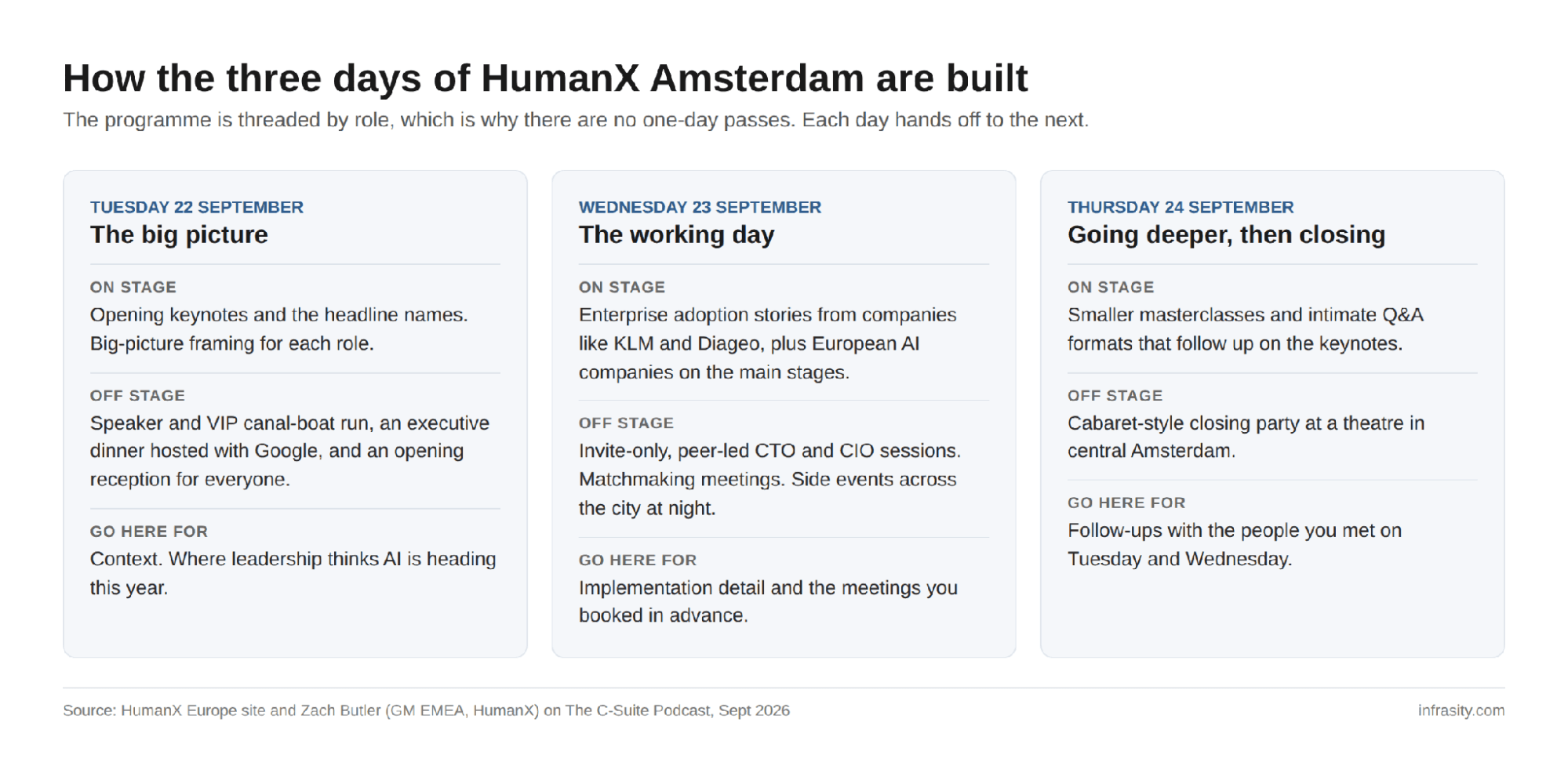
How the three days hand off to each other.
Tuesday: keynotes and the first evening
Tuesday opens with the keynotes. In the evening there are three parallel events: a canal-boat run for speakers and VIPs that picks them up at the RAI, an executive dinner hosted with Google, and an opening reception for the wider audience.
Wednesday: the working day
If I had to pick one day, it would be Wednesday. This is when the invite-only, peer-led CTO and CIO sessions run, and when enterprises that have actually shipped AI tell their stories. KLM's CEO Marjan Rintel and Diageo's CDO Susan Jones are both on the speaker list. Those are the talks I will sit in on, because a company flying planes or shipping drinks has no reason to oversell AI.
Thursday: going deeper, then closing
Thursday is for smaller formats and follow-ups, and it ends with a cabaret-style closing party at a theatre in central Amsterdam.
The stages and pavilions worth knowing about
Beyond the tracks, the expo has a Dutch AI Pavilion and a Physical AI Pavilion. The physical AI angle ties in with Wayve's Alex Kendall being on the programme. Autonomous driving is the oldest promised AI use case, and it is now running on real streets in London. I want to hear how they talk about it to a room of people who approve budgets.
Which HumanX track should you attend for your role?
Pick the track that matches the problem you own. HumanX splits its content into five role-based tracks.
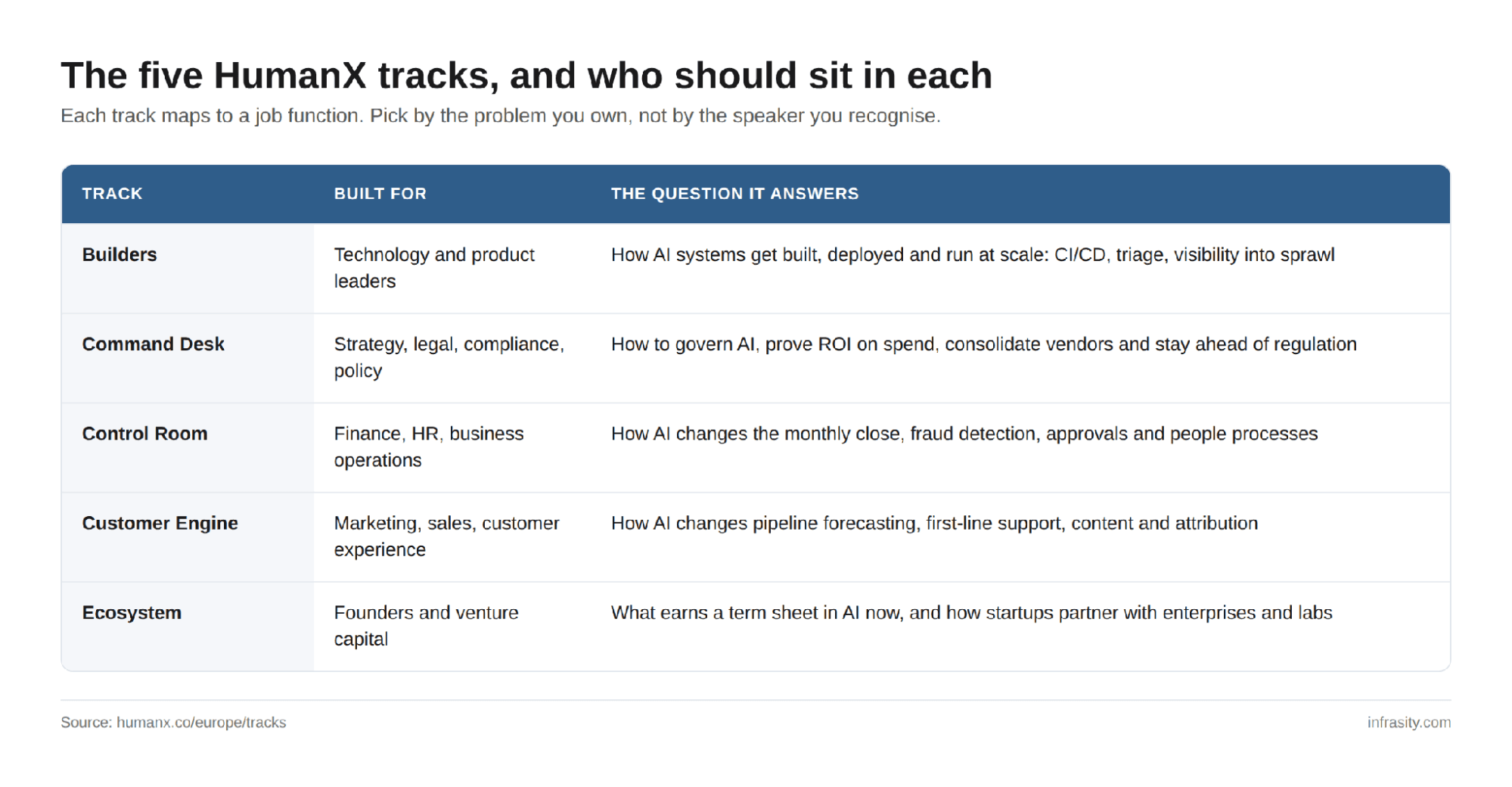
Five tracks, five job functions. Source: humanx.co/europe/tracks
A small finding about the Builders track
Engineers should read this before choosing. I went through the key speakers listed for each track. All four headline speakers in the Builders track are company founders or CEOs: May Habib of WRITER, Jan Oberhauser of n8n, Arvind Jain of Glean, and Clay Bavor of Sierra. None of them is a practicing engineer or developer advocate.
That tells me "Builders" here means people who build companies and systems, and the talks will sit at the architecture and strategy level.
For code-level content, the hallway and the side events will serve you better than the stage. For a view of how founders of successful AI companies think about building, it is the best track in the building.
Where I will spend my time
I will split between Builders and Customer Engine. Builders because our clients are DevTool and AI agent companies, and I want to hear how their buyers' vendors think. Customer Engine because Fin's Des Traynor, Zendesk's Tom Eggemeier, and Jasper's Timothy Young will be talking about how AI changes content and attribution, which is the work we do every day.
What conversations do I expect to dominate HumanX Amsterdam?
I expect four conversations to take over the stages and hallways. Two are built into the agenda. Two were handed to it by launches in the last three weeks.
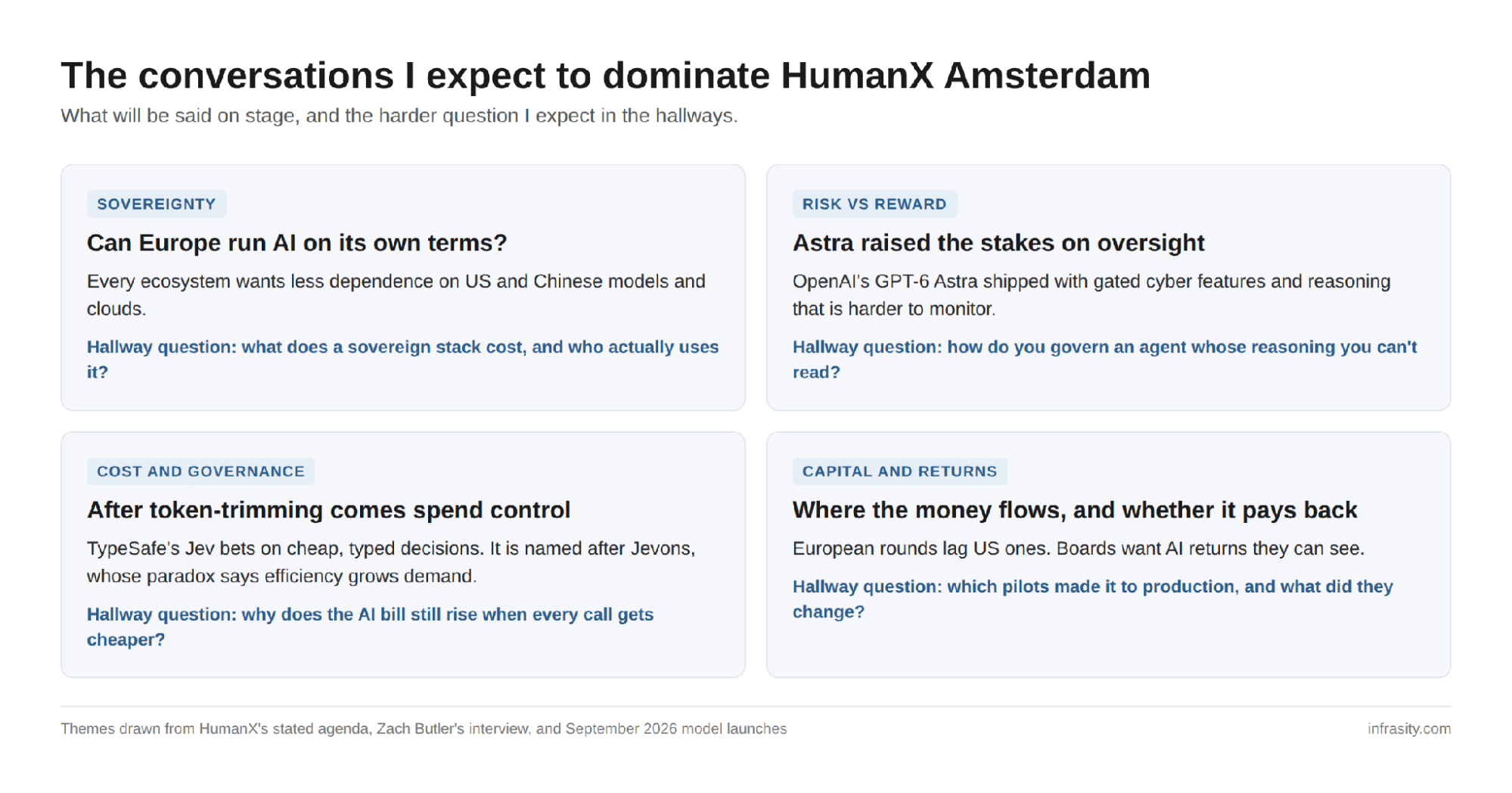
My bets for the week. I'll grade them in the recap.
European sovereignty, and how realistic it is
Sovereignty is the theme the organizers expect to dominate. Every European ecosystem has a plan to depend less on US and Chinese AI. Zach Butler was candid that this will be very difficult to achieve, which is a refreshing thing for an organizer to say about his own headline topic.
My view: the sovereignty talk will be ambitious on stage and practical in the hallways. On stage you will hear about national models and European clouds. In the hallways, I expect CTOs to ask a simpler question: which parts of my stack actually need to be sovereign, and what does that cost me? That second conversation is the useful one.
Risk versus reward, with Astra as the live example
The timing here is almost too good. OpenAI released GPT-6 Astra on 3 September, starting with a limited group of cybersecurity partners before wider rollout through ChatGPT plans and the API. OpenAI calls it its most capable model yet, with a strong focus on computer use.
It is also the most argued-about launch of the year, because Astra uses a reasoning technique called opaque recurrence, which makes its chain of thought harder to inspect.
I expect this to shape every governance panel at HumanX. For two years, the enterprise safety story has leaned on "we can read what the model was thinking." If the most capable models stop making that easy, a CIO has to answer a new question: how do you govern an agent that clicks through your systems when you can't read its reasoning? That is where the risk-versus-reward conversation gets real.
There is a second layer. Zach pointed out that some of the scaremongering around AI risk suits the big labs, because it proves how important they are. I agree, and I expect sharp people in the audience to push back on panels that feel like positioning.
Cost and governance, the second act of the token conversation
In Berlin, every AI conversation turned into the same practical question: how do you get the same work for fewer tokens? Trim the data you hand the model. Load tools on demand. Write better tool descriptions. That was the developer version of cost control.
I expect HumanX to have the same conversation from the other side of the table. The organizers already flag cost optimization as a big theme, with stories of large companies burning through AI credits with little governance.
The launch that frames this best came out last week. TypeSafe released Jev, a model that returns typed decisions instead of free text, built for routing and classification steps inside software where a fast, predictable answer matters more than prose. It is a bet that a lot of AI work inside an application is a yes, a no, or a pick from a list, and that paying a frontier model to write paragraphs for those steps is a waste.
The detail I like most is the name. TypeSafe named Jev after William Stanley Jevons, the economist who noticed that more efficient steam engines led to more coal being burned overall. That is exactly the tension I expect in Amsterdam. Every team is making each AI call cheaper. The total bill keeps rising anyway, because cheap calls get used everywhere.
So my prediction is this. The developer rooms in Berlin were about tokens per task. The executive rooms in Amsterdam will be about total spend, who approves it, and how you tie it to results. Same problem, different chair.
Capital, and whether AI pays back
The fourth theme is money. Funding rounds for European AI startups and scale-ups still lag the US, and there is a push to bring in more institutional capital, from pension funds to sovereign wealth. The Ecosystem track and VentureConnect exist for exactly this.
Underneath it sits the question that decides everything else. The technology works. Proof of results is what boards are still waiting for. Zach said it plainly: the market succeeds or fails on whether companies can actually adopt AI and change how they operate. I expect the best-attended sessions to be the ones where someone shows what changed after a pilot went to production.
What are the real benefits of attending an event like HumanX?
The biggest benefit is access to people who make AI decisions, in a setting built for honest conversation. The talks are the smaller part of the value.
You hear how buyers actually decide
On a vendor floor, you hear pitches. In a peer room, you hear how a CIO really picked a tool, what almost made them walk away, and who else was in the room when they signed. For anyone who sells to enterprises, that is worth more than any keynote.
You get perspective you can't get from a feed
AI news moves daily. A three-day event forces you to hear the same topics from a regulator, a founder, an investor and an airline in one week. The organizers want HumanX to be for AI executives what the FT or Bloomberg is for a CFO's morning. Whether or not they get there, that is the right ambition, because the problem for most leaders right now is too much noise and too little signal they trust.
Community forms around trust
Zach said that if HumanX had one word, it would be trust. I think that is the most important idea in the whole interview. Trust is lacking across the AI market right now, between buyers and vendors, and between the public and the labs.
Communities form where people feel safe enough to say what isn't working. Editorial speakers, closed peer sessions, and no-pitch rules are all ways of building that safety. It is also why I think HumanX has a real chance of lasting, even though it is new here.
Europe meets Silicon Valley in one place
For a European founder, this is a rare chance to meet US leadership and investors without flying to San Francisco. For US companies, it is a fast way to understand how differently European buyers think about sovereignty, regulation, and risk.
What could go wrong at HumanX in its first European year?
I want to be fair here. There are real reasons this might disappoint some attendees.
The brand is new in Europe
In the US, the AI community knows HumanX. In Europe, almost nobody did a year ago, and the name doesn't obviously say "AI conference." The organizers admit European companies have been more cautious: wait and see how the first year goes. First editions often feel thinner than the pitch.
It is priced as an executive event
HumanX calls itself unapologetically premium. For a senior leader with a budget, that is fine. For an early-stage founder, it is a real cost. There is a discounted Startups Pass, but it requires an application. It's a three-day pass with no single-day option, and you plan for it weeks in advance.
Developers may find it high-level
For hands-on workshops, WeAreDevelopers is the better event. HumanX has technical leaders on stage, and their content is aimed at decisions about systems. Expect architecture and trade-offs on stage, with code staying in the hallway. As the Builders finding above shows, even the technical track leans towards founders.
Big names can become soundbites
The media engine is a strength, and it has a cost. When every keynote is designed to make news within 20 minutes, some speakers will play to the headline. I expect the Q&A stages and closed sessions to be more honest than the main stage.
Late sign-ups make the room hard to predict
AI events register very late. In the US, HumanX hit the halfway point of its registrations only about three weeks out. For attendees, that means the final room may look different from the attendee snapshot you saw a month ago. It is worth checking HumanX Connect again this week before booking meetings.
How should a DevTool or AI startup founder get value from HumanX?
Go with a list of buyers to meet, book those meetings before Tuesday, and plan the follow-up content before you fly home. Most founders only do the middle step.
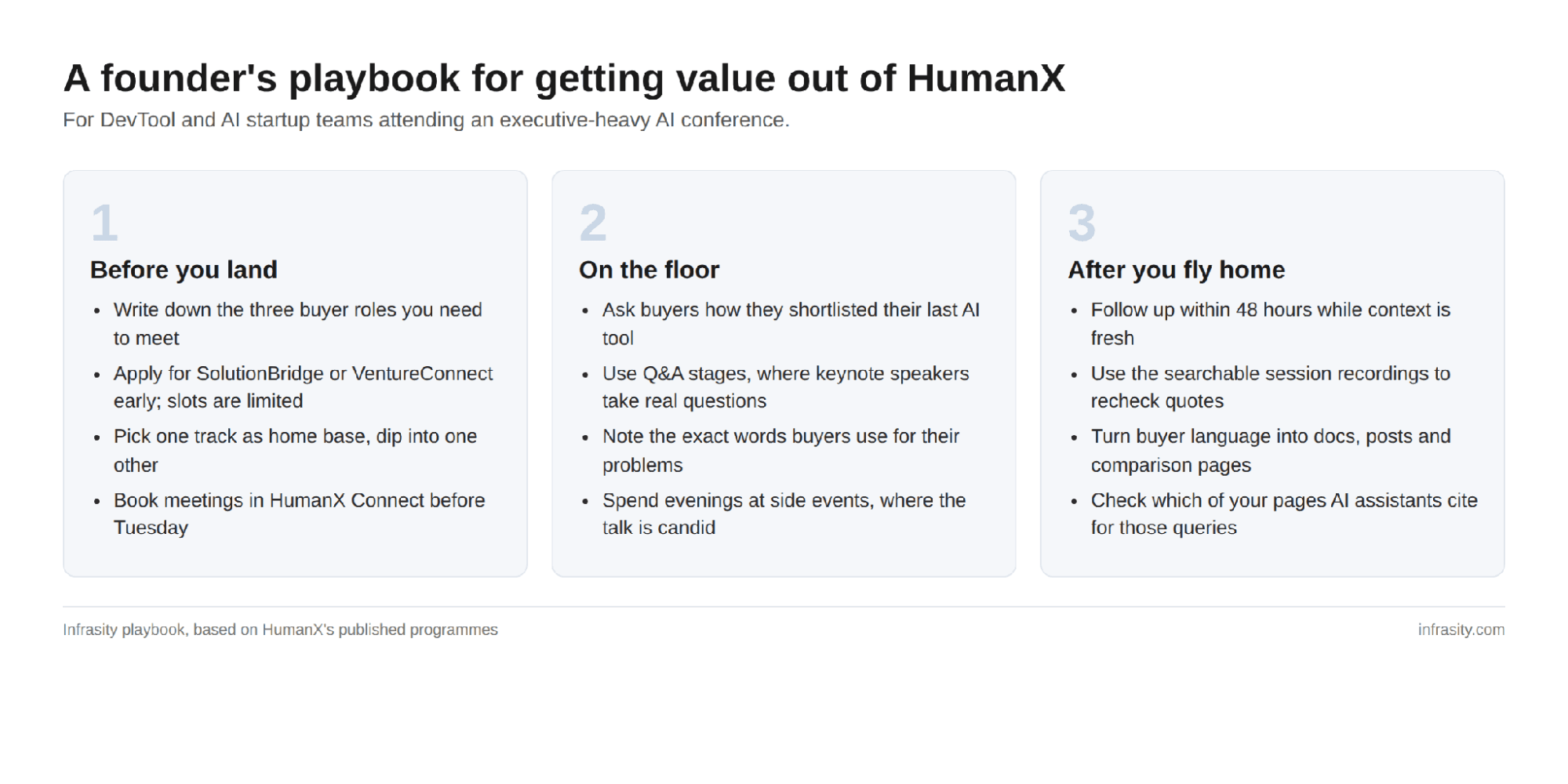
The playbook we are using this week.
Before: decide who you need to meet
Write down the three buyer roles that matter to you. Apply for SolutionBridge or VentureConnect early, since slots are limited. Book meetings in HumanX Connect before the first keynote, because the good calendars fill on day one.
One point from the interview is worth repeating for founders. Everyone wants Fortune 500 executives. The organizers say a lot of AI money is actually being spent in the mid-market and inside product teams. A list with only enterprise CIOs on it is too narrow.
During: collect the exact words buyers use
The most valuable thing you can bring home is language. How does a head of platform describe the problem your tool solves? What did they search for, or ask an AI assistant, when they started looking? Write it down word for word.
This matters because the B2B buyer journey now starts in an LLM more often than a search engine. If your docs and blog posts don't use the words buyers use, AI assistants won't connect you to their questions.
After: turn the conversations into content
Follow up within 48 hours. Then use what you heard. The searchable session recordings are useful for rechecking exactly what a speaker said before you reference it. Turn buyer questions into documentation, comparison pages, and posts, and check whether AI assistants cite you for those questions.
That last step is where most event spend gets wasted, and it is exactly the work we do for DevTool and AI companies through our AI GEO optimization service. If you are at HumanX this week and want to talk about how buyers find tools like yours, book 15 minutes with us on the floor.
What am I hoping to take home from Amsterdam?
Three things:
First, a clear read on how European buyers talk about AI spend and governance after Astra and Jev, in their own words.
Second, a few honest conversations with enterprise leaders about how they shortlist AI and developer tools today.
Third, a view on whether a premium, trust-first event format works in a market that is famously cautious about new things.
My overall bet is that the word I hear most in Amsterdam will be control: control over cost, over risk, and over where your AI runs. The developer events we attended this year asked how to build with AI efficiently. This one will ask who is accountable when it runs at scale.
Too early to call. The doors open tomorrow. I will be back with what held up, what didn't, and which of these predictions I got wrong.
If you build developer tools or AI agents and you are at the RAI this week, come and find us. And if you can't make it, our developer marketing team can help you turn conversations like these into content your buyers will actually find.
Frequently Asked Questions
When and where is HumanX Amsterdam 2026?
HumanX Amsterdam runs from 22 to 24 September 2026 at RAI Amsterdam in the Netherlands. It is the first European edition of HumanX. The next US edition is at Mandalay Bay, Las Vegas, from 7 to 10 March 2027.
Who should attend HumanX Amsterdam?
HumanX is built for senior leaders who build or adopt AI: technology, product, strategy, finance, HR, marketing and sales leaders, plus founders and investors. The organizers report that about 60% of attendees are VP level or above. Developers can attend, but the content is aimed at decision-makers more than hands-on implementation.
Does HumanX Amsterdam offer one-day passes?
No. The agenda is threaded by role across all three days, with keynote framing on one day and deeper masterclasses on another. The organizers say a single day would give you only half of that journey, so they sell full-event passes only.
Can sponsors pay to speak at HumanX?
No. HumanX runs a strict no pay-to-play policy. Sponsorships do not include speaking slots, and the speaker program is chosen editorially.
What are the HumanX Amsterdam tracks?
There are five role-based tracks: Builders for technology and product, Command Desk for strategy, legal and policy, Control Room for finance, HR and operations, Customer Engine for marketing, sales and customer experience, and Ecosystem for founders and investors.
How is HumanX different from KubeCon or WeAreDevelopers?
KubeCon goes deep on one technology community, and WeAreDevelopers is a broad, hands-on developer event with lots of workshops. HumanX is built for AI decision-makers, with curated matchmaking, peer-led closed sessions, and editorial keynotes. Pick it if your goal is to understand or meet buyers. Pick the other two to go deeper on a technology.