
KubeCon + CloudNativeCon North America 2026 runs November 9 to 12 at the Salt Palace in Salt Lake City, and the clearest signal about this year's show is already public. The Diamond tier doubled from 5 sponsors in Atlanta to 10, while the start-up tier fell from 69 to 36.
I have spent a lot of time on KubeCon floors, from Mumbai to the European editions, and I read the sponsor page before I read the schedule. The schedule tells you what the community wants to talk about. The sponsor tiers tell you where companies are willing to spend to be seen, and this year the two pictures line up more closely than usual.
This is a short letter for anyone heading to Salt Lake City, whether you are attending, exhibiting, or watching from home: what changed, what I think it says, and how I would spend the four days.
Key takeaways
- The money moved up: Diamond and Platinum together grew from 27 to 40 sponsors, a 48% jump. Gold dropped from 47 to 32 and the start-up tier nearly halved.
- AI companies now sit at the top table: Anthropic is a Diamond sponsor for the first time, and GPU clouds like Crusoe and Nebius jumped to Platinum.
- Kubernetes cost tools are buying bigger booths: ScaleOps moved to Diamond, PerfectScale and Sedai moved to Platinum, and DevZero went from the start-up tier to Gold.
- The program follows the same line: Monday opens with Agentics Day: MCP + Agents and Cloud Native AI + Inference Day, and the End User TAB picks lean hard on GPU scheduling and agent sandboxing.
- Early-stage teams have cheaper ways in: Platform Coffees, Birds of a Feather sessions, the Project Pavilion, and poster sessions put you in front of practitioners without a booth.
How the 2026 sponsor tiers compare with Atlanta 2025
I counted every logo by tier on the archived Atlanta 2025 event page and on the live page. The total dipped slightly, from 263 to 231 sponsors, but the shape of the wall changed a lot more than the count.
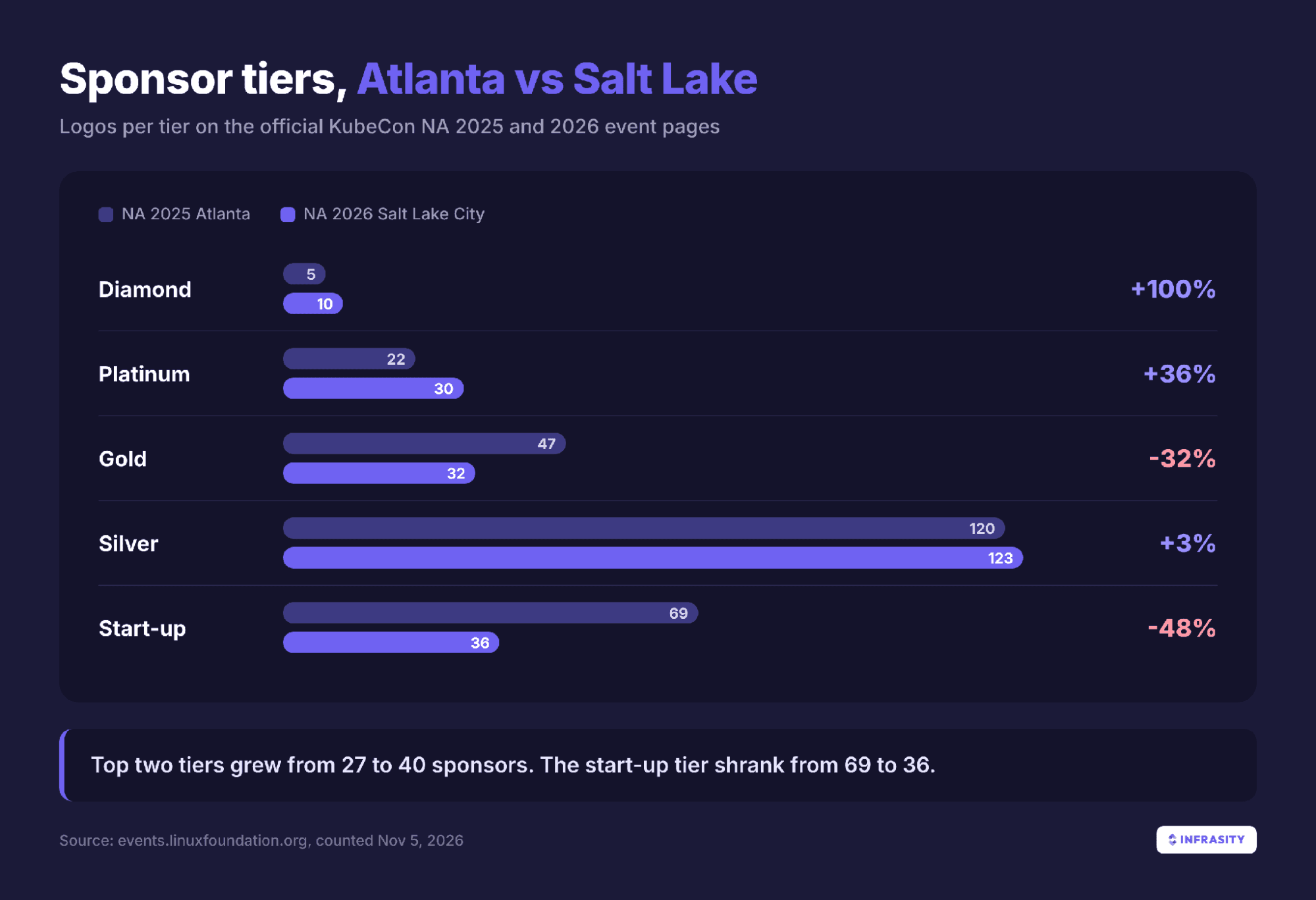
Read the chart from top to bottom, and the pattern is simple. Fewer companies are buying the middle of the market, and more are paying for the most visible spots on the floor.
The Diamond row on the official event page shows who is paying for that visibility this year.
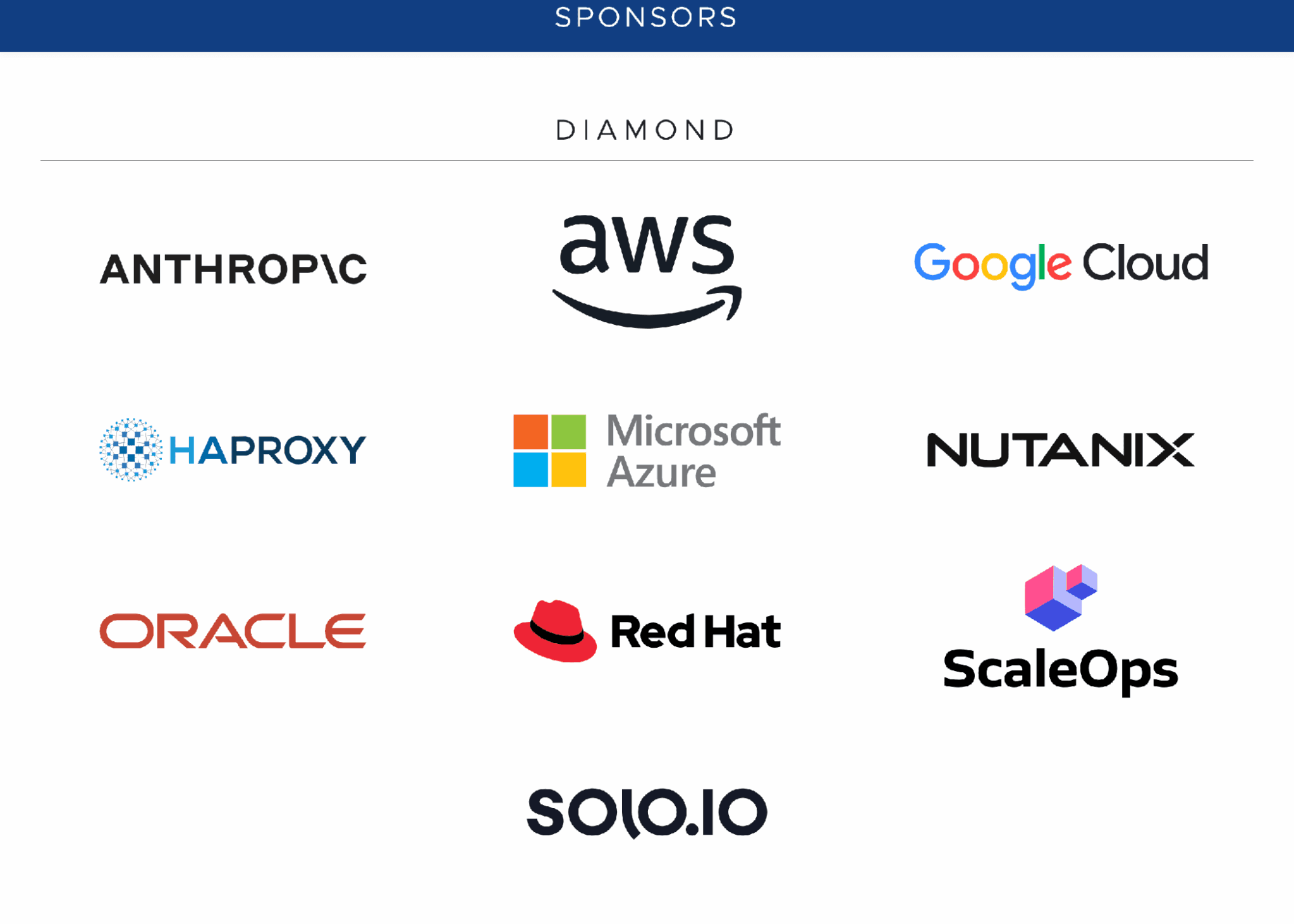
Ten Diamond sponsors this year, where Atlanta had five.
Which companies climbed the sponsor tiers this year
Comparing the two lists name by name tells a sharper story than the totals. The climbers cluster in three groups, and each one maps to a problem platform teams are paying to solve.
AI model providers: Anthropic appears at Diamond with no 2025 listing at all, and two Anthropic engineers are on the keynote roster. A model lab sponsoring the top tier of a Kubernetes conference tells you how much of AI's production footprint now runs on clusters.
GPU clouds: The companies that rent out accelerators moved up fast:
- Crusoe went from Silver to Platinum
- Nebius went from Gold to Platinum
- CoreWeave and NVIDIA both moved from Silver to Gold
- Runpod, Latitude.sh and NorthMark Compute appear for the first time
Kubernetes cost optimization: This is the group I find most telling, because cost tools used to fill the lower tiers:
- ScaleOps moved from Platinum to Diamond
- PerfectScale by DoiT moved from Gold to Platinum
- Sedai moved from Silver to Platinum
- DevZero moved from the start-up tier to Gold
My read is that GPU spend changed who signs the cheque. When a cluster bill includes accelerators, cost and scheduling stop being an optimization project and become a finance conversation, and vendors are following that budget onto the floor.
The CNCF End User TAB's session picks back this up from the practitioner side. Adobe will show how it attributes network egress cost across 400K pods in 31K namespaces, and several picks cover topology-aware GPU scheduling and sharing GPUs across clusters.
What the smaller start-up tier means for early-stage teams
The start-up tier going from 69 to 36 is the number I would think hardest about if I ran an early-stage company. The public pages don't explain the drop, so I wouldn't credit any single cause too much. Some companies graduated to higher tiers, as DevZero and Firefly did, and others may have skipped North America this year.
What I would take from it is practical. With fewer start-ups on the floor, each one gets more attention, and the ones that stay away need other ways to reach the same people.
Here is where I would go without a booth:
- Platform Coffees, run by the CNCF Platform Engineering community from 7:00 to 8:30 AM every day, free and with no registration
- Birds of a Feather sessions, which return with the new end user groups for Platform Engineering, Public Sector, Telecom and Research
- The Project Pavilion, where you can talk to maintainers of sandbox and incubating projects about adoption
- Poster sessions, which the TAB calls out as the best place for long conversations with authors
How I would plan four days in Salt Lake City
The schedule is big: 9,000+ attendees, 2,100+ organizations and 400+ sessions across four days. Here is how I would split it.
Monday, November 9. Co-located events like Platform Engineering Day, Agentics Day, and Cloud Native AI + Inference Day need the All-Access pass, so check your ticket before you plan the day. If agents are on your roadmap, Agentics Day is the room I would sit in.
Tuesday to Thursday. Pick sessions where an end user tells you what broke. Two from the TAB list stand out to me:
- Anthropic's war story on how one LIST call pushed a cluster of tens of thousands of nodes into a relist spiral, twice in two weeks
- Walmart's zero-downtime CNI migration from Canal to Cilium across hundreds of clusters
I would also catch Justin O'Leary's talk on operators that trust user annotations. His speaker preview makes the point in under a minute: you can lock down RBAC and still hand a namespace user your cloud account through an operator that says yes.
Carry one theme between rooms. In a recap of KubeCon Europe 2026, attendees described the shift from running AI workloads on Kubernetes to operating platforms where AI is part of the team. Observability vendors stole that show, because nobody hands more work to automation they cannot see. I expect Salt Lake City to push the same question further into governance, identity and cost.
Red Hat's Mike Barrett made a related point in a preview with theCUBE: Kubernetes was built for web-scale apps, and inference forced new work like leader worker sets, DRA for sharing expensive hardware, and token-aware routing. His next prediction was sandboxing for agents, which is exactly where several 2026 sessions land.
What happens to developer adoption after the booth packs up
This is the part I care about most, because I have watched it play out at every KubeCon we have covered. At KubeCon India 2026 in Mumbai, almost every company we spoke with had strong technology and the same problem: getting developers to adopt the tool after the conversation ended.
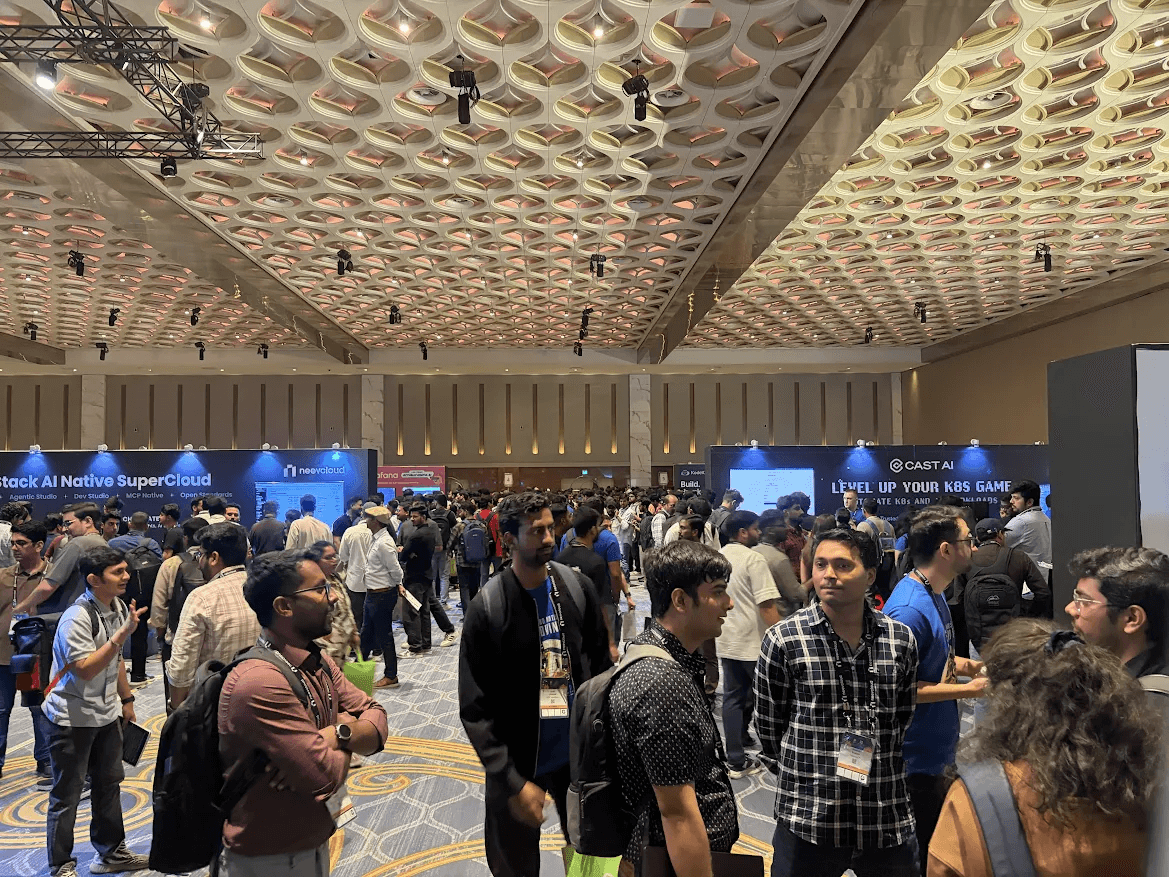
The floor at KubeCon India 2026, where we heard the same adoption problem from booth after booth.
A Diamond booth buys four days of attention. What happens on day five decides whether that spend pays off. An engineer who liked your demo will search for it, ask a teammate, check GitHub, or ask ChatGPT or Claude which tool fits their cluster. If your company is missing from those answers, the booth did its job and the follow-through did not.
Three things I would have ready before November 9:
- A use case page for each problem you demo, written the way an engineer would describe it
- Answers in the places developers ask, from Reddit threads to the AI assistants they already use
- A check on whether AI assistants name you for your category's buyer questions today
If you sponsor or exhibit and want help turning booth traffic into adoption, talk to us at Infrasity. We write technical content for DevTool and cloud native teams, and we track whether ChatGPT, Claude, Perplexity, and Gemini recommend you.
Teams we work with on the KubeCon NA 2026 floor
Several teams we work with are on the 2026 sponsor wall, and their moves mirror the wider trend. If you are walking the Solutions Showcase, these are the conversations I would start with each of them.
DevZero (Gold, up from the start-up tier). DevZero is a Kubernetes cost optimization platform, and its jump of two tiers is the single clearest example of cost tooling buying more visibility this year. If GPU or node spend is on your mind, ask the team how they measure waste before they change anything in a cluster.
Firefly (Silver, up from the start-up tier). Firefly is a cloud asset management platform that helps teams codify unmanaged resources and catch drift between infrastructure as code and what is running. With so many sessions on multi-cluster fleets this year, drift is a good question to bring to their booth.
StackGuardian (start-up tier, back for a second year). StackGuardian is an infrastructure automation platform for orchestrating Terraform and OpenTofu workflows with governance built in. OpenTofu Day on Monday makes this a natural week to compare notes with them on policy and self-service.
Two of these teams moved up a tier since Atlanta, which tells me the companies investing in developer education all year are the ones confident enough to spend more on the floor. If you want the basics before you go, our guide to what KubeCon + CloudNativeCon is covers how the event works.
Frequently asked questions
What are the dates of KubeCon + CloudNativeCon North America 2026?
It runs November 9 to 12, 2026, in Salt Lake City, Utah. Monday is for co-located events and project lightning talks, and Tuesday to Thursday carry keynotes, breakouts, and the Solutions Showcase.
Who are the Diamond sponsors of KubeCon NA 2026?
Anthropic, AWS, Google Cloud, HAProxy, Microsoft Azure, Nutanix, Oracle, Red Hat, ScaleOps and Solo.io. That is 10 Diamond sponsors, up from 5 on the Atlanta 2025 page.
Do co-located events need a separate ticket?
Platform Engineering Day, Agentics Day and Cloud Native AI + Inference Day require the All-Access pass. Check your registration before you plan Monday.
Will KubeCon NA 2026 sessions be recorded?
CNCF published the Atlanta 2025 talks on its YouTube channel after the event. I would expect the same for 2026, but check the CNCF channel for a specific talk.
How can Infrasity help KubeCon sponsors after the event?
We turn what you demoed into technical content, use case pages, Reddit and community answers, and AI visibility work. The goal is that developers who met you at the booth find you again when they search or ask an AI assistant.
Does Infrasity work with cloud native companies?
Yes. We work with DevTool, Kubernetes, observability and AI infrastructure teams, with content written by engineers. You can book a call to see if we are a fit.