
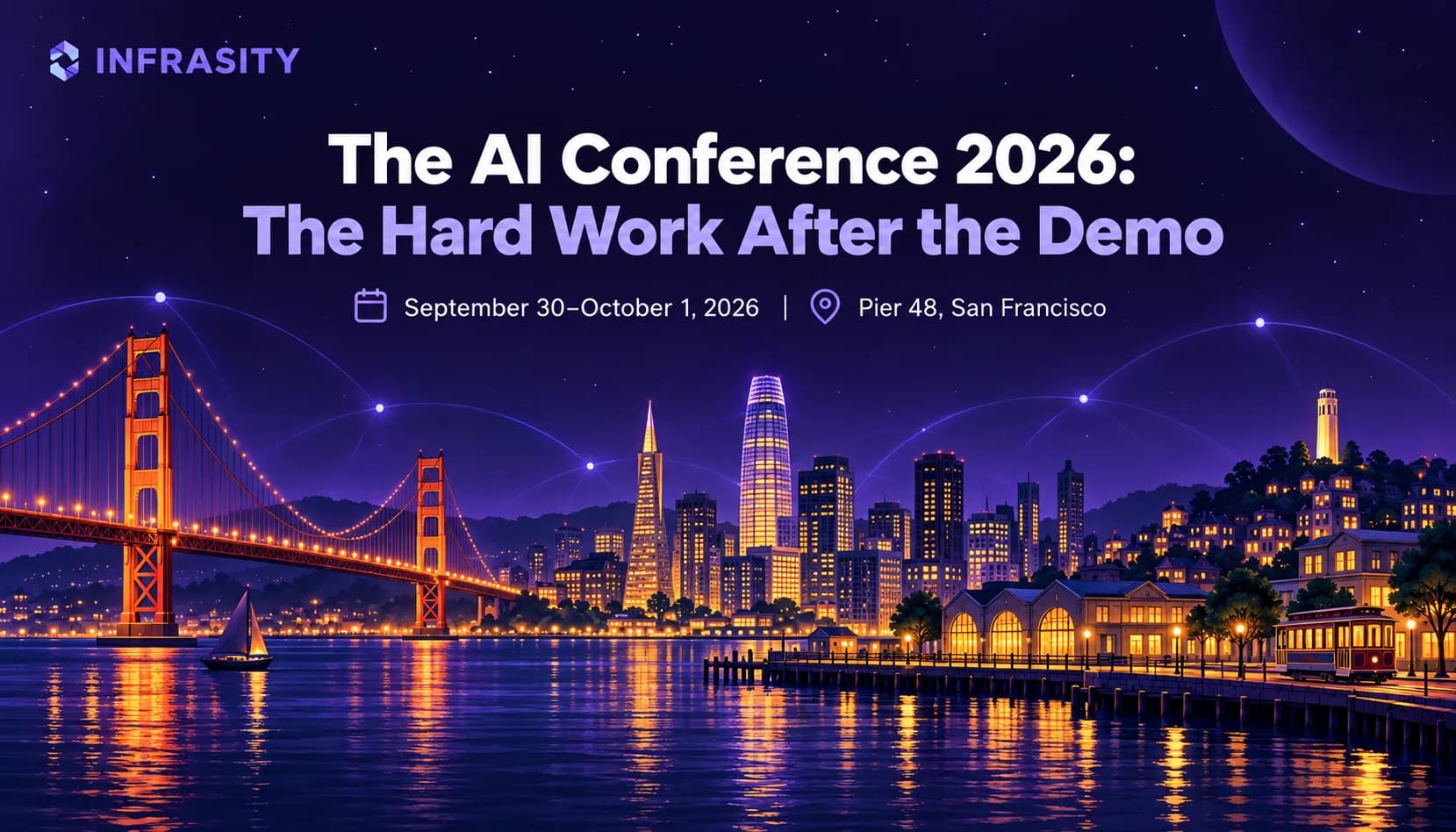
The AI Conference 2026 catches my attention because its program puts deployment problems front and center: agent failures, evaluation, context, and inference costs. Those are the conversations I would prioritize if I were choosing where to spend two days learning about AI.
The main conference runs September 30 to October 1 at Pier 48 in San Francisco's Mission Rock neighborhood, following September 29's Day ZERØ workshops. The organizer advertises 120-plus speakers across five tracks. I'm interested in how those tracks connect around the work of shipping a useful system.
For the startups and companies taking part, I also care about what happens after someone leaves your booth. If that person asks an AI assistant about tools in your category, does your company appear? We built a free AI visibility benchmark for The AI Conference 2026 to help companies check where they stand.
What makes this year's program worth paying attention to?
AI Builders covers shipping agentic systems; The AI Stack goes deeper into infrastructure and models; Applied AI focuses on deployments. AI Strategy and AI Frontiers extend the discussion into adoption, governance, and research.
I would move between those rooms. An engineer choosing an agent architecture also needs to understand its operating cost. A founder choosing a product direction needs to understand where the system fails.
That connection is what interests me about this event. In our WeAreDevelopers Day 0 notes, token consumption kept coming back into the discussion. Here, the published program gives that question more room, alongside the equally difficult question of whether an agent actually completed its task.
Which sessions would I prioritize?
My first choice would be Divya Mahajan's session on eight ways production agents fail silently. A silent failure is exactly the kind of problem I want a technical conference to help me understand: the application returns something plausible, while the underlying action is wrong.
There is a scheduling catch. On September 30 at 2:30 p.m. Pacific, Mahajan's session overlaps with Jaclyn Konzelmann's agentic product-design talk and Parth Sareen and Zain Hasan's session on evaluating open models against production traffic. Three relevant perspectives, three rooms. I checked that slot against the published agenda.
For an agent already failing in production, I would choose failure detection. A model change makes production-traffic evaluation the useful choice. Product design deserves priority when you are deciding what an agent should do for a customer. A team attending together can split that slot and compare notes afterward.
On October 1, I would also flag Sai Maddali's production-inference session at 11:30 a.m. and Camila Maia's inference-cost playbook at 12:45 p.m. My question for both would be what happens to cost and latency across a completed workflow, including retries.
Is your company showing up in AI answers?
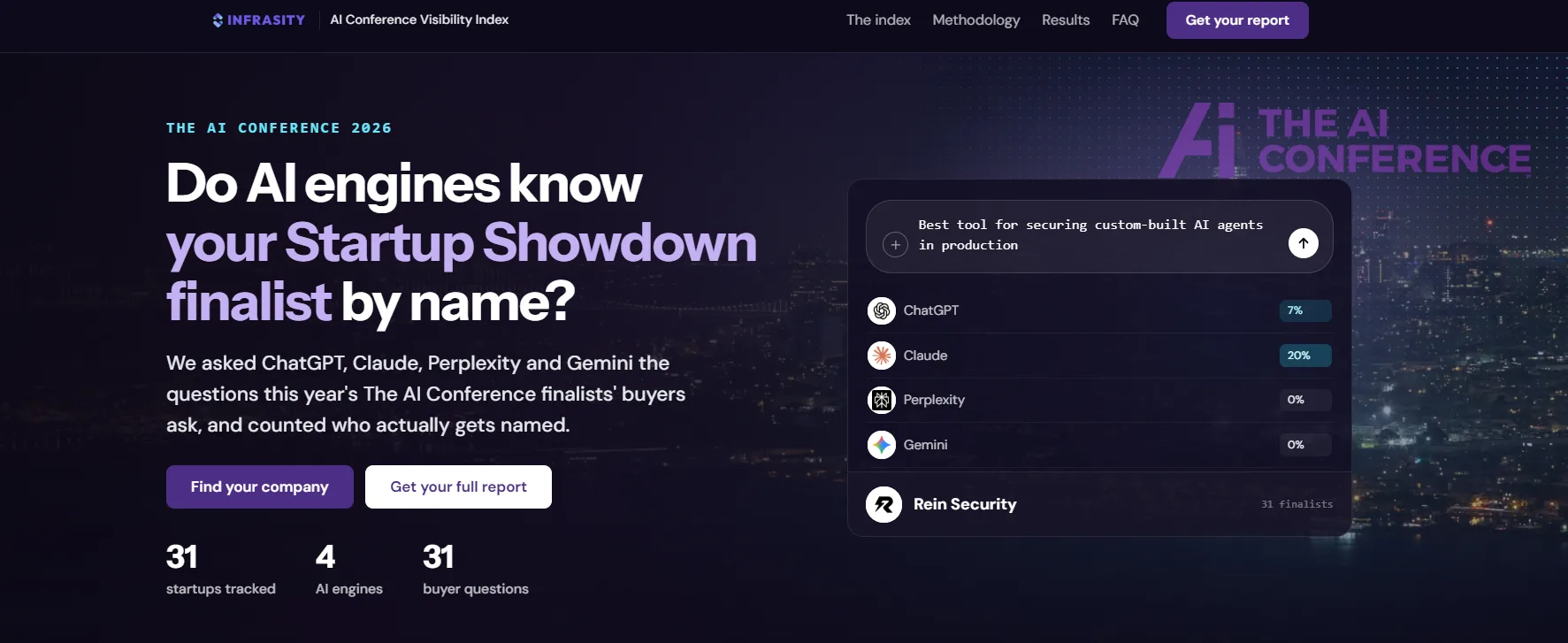
This is for all event visitors. Our AI Conference Visibility Index tests buyer questions across ChatGPT, Claude, Perplexity, and Gemini, then shows how often each engine names your company. The questions are unbranded, so we check whether you appear when someone asks about a solution, without giving the assistant your company's name.
Find your company to check its results across the four engines. You can also request the full report to see the tested question, competitors appearing in the answers, and cited sources. If you're exhibiting or sponsoring and your company isn't listed, request a report and tell us the question your buyers actually ask. The benchmark is free.
Check your company's AI visibilitySee how often ChatGPT, Claude, Perplexity, and Gemini name your company when buyers ask about your category.
I would use the result to identify which buyer questions our content needs to answer better.
What can last year's talks tell us about this year's questions?
One useful detail comes from Du'an Lightfoot's 2025 conference talk. At around 7:44, he describes the difficulty of giving an agent hundreds of tools, then explains using semantic search to provide relevant tools for a task. His point connects tool selection with context consumption.
That is the kind of implementation detail I value. Before paying for more context, I would check whether the agent needs everything being put into it.
The same talk offers a second useful example. Later, he demonstrated that the agent requests authorization before accessing a calendar. Lightfoot then walks through traces showing the model invocations and tool calls used to create an event.
The presentation uses AWS AgentCore. My takeaway is an architectural question I would bring to any agent demo at this year's Innovation Hub: can you show the permission check and the trace proving the action happened?
What would I look for beyond the engineering sessions?
For founders, Eric Ries and Tim O'Reilly's company-building conversation deserves attention. So does Ann Miura-Ko's session about the gap between individual AI acceleration and institutional adoption. Both are listed in the 2026 program.
I read those topics as a reminder to ask who owns the workflow after a pilot succeeds. Access approval and responsibility for an incorrect action need clear owners. Users also need a reason to keep using the product.
The event includes the Innovation Hub and Startup Showdown, with Party in the Park and Ignite Talks extending the program beyond daytime sessions.
At the Innovation Hub, I would ask a company to walk through one user task, including the failure path. At Startup Showdown, I would listen for the customer problem, the evidence of demand, and how the company expects someone to adopt its product. That adoption question also runs through our KubeCon India recap.
My view of this program is straightforward: it earns attention by putting difficult operational questions alongside product and company-building questions. I would judge its usefulness by the answers attendees can bring back about a failure they can detect, a cost they can explain, or a workflow they can improve.
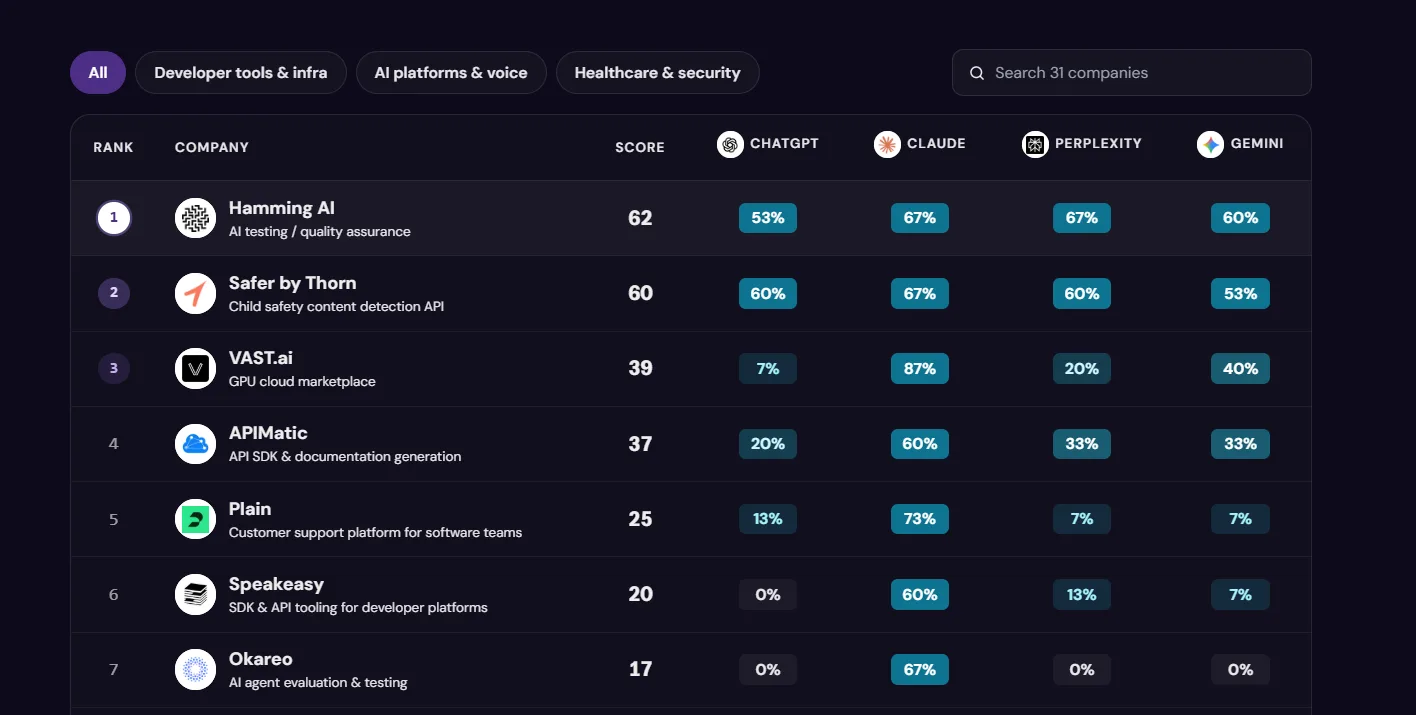
This is for all event visitors. Our AI Conference Visibility Index tests buyer questions across ChatGPT, Claude, Perplexity, and Gemini, then shows how often each engine names your company. The questions are unbranded, so we check whether you appear when someone asks about a solution, without giving the assistant your company's name.
Find your company to check its results across the four engines. You can also request the full report to see the tested question, competitors appearing in the answers, and cited sources. If you're exhibiting or sponsoring and your company isn't listed, request a report
Frequently Asked Questions
Can I get a benchmark if my company isn't listed?
Yes. If your company is exhibiting or sponsoring at The AI Conference, you can request a report. You can also suggest a question your buyers actually ask so the benchmark reflects your use case.
How can Infrasity help if my AI visibility score is low?
Infrasity's report identifies competitors appearing in the tested answers and the sources those answers cite. That gives us a starting point for reviewing gaps in your technical content, comparison pages, and buyer-question coverage. A low score reflects the questions tested, rather than every possible AI answer about your company.
Can I attend The AI Conference 2026 virtually?
The organizer lists it as an in-person-only event. The main venue is Pier 48 in San Francisco.
Which track should an engineer building AI agents choose?
I would start with AI Builders, then check Applied AI for deployment examples and The AI Stack for inference and evaluation. Choosing individual sessions across tracks makes sense when your problem spans architecture and operations.
Does the regular conference pass include Day ZERØ?
The agenda marks Day ZERØ as requiring a Day ZERØ pass. September 29 was the workshop day; September 30 and October 1 are the main conference days. Check the ticket description rather than assuming workshop access.
Will the 2026 sessions be available on YouTube?
The organizer publishes previous conference talks on its official YouTube channel. I have not found a confirmed release date or a promise that every 2026 session will be uploaded, so I would check the channel for the specific talk.