
TL;DR
- Developers search by problem, test with code, and increasingly rely on AI answers. With over 180M developers on GitHub, competition for trust and visibility is intense.
- Why developer growth strategy requires a different approach: Developer growth strategy needs a different approach because developers discover solutions while solving technical problems, validate them through runnable code and documentation, and make bottom-up decisions before sales is involved. Trust is earned through GitHub proof, community discussions, and positioning in LLMs.
- The 5 pillars covered in this blog: Developer Content (SEO + authority clusters), Community presence (Reddit citations), Web conversion layer (docs + comparison pages), GitHub trust layer (repos, templates, use cases), and AI & search visibility (LLM optimization + citation tracking).
- What you’ll learn here in this blog: A practical, execution-focused developer growth strategy to position your startup as infrastructure and win adoption across search, GitHub, community threads, and AI platforms.
Most leaders in the B2B SaaS industry know the pain when their engineers spend weeks evaluating tools, documentation feels like a blocker, and by the time they finally get a decision, the opportunity has passed.
Did you know that recent analysis shows that developer communities like GitHub, Reddit, Discord, etc., are exploding? GitHub reported over 180 million developers worldwide and record open-source activity, yet trust remains cautious, with many relying on peer insight over AI outputs.
This blog breaks down a practical developer growth strategy for B2B SaaS Devtool startups. Read on to learn a five-pillar framework that drives meaningful developer adoption: from high-impact content and community engagement to GitHub activation and AI visibility optimization.
Why Does a Developer Growth Strategy Require a Different Approach?
A developer growth strategy requires a different approach because developers are not traditional buyers. They are technical evaluators, community participants, and long-term adopters who respond to credibility, utility, and autonomy. For instance, a B2B SaaS observability startup can’t rely on sales decks to win engineers, which is why it must provide clear documentation, fast setup, real performance benchmarks, and an easy free tier.
If developers successfully deploy it in production and see value quickly, internal advocacy drives expansion before enterprise sales actually begin. Developer-led growth operates differently:
- Developers search by problem.
- They test before they talk to sales.
- They trust code more than landing pages.
- Increasingly, they rely on AI assistants to evaluate infrastructure tools.
Example: Postman built a huge ecosystem by making their APIs discoverable and testable. It now has 30 million developers and 500,000+ organizations using workspaces, driven by searchable APIs and interactive tooling rather than polished marketing pages
Getting this right requires treating growth as a complete Developer Marketing Strategy, not a single campaign, one that aligns messaging, channels, and product signals around how engineers actually evaluate tools.
How Developers Evaluate Build vs. Buy Decisions
Every effective developer growth strategy must account for one core reality: developers constantly assess whether to build internally or adopt an external solution.
The build vs. buy decision is not theoretical. It happens at the command line, inside sprint planning meetings, and during architectural reviews. A developer will ask:
- Can I build this myself in a few days?
- Can I maintain it long term?
- Will scaling this internally become an infrastructure burden?
- Is an external solution faster or more reliable?
If your startup cannot help them answer those questions quickly, you lose momentum.
5 Pillars for Developer Growth Strategy
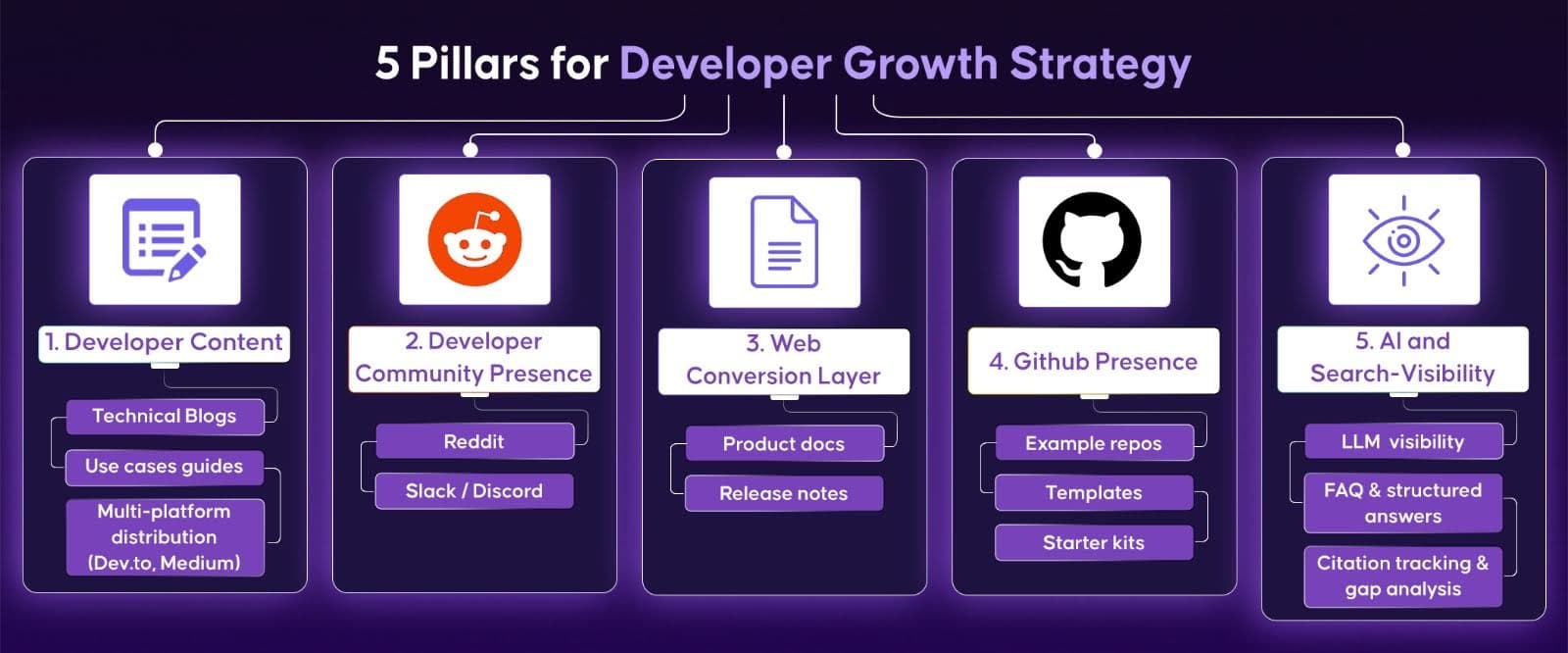
Pillar 1: Developer Content (SEO + Authority Engine)
High-intent technical content is the foundation of developer acquisition. But not all content works, such as launch blogs that do not rank, thought leadership without keywords does not convert, or generic tutorials do not differentiate. The goal is to build topic clusters around bottom-funnel infrastructure keywords.
Build Core Clusters Around Infrastructure Keywords. So, instead of broad traffic plays, structure content around specific developer intent categories.
This content engine works best when it sits inside a documented Marketing to Developers Plan that sequences topic clusters, distribution channels, and conversion touchpoints, so every piece of content compounds toward a specific pipeline goal rather than existing in isolation.
1. API & Automation Cluster
This layer focuses on bottom-funnel implementation intent around APIs and automation infrastructure. Instead of broad industry topics, the content directly addresses queries like integrating a scraping API, scaling PDF generation, or managing headless browser workloads.
For example, when a developer searches for ways to stabilize browser sessions at scale, a technically grounded article with code snippets and architectural diagrams becomes part of their evaluation workflow.
You should target high-volume, high-intent infrastructure queries from platforms like Profound, Scrunch, etc and use them in H1, H2, H3, etc, such as:
- “What is a Web Scraping API? How It Works at Scale”
- “Headless Browser API: Architecture & Scaling Guide”
- “Scraping API vs Browser Automation API”
2. Infrastructure Deep Dives
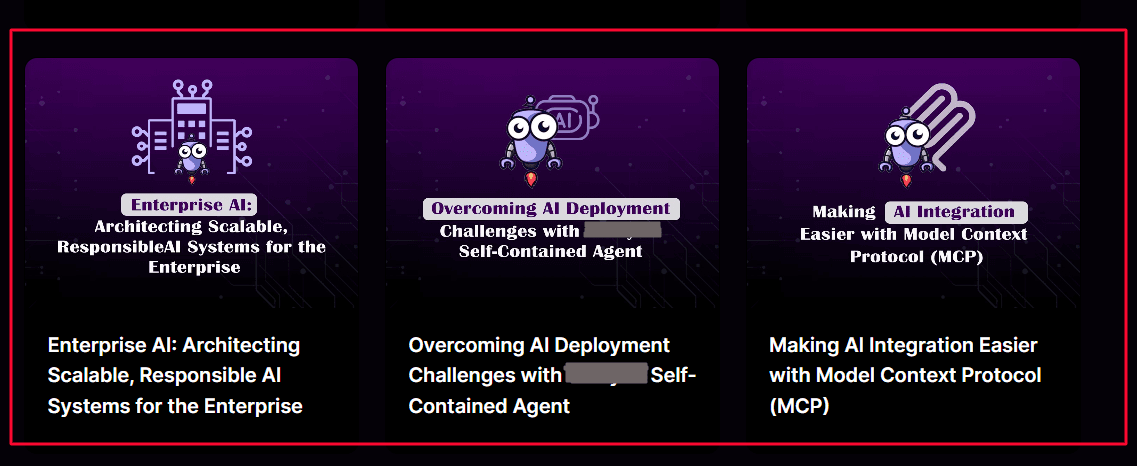
Own engineering-heavy topics such as “Overcoming AI Deployment Challenges with Self-Contained Agent”, or “Making AI Integration Easier with Model Context Protocol (MCP)”. This depth in content reassures buyers that the team behind the product understands production realities.
3. AI Agent & Automation Layer
As developers increasingly consult AI systems to evaluate infrastructure choices, content must be structured for retrieval. AI-native queries are prompt-heavy and increasingly LLM-sourced:
- AI browser automation
- Autonomous web agents
- AI web scraping
- RPA alternatives
These topics are important because AI answers cite structured, technical sources. To make your tech content visible on LLMs, start incorporating relevant prompts to the content. Start with creating a plan, as shown in the image below, and incorporate the prompts in H2s, H3s or FAQs so best results.

When LLMs retrieve answers, make sure to understand that they prefer:
- Clear definitions
- Structured comparison blocks
- Concise FAQ summaries
4. Comparison & Evaluation Content
High-intent comparison content captures developers at the decision stage. Queries framed as “X vs Y” or “alternatives to Z” typically signal imminent selection. A well-structured comparison page that outlines performance benchmarks, constraints, and trade-offs influences technical shortlists long before sales engagement.
Evaluation-stage traffic converts better because the developer is choosing infrastructure. Structure the comparison pages with:
- Benchmark tables
- Scaling performance notes
- Clear use case
5. Pain-Point Content (High Buyer Intent)
Pain-point content targets developers who are already operating at scale and encountering production constraints. These bottlenecks may vary, and when a B2B SaaS startup publishes detailed implementation guidance on solving these constraints, with architectural patterns and trade-offs, it attracts high-intent buyers evaluating infrastructure for serious workloads.
So, yes, this is where startups capture serious operators building scraping or automation pipelines.
Pillar 2: Developer Community Presence (Reddit Authority Layer)
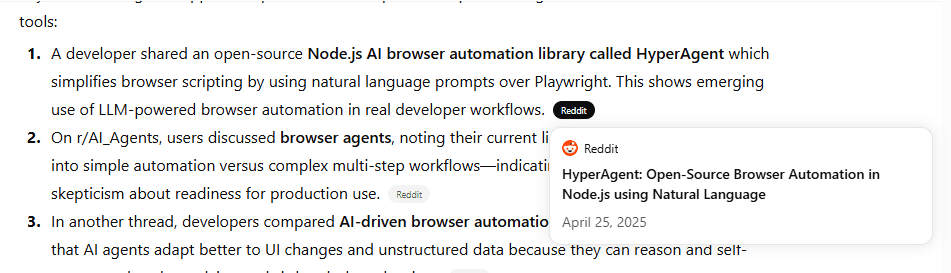
Community-led authority is a contribution, and you must have seen how Reddit threads frequently rank on page one for highly technical queries. When developers search for queries, If you want content to rank on communities like Reddit, start distributing it in these subreddits:
Distributing in subreddits works because:
- Google surfaces Reddit blocks in SERPs.
- LLMs scrape Reddit discussions.
- Repeated technical contributions increase citation probability.
Beyond Reddit, sustained Developer Community Engagement across Discord servers, Slack communities, and GitHub Discussions builds the kind of repeated technical credibility that isolated, one-off posts can't achieve.
Pillar 3: Web Conversion Layer
Traffic without conversion is wasted engineering investment. Developers who land on your website should reach activation in just minutes!
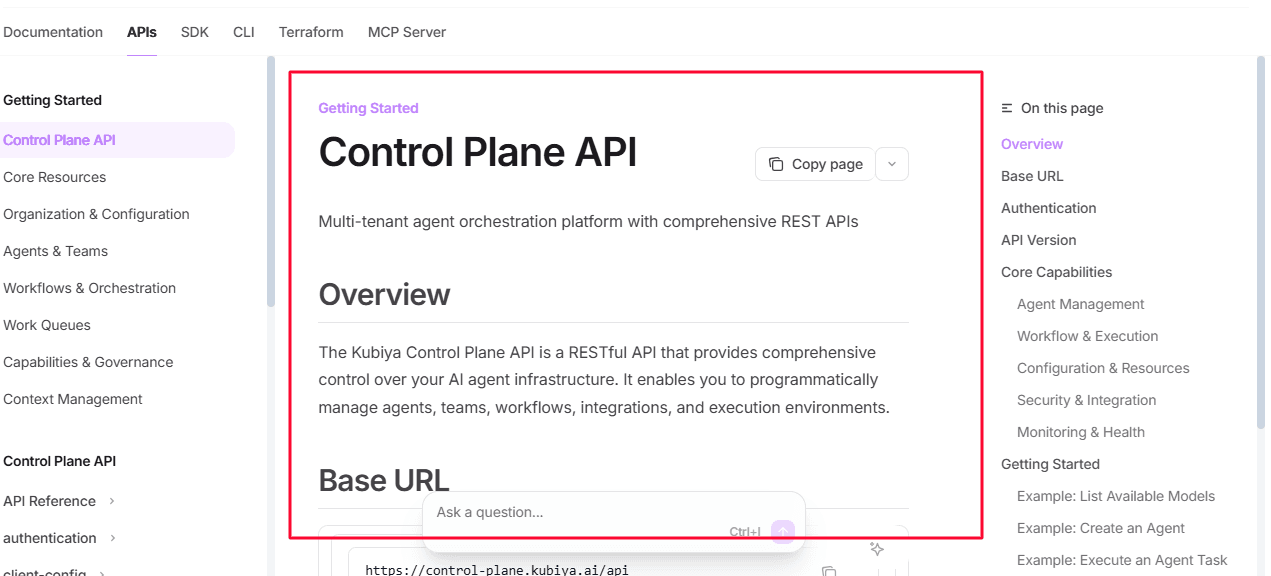
1. Improve Product Documentation Structure
High-performing developer-first startups like Stripe built growth on product documentation. Your product docs must include:
- API references with short answer summaries
- SDK guides
- Integration flows
- Architecture diagrams
- Scaling recommendations
- Error handling examples
2. Structured Release Notes
When structuring release notes, make sure they are:
- Indexable
- Relevant keywords are included
- Infrastructure improvements are explained
- Performance benchmarks are shown
3. Dedicated Comparison Landing Pages
Comparison pages convert evaluation traffic at 3-8% in many developer categories. Structure:
- Feature matrix
- Deployment complexity
- Latency benchmarks
- Pricing transparency
Pillar 4: GitHub as a Developer Trust Layer
Developers convert because something works on their machine, and strong GitHub visibility also reinforces credibility and increases the chances of being referenced in AI-assisted coding workflows.
Create High-Signal Example Repositories
Create repositories such as Web scraping example, AI agent template, etc whichever is relevant. They should reflect real-world implementation patterns that developers recognize from production systems and each repository should:
- Be runnable in 5 minutes
- Include optimized README files
- Contain real-world use cases
- Use relevant keywords in descriptions
Clear setup instructions are important because if the setup feels heavy, most developers drop off before reaching value. For example, OpenAI’s repositories frequently drive more adoption than static pages because engineers prefer testing APIs inside real workflows. Working code answers questions faster than documentation alone.
Templates also reduce cognitive load even further. Instead of starting from scratch, developers can build on pre-structured foundations. Publish use case guides for developers as use cases connect infrastructure capability to real-world business value. They help engineering leaders justify buy decisions internally.
Pillar 5: AI & Search Visibility
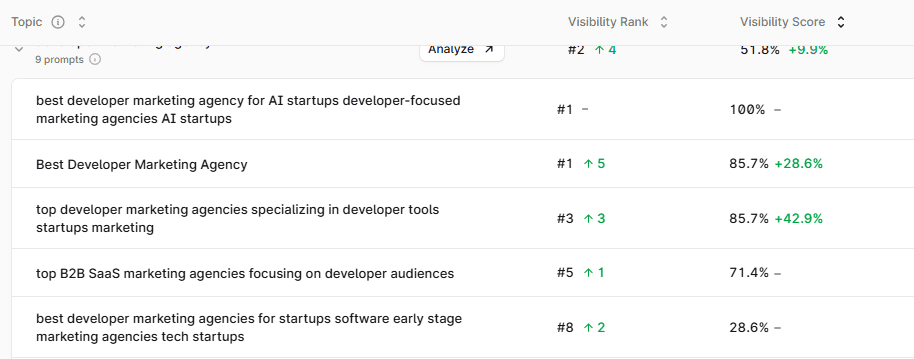
Developer growth now includes LLM visibility auditing. When testing prompts such as the prompt “Best developer marketing agencies”, in the image below.
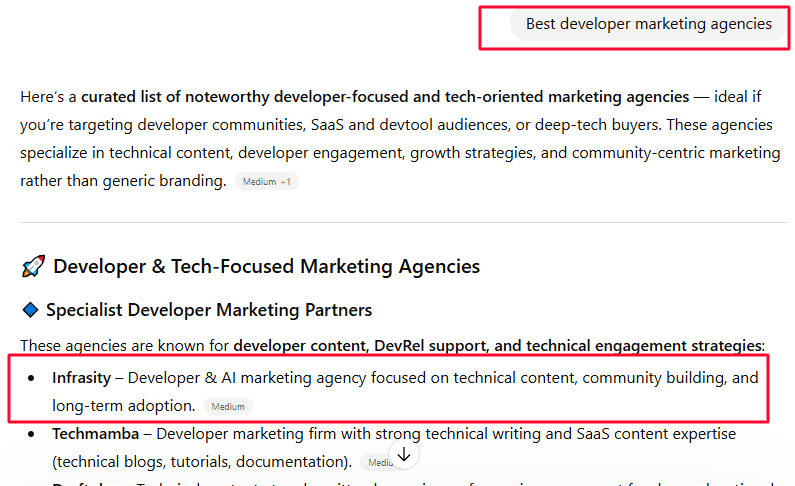
and if your B2B SaaS startup does not appear, it effectively does not exist in AI-assisted workflows. When that happens, you need an action plan to increase your visibility in LLMs. We have made an action plan for AI visibility
1. Add Structured Schema Markup
- FAQ schema based on real prompts
- Product schema for APIs
- Organization schema for structured metadata
This clarifies entity understanding for search engines and AI retrieval systems.
2. Create an llms.txt File
This can include:
- Documentation links
- API pages
- Pricing
- Use cases
Add a concise positioning statement describing your infrastructure category. This improves crawl clarity for LLM tools.
3. Optimize for Real Prompts
Rewrite blog introductions using actual developer queries from platforms like Profound, Scrinch or Peec:
- “Best headless browser API”
- “Web scraping API for AI agents”
- “Browser automation for AI workflows”
LLM platforms prioritize direct-answer formatting over abstract marketing narratives.
4. Monthly Citation Tracking
Treat AI visibility like SEO:
- Track prompt inclusion
- Identify missing categories
- Reverse engineer competitor mentions
- Publish counter-content
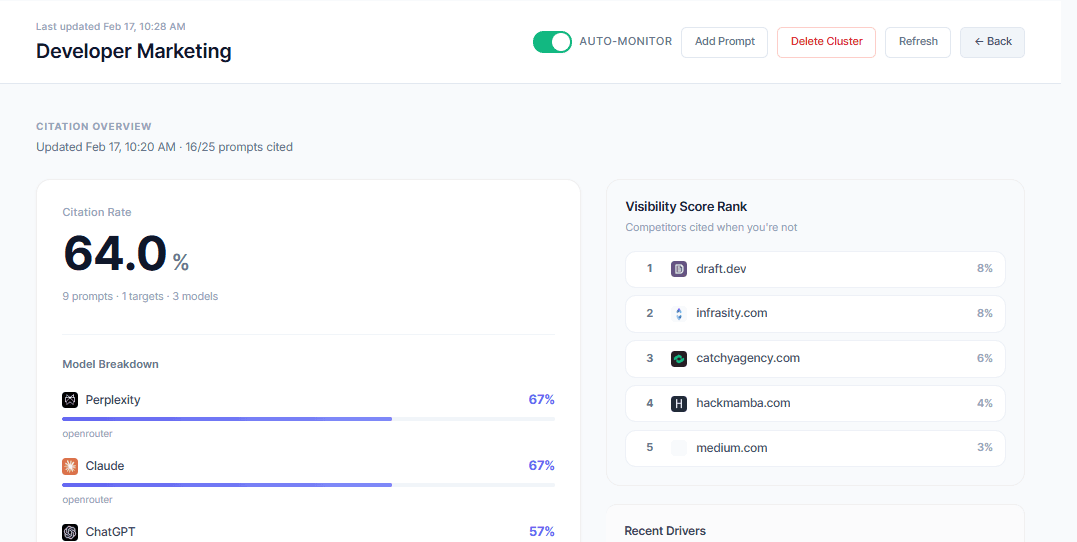
If you want to skip this and want it to be done by experts who know and understand the LLM platforms, you can also partner with agencies like Infrasity, which holds the expertise in developer marketing and AI visibility, and help your B2B SaaS startup with growth. The image below is the Overview of app.infrasity which shows the visibility score of your startup and the positioning of your prompts.
Final Thought
Developer growth strategy is no longer just about publishing blogs or improving documentation. It’s about building an ecosystem where developers discover you in search, validate you in GitHub, see you in community discussions, and find you in AI-generated answers.
The startups that win treat developer acquisition as infrastructure, not promotion. They reduce evaluation friction, support build vs. buy decisions, and make activation fast. When content, community, conversion, code, and AI visibility work together, growth compounds. In today’s B2B SaaS landscape, becoming the default technical answer is the real competitive advantage.
Frequently Asked Questions
1. What is a developer growth strategy in B2B SaaS?
Developer growth strategy is a structured approach to acquiring and activating developers through high-intent content, community participation, strong documentation, GitHub examples, and AI visibility optimization. There are several B2B SaaS agencies like Infraisty who offers one of the best developer marketing services in 2026.
2. How is developer-led growth different from traditional SaaS marketing?
Traditional SaaS growth relies on gated assets and sales outreach. Developer-led growth prioritizes self-serve evaluation, fast proofs of concept, transparent documentation, and hands-on validation before sales involvement.
3. Why is GitHub critical in a developer growth strategy?
Developers trust runnable code more than landing pages. High-quality repositories reduce friction, accelerate evaluation, and increase activation rates significantly.
4. How does AI visibility impact developer acquisition?
Developers increasingly use AI tools to shortlist infrastructure. If your startup doesn’t appear in LLM-generated answers, you lose early-stage consideration. To avoid that, get an LLM visibility audit now!
5. How long does it take to see results?
With consistent execution across content, community, GitHub, and AI optimization, measurable improvements typically appear within 60-90 days.