How to Know Who's Getting Cited Instead of You
Track exactly who's winning the citations you're not, prompt by prompt, over Content Hub MCP, instead of manually comparing domains one at a time.
Knowing your own citation rate is only half the picture. The more useful question is usually who is winning the citations you're not getting, on which specific prompts, and whether that's getting better or worse over time. Once Claude Desktop is connected to Infrasity's Content Hub via MCP, you can pull all of that in one conversation instead of manually comparing domains prompt by prompt.
Before you start, make sure:
- A GEO cluster exists with prompts added to it
- The cluster has enough runs completed to have real evaluation data to compare against
Here's the full flow, from a cluster overview down to a prioritized list of what to do about it.
Fetch the cluster overview and spot the weak points
Start broad, and name the tool explicitly if you want Claude to use it, for example:
"can you fetch the detailed data about developer marketing agency cluster for infrasity org using content hub mcp"
Claude works out what it needs (the company ID, then the cluster) before running anything, then returns a summary: Infrasity gets cited across most prompts and holds the #1 rank on the vast majority of them, with standout showings like "best developer marketing agency for AI startups" at 88% citation and 15% share of voice. It also names the biggest recurring competitors popping up across the cluster: hackmamba.io, draft.dev, catchyagency.com, devmarklab.com, dev.to, and business.daily.dev.
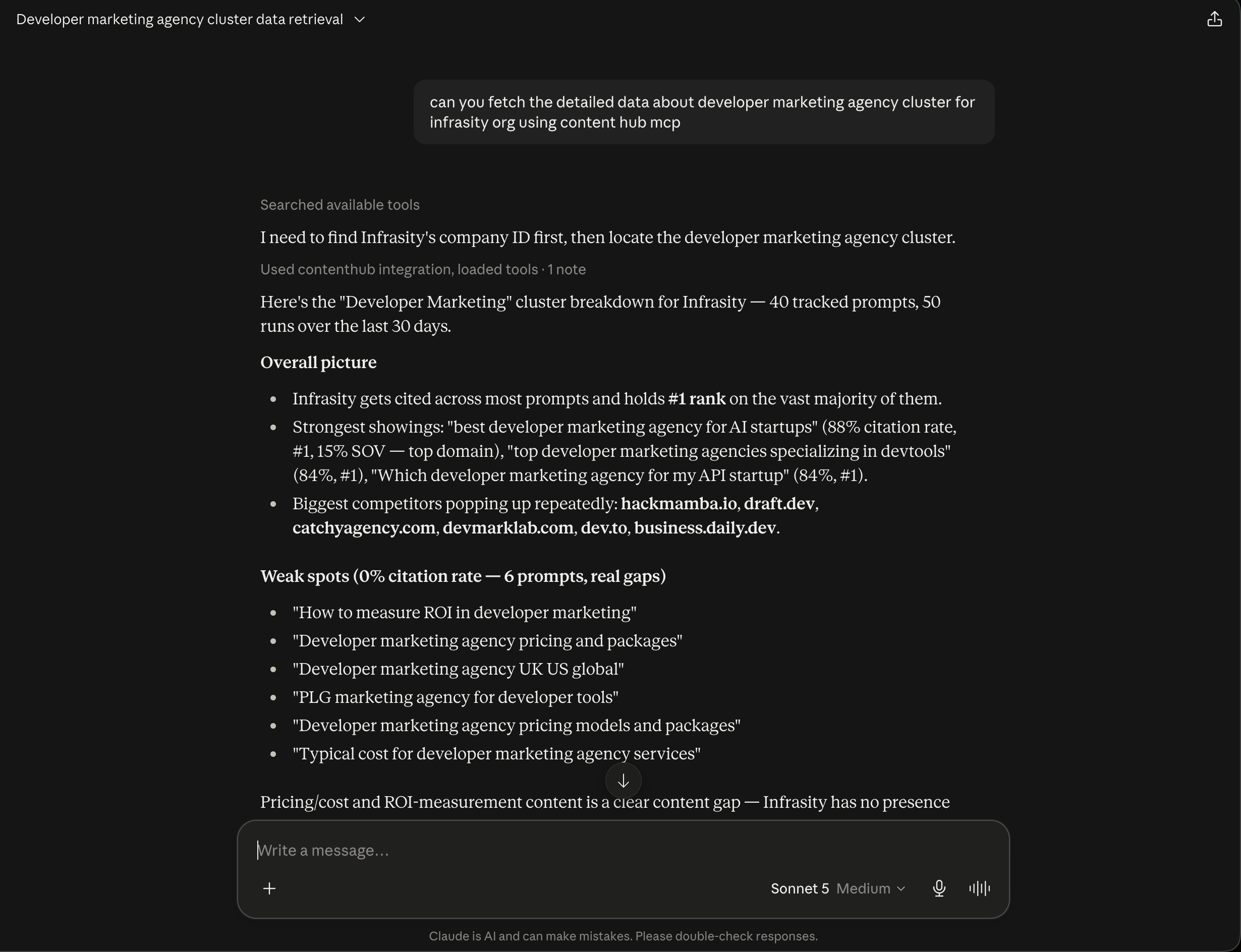
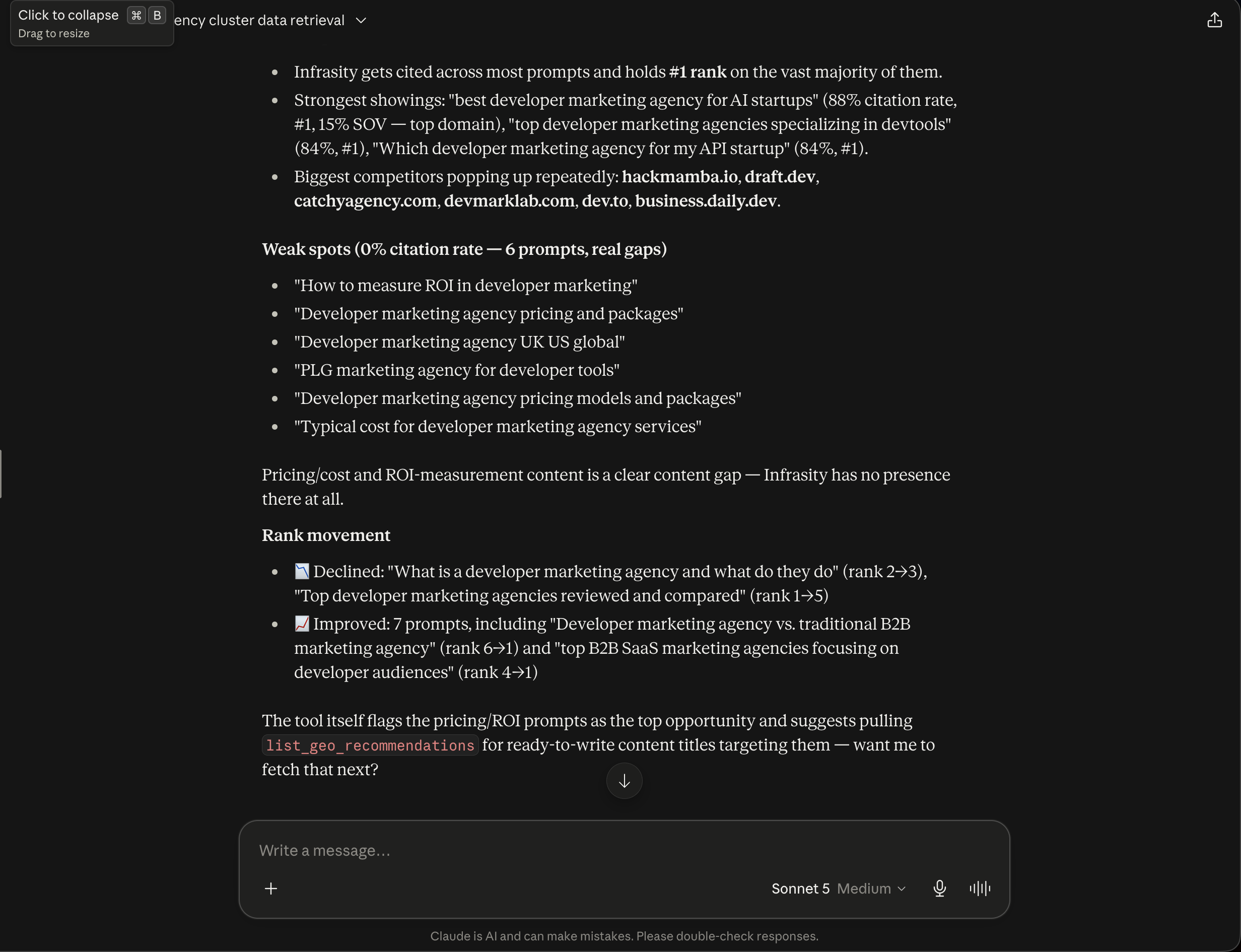
It names the weak spots directly: 6 prompts sitting at 0% citation rate, listed individually rather than just a count, things like "How to measure ROI in developer marketing" and "Developer marketing agency pricing and packages," a real content gap rather than noise. It closes with a short rank-movement summary, pointing at the pricing and ROI prompts as the top opportunity before you even ask for analysis.
Get the full win/loss breakdown, prompt by prompt
The overview tells you the shape of the problem. To see exactly who's winning each prompt you're not, ask for the detailed breakdown, for example:
"now give me in detail data about where Infrasity wins and loses citations, to which Models and which prompt and other in detail data for this cluster"
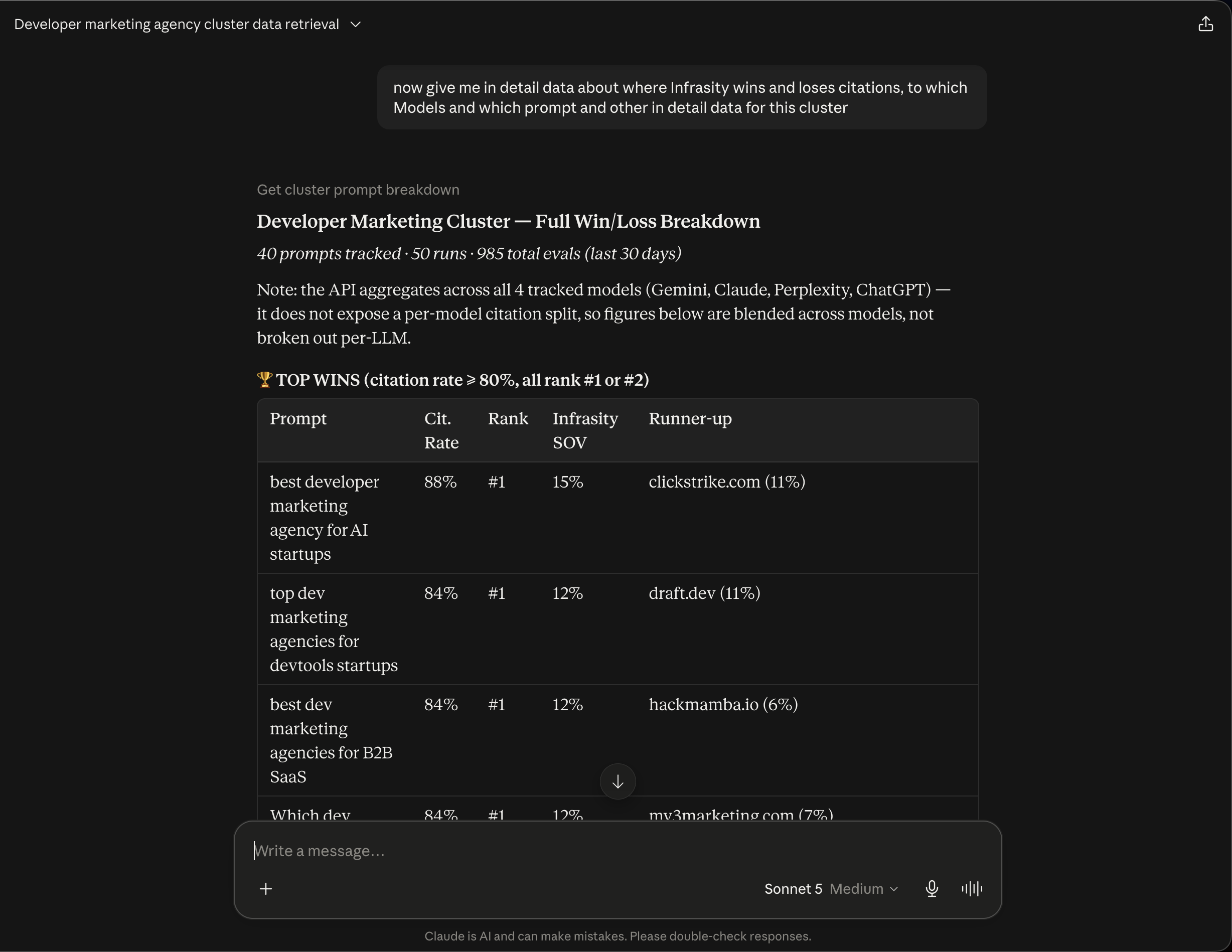
Claude is upfront that the underlying API aggregates across all four tracked models (Gemini, Claude, Perplexity, ChatGPT) rather than exposing a per-model split, so every figure that follows is blended across engines, not broken out per-LLM. It then returns a top wins table: prompts at 80% citation rate or higher, all rank #1 or #2, each paired with the exact runner-up domain and its share of voice, for example "best developer marketing agency for AI startups" at 88% citation with Infrasity holding 15% share of voice against a runner-up at 11%, and several "devtools" and "API startup" prompts sitting at 84% citation with 12% share of voice apiece.
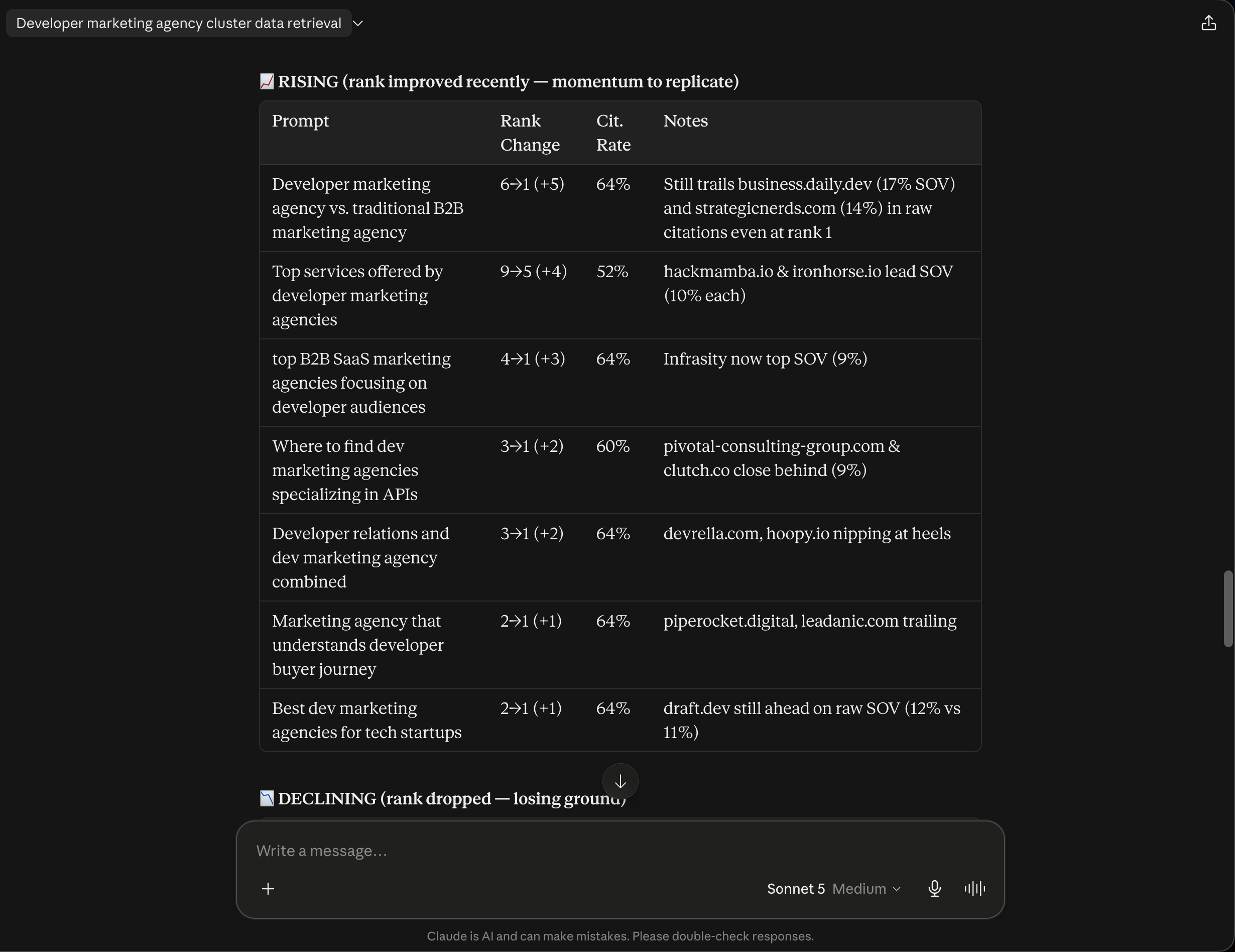
It then shows the prompts that recently improved in rank, each with the exact shift, current citation rate, and a note on who's still ahead even after the gain, for example a prompt that jumped from rank 6 to rank 1 but still trails two named competitors on raw citation share, a reminder that a rank win and a share-of-voice win aren't always the same thing.
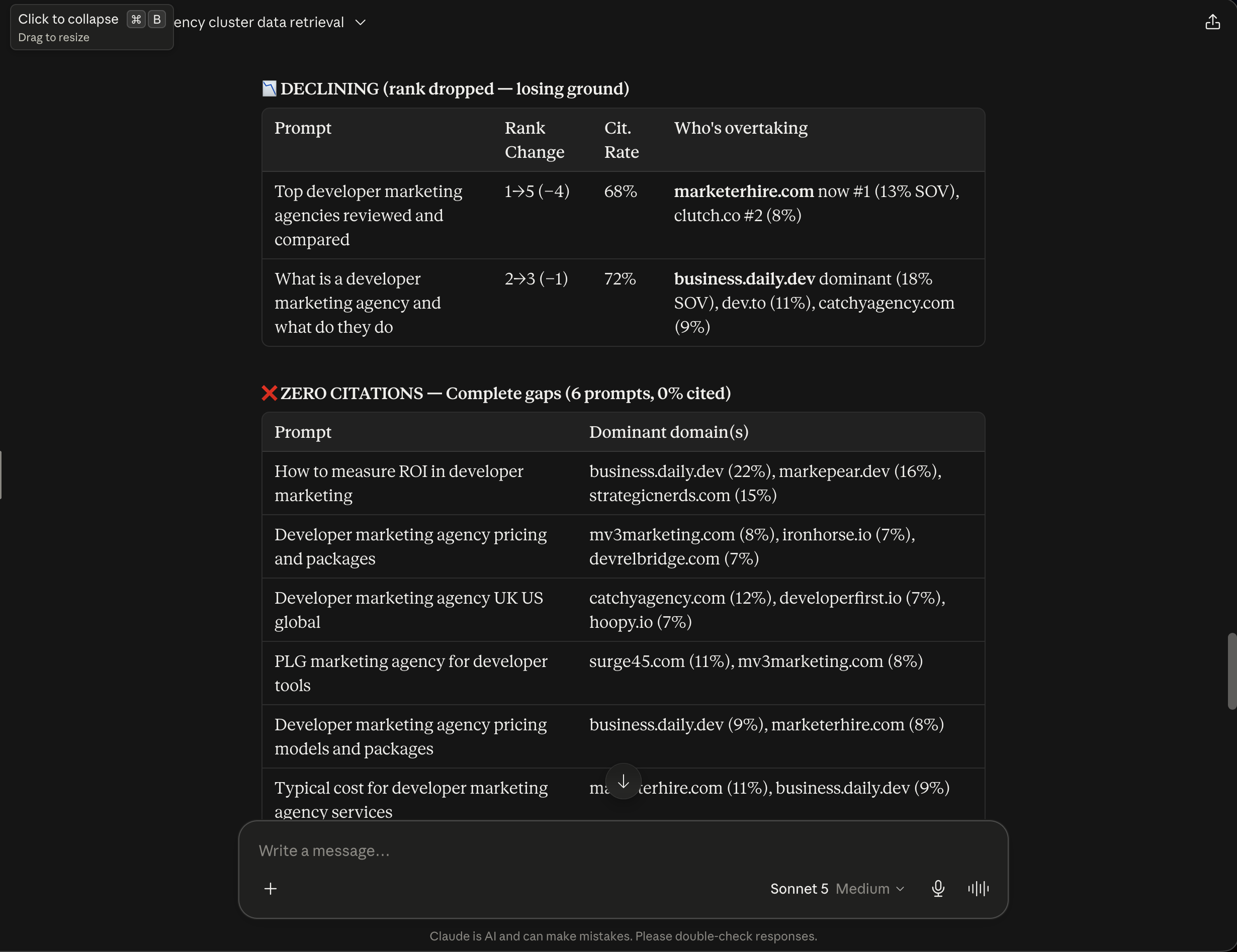
The mirror image comes next: prompts that declined, with the exact rank change, citation rate, and who's overtaking each one named directly, this is where a real, specific threat becomes visible instead of staying buried in a cluster-wide average. It's followed by the complete zero-citation table, pairing each gap with the domains actually dominating it, so a content gap isn't just "no one's citing us," it's "here's exactly who is, and what share they hold."
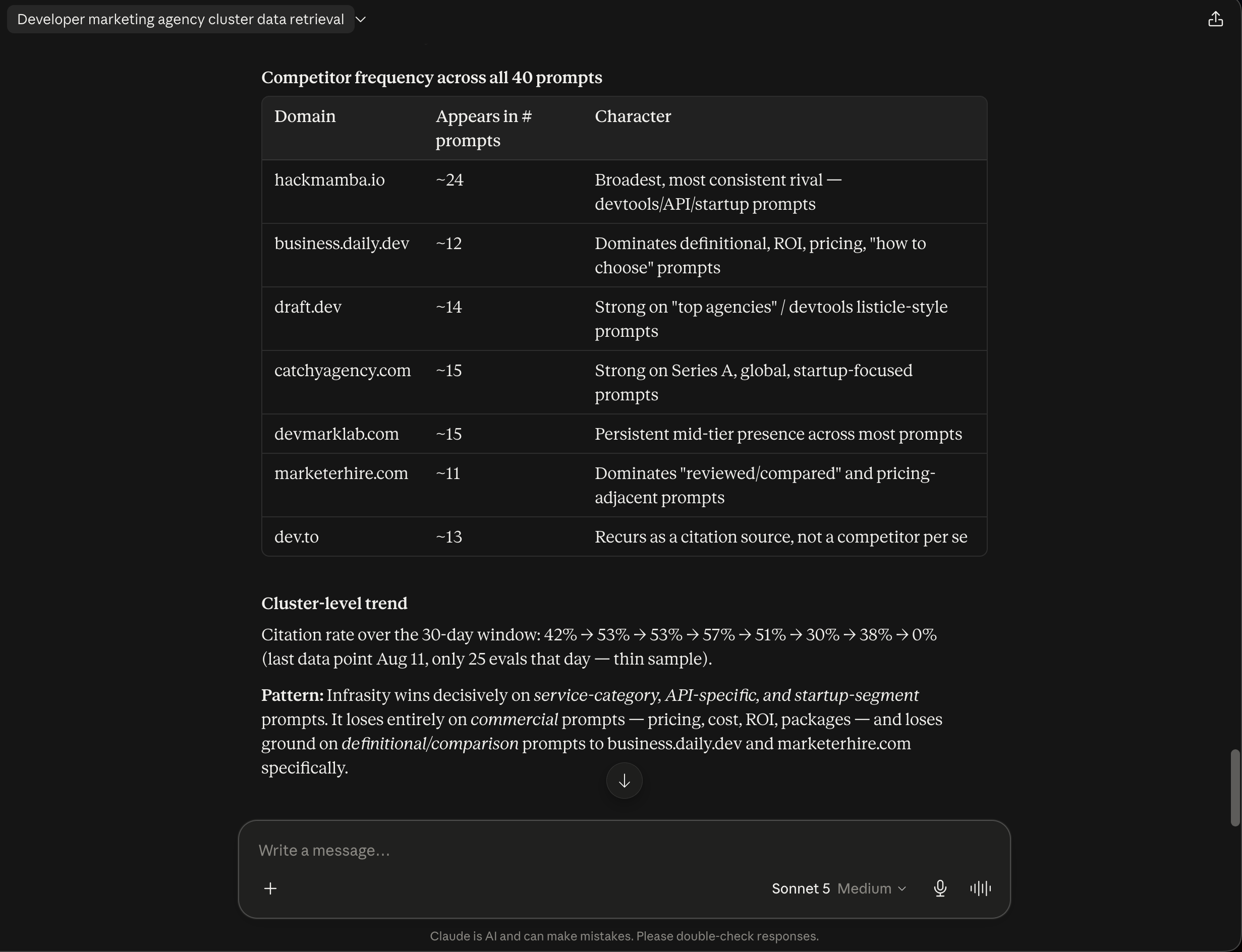
Claude closes by zooming out: a competitor frequency table ranking every recurring domain by how many of the 40 prompts it appears in, with a one-line read on each competitor's character, for example one domain that dominates definitional and "how to choose" prompts specifically, versus another that's strong on startup and Series A-focused prompts instead. It finishes with the cluster's citation-rate trend over the full 30-day window, and a direct statement of the pattern: Infrasity wins decisively on service-category, API-specific, and startup-segment prompts, loses entirely on commercial prompts like pricing, cost, ROI, and packages, and is losing ground on definitional and comparison prompts to those same two named competitors.
Ask for takeaways
With the full win/loss picture already in the conversation, ask Claude to turn it into something actionable, for example:
"okay according to this data give me takeaways"
Claude returns a numbered list, each one a genuine insight rather than a repeated statistic. It opens by naming the split directly: Infrasity dominates intent-specific searches (often ranking #1 with double-digit share of voice on "best agency for X type of startup" prompts) but is invisible on commercial ones, every prompt touching pricing, cost, packages, or ROI sits at 0% citation, which it frames as a content-existence problem rather than a ranking problem, there's likely no page on infrasity.com that discusses pricing or ROI at all, so models have nothing to cite. It then names the two domains actually worth treating as priority competitors: one that functions as the default explainer and directory source models reach for on definitional and "how to choose" prompts, and one that just overtook Infrasity on a prompt it held a cycle ago, distinct from the smaller sites that only pick up a few percentage points of share of voice here and there.
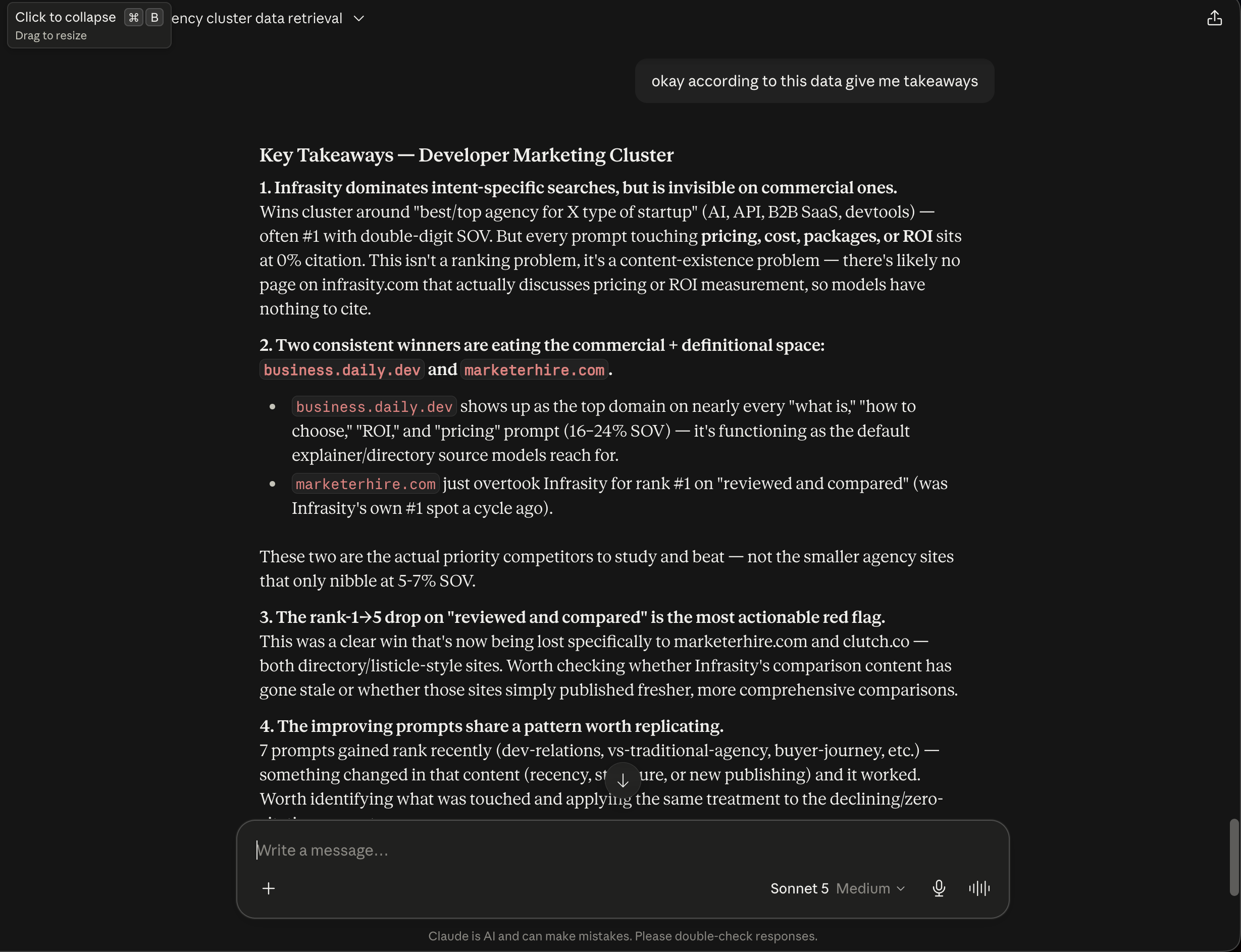
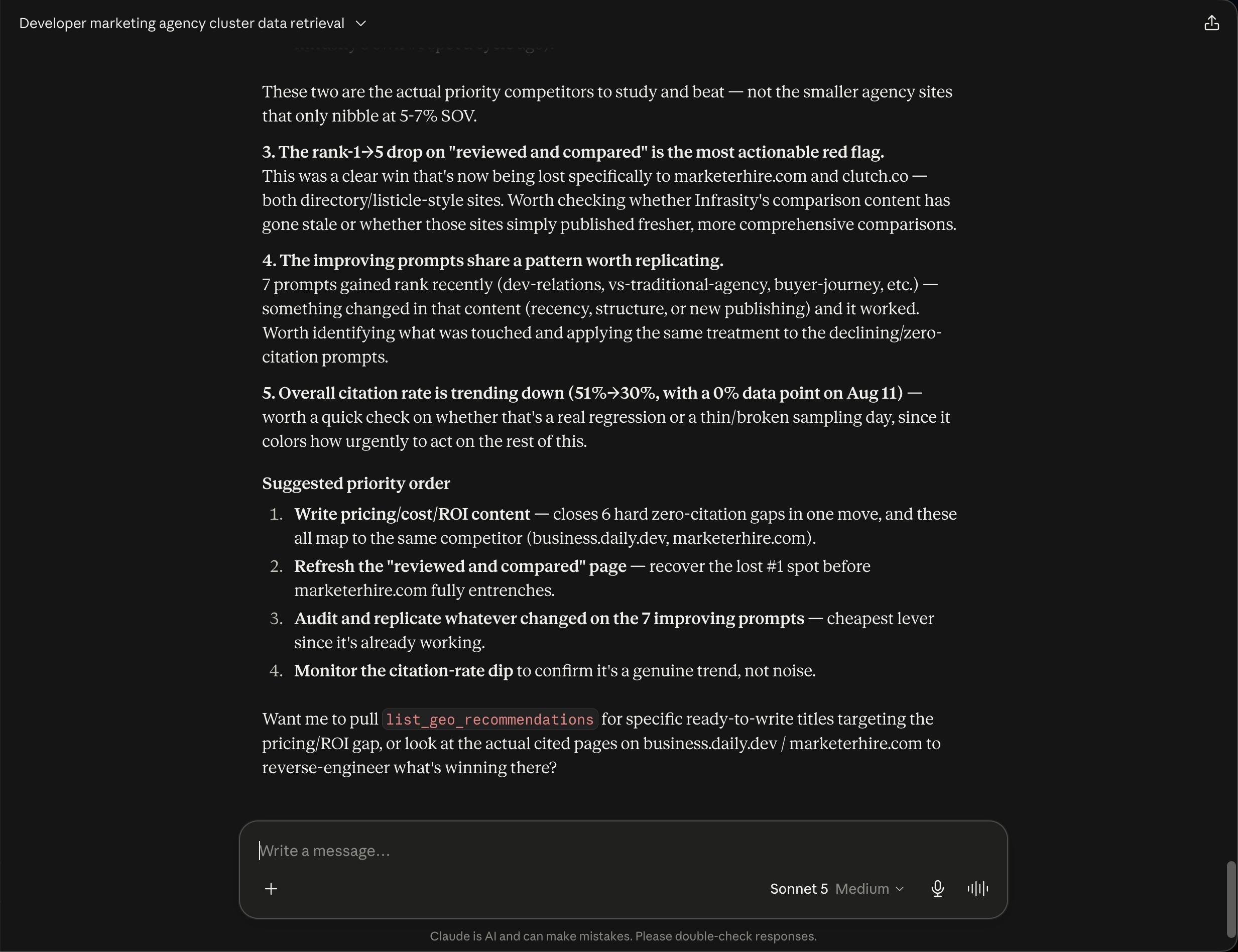
It closes with the rest of the takeaways: the specific rank drop as the most actionable red flag, worth checking whether Infrasity's own comparison content has gone stale or a competitor simply published something fresher; a pattern behind the improving prompts (something specific changed in that content and worked) worth identifying and replicating on the declining and zero-citation prompts; and the overall citation-rate trend flagged as worth a sanity check, since a late drop could be a genuine regression or just a thin sampling day, and that distinction changes how urgently to react. It ends with a suggested priority order (write the pricing and ROI content first since it closes the most gaps in one move, refresh the page losing its top rank, audit and replicate what's working on the improving prompts, then monitor the citation-rate dip to confirm it's real) and an offer to keep going.
A cluster overview turns into a full win/loss breakdown and a prioritized action list, all inside one Claude Desktop conversation, with every competitor threat traceable back to a specific prompt and rank.
Head to app.infrasity.com and pull up your own cluster's win/loss breakdown to see exactly which competitors are beating you, and where.
How to Turn GEO Audits Into a Content Backlog
Cross-reference a GEO cluster against your published content over Content Hub MCP, and turn the underperforming prompts into a prioritized content backlog.
How the Sprint Analytics Report Works: Fixes, Themes, and What Worked
Turn a raw month of sprint analytics into a structured performance review over Content Hub MCP, complete with what's working, what needs fixing, and the recurring content themes.