How to Turn GEO Audits Into a Content Backlog
Cross-reference a GEO cluster against your published content over Content Hub MCP, and turn the underperforming prompts into a prioritized content backlog.
A GEO cluster on its own tells you how you're performing. What it doesn't tell you automatically is what to actually go write next. A content gap is a prompt your cluster tracks that has no page behind it at all, or the wrong page for the job, the specific, actionable difference between a citation report and a backlog. Once Claude Desktop is connected to Infrasity's Content Hub via MCP, you can close that loop in one conversation: pull the cluster data, cross-reference it against what's already published, isolate what's underperforming, and end with a prioritized, ready-to-action content backlog, not just a citation report.
Before you start, make sure:
- A GEO cluster exists with prompts added to it
- The cluster has a few runs completed, so there's real citation data
- Your sprints have published topics with real URLs, so Claude has something to match citations against
Here's the full flow.
Fetch the GEO cluster and match it against published content
Ask for the cluster and your sprint content together, and be specific about what you want compared, for example:
"can you fetch the details of geo cluster developer marketing and the sprints data for infrasity org and compare the urls for both, if the page is being cited"
Claude returns a single table linking each top prompt to the specific published page behind it: prompt, citation rate, rank, and the best-matching URL, so you can see exactly which piece of content is earning each citation. For example, "top developer marketing agencies specializing in developer tools" sits at 78% citation and rank #1, traced back to a specific comparison-post family rather than a generic landing page.
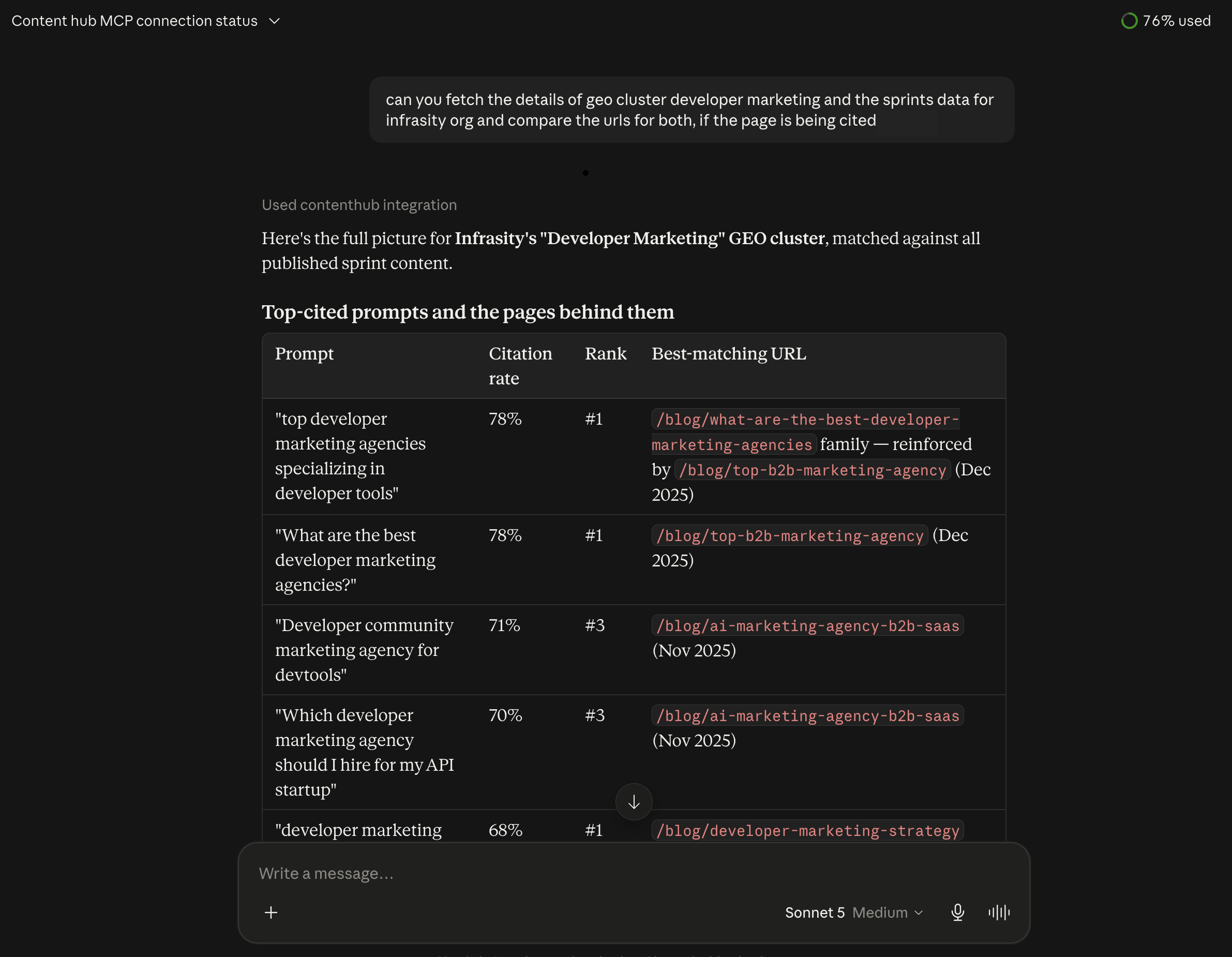
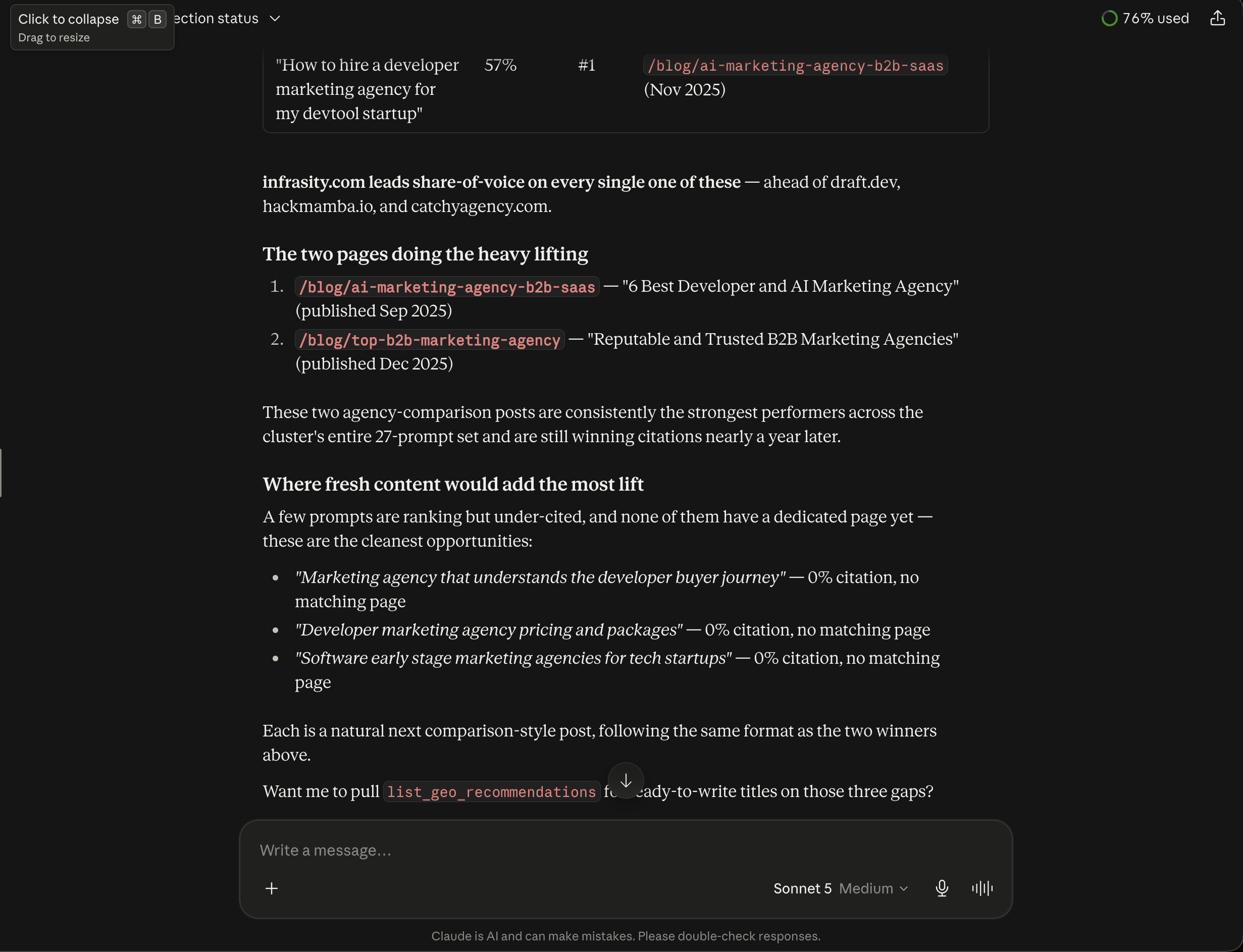
It names the pattern directly: infrasity.com leads share of voice on every one of these prompts, ahead of the same handful of recurring competitor domains. It then calls out the two specific pages doing most of the heavy lifting across the entire prompt set, agency-comparison posts that are still winning citations nearly a year after publishing, evidence that this content type has staying power rather than needing constant refreshes. It closes with a short list of prompts that are clearly relevant to the cluster but have no dedicated page behind them at all yet, each one a specific, nameable gap rather than a vague "write more content" suggestion.
Compare the underperforming prompts
With the winners established, ask Claude to flip the lens and look at what's not working, for example:
"okay now compare other prompts and pages in the same cluster which didnt perform as well as these"
Claude returns every underperforming prompt paired with the page most likely meant to serve it (or a note that no such page exists), including citation rate, rank, and trend direction, for example a pricing-related prompt sitting at 0% citation with no dedicated page at all, or a previously strong prompt that's fallen from rank #1 to #6 as a competitor caught up.
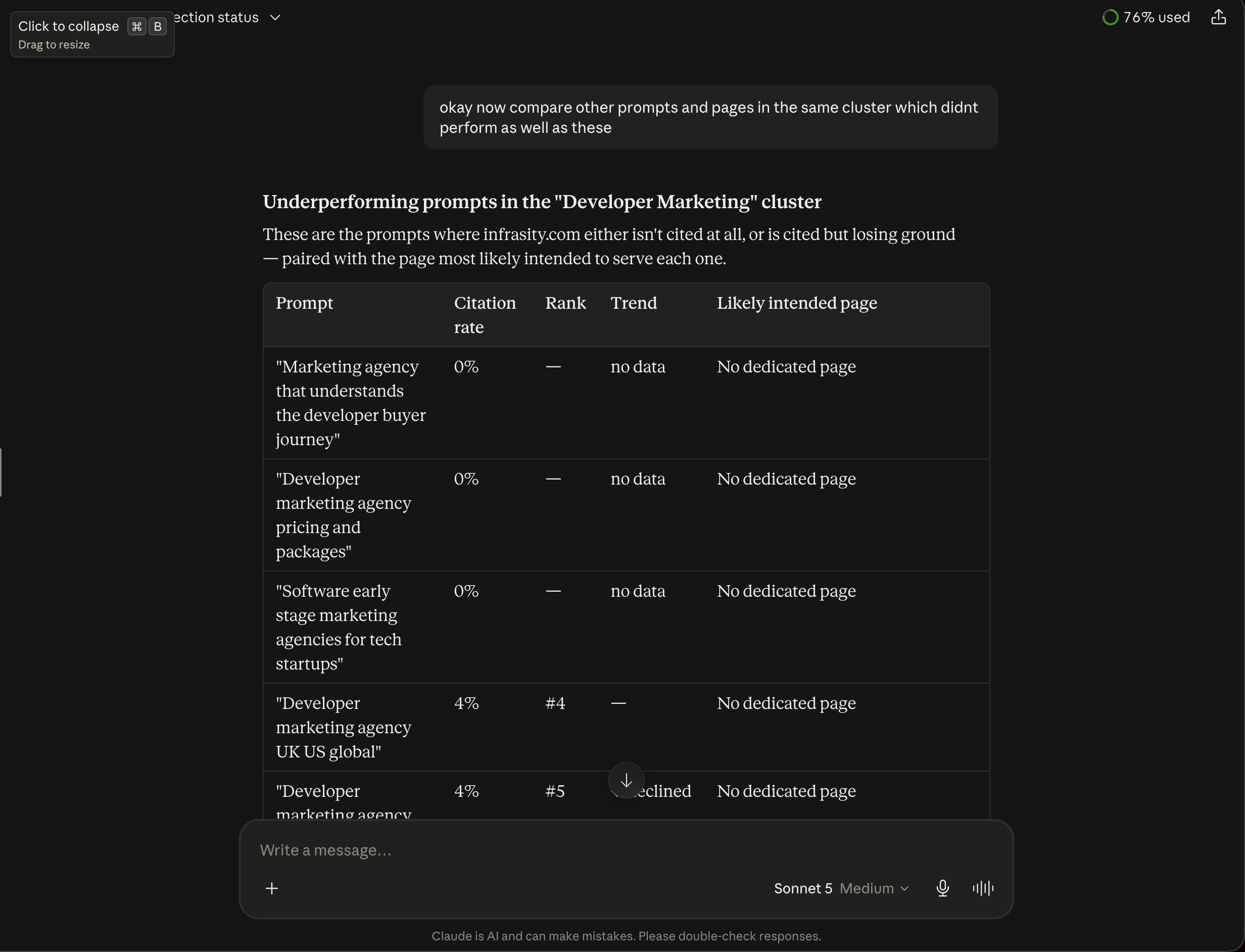
It then explains, in plain terms, why each group is underperforming rather than just listing numbers:
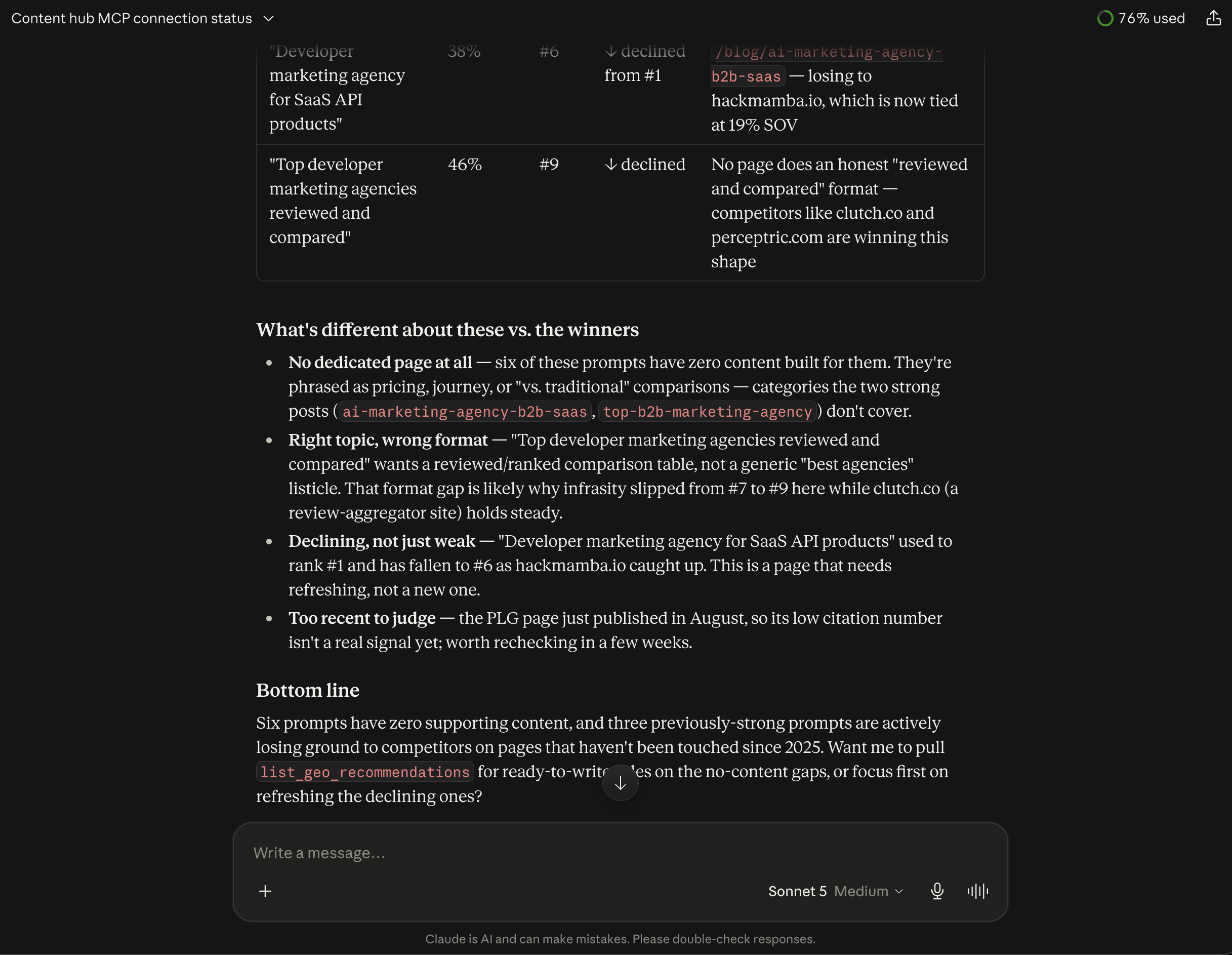
- No dedicated page at all. Several prompts have zero content built for them, phrased as pricing, buyer-journey, or "vs. traditional" comparisons, categories the strongest existing posts simply don't cover.
- Right topic, wrong format. One prompt wants a reviewed, ranked comparison table, not a generic "best agencies" listicle, and that format mismatch is the likely reason a review-aggregator competitor is holding steady while Infrasity slips.
- Declining, not just weak. A page that used to rank #1 has fallen several spots as a specific competitor caught up, flagged as needing a refresh rather than a brand-new page.
- Too recent to judge. A newly published page's low citation count is flagged explicitly as not yet a real signal, worth rechecking in a few weeks rather than acting on now.
It closes with the bottom line: several prompts have zero supporting content at all, and a handful of previously strong ones are actively losing ground to competitors on pages that haven't been touched in months.
Turn the analysis into a content-gap recommendation
Ask Claude to convert everything gathered so far into an actual recommendation, for example:
"Based on these analysis give me a Content-Gap Recommendation"
Claude tries the purpose-built recommendations tool first, and says so directly when its results don't actually match the gaps just found, building the recommendation from the analysis already in the conversation instead.
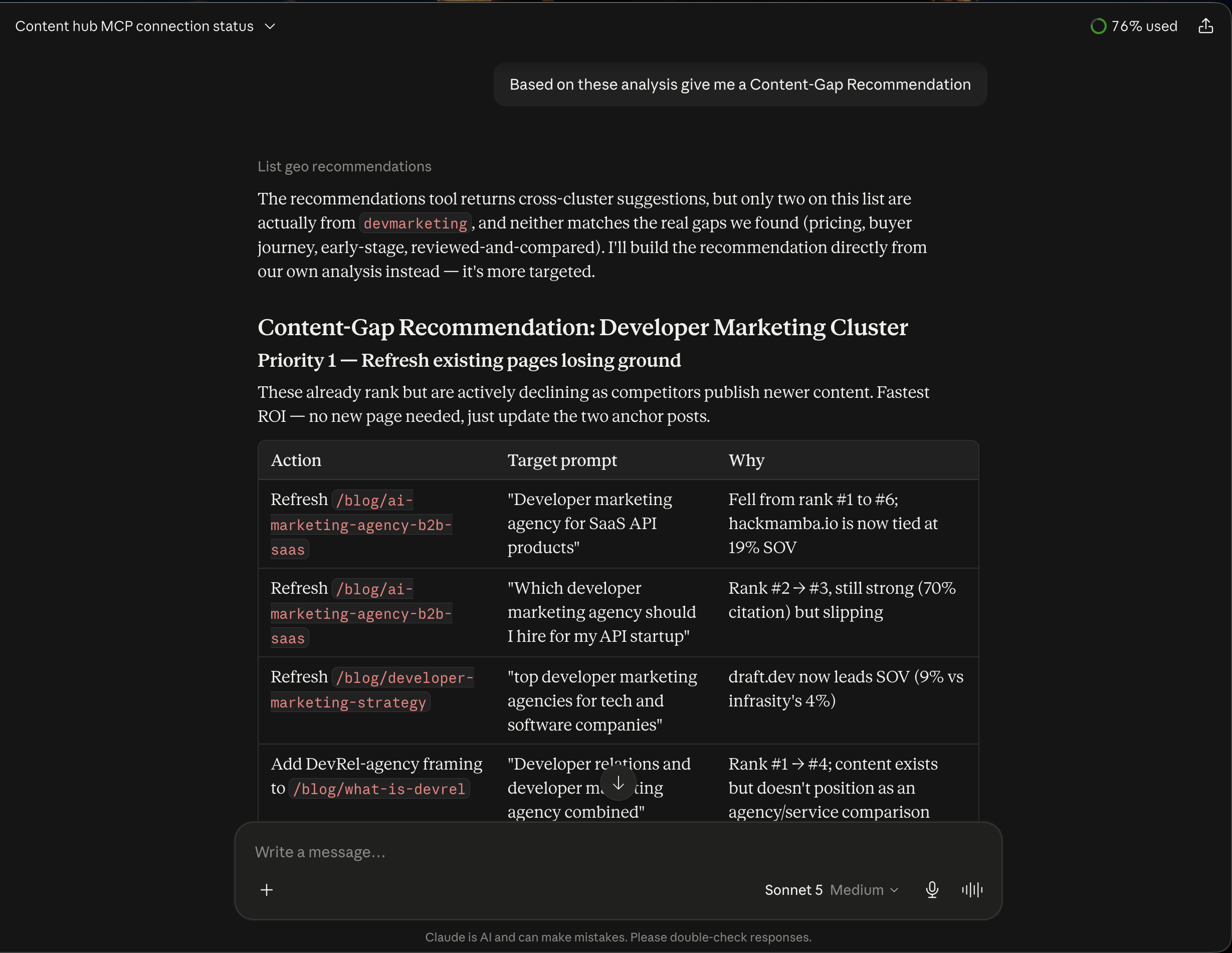
It returns a backlog split into three tiers:
- Priority 1, refresh existing pages losing ground. Framed explicitly as the fastest win since no new page is needed, just an update. A table lists the specific page to refresh, the prompt it's meant to defend, and exactly why it needs attention, for example a page that fell from rank #1 to #6 as a named competitor tied it on share of voice.
- Priority 2, one new page for the highest-value gap. A single new page recommendation, with the target prompt, an explanation of why the existing content format won't work for it (a listicle can't beat a review-aggregator competitor at its own game, a structured comparison table can), and a ready-to-use suggested title.
- Priority 3, new pages for the zero-citation prompts. The cleanest opportunities since literally no content exists for them yet, each paired with a specific suggested title, ready to hand to a writer.
It finishes with a suggested sprint sequencing, ordering the priorities into an actual plan, tackling the cheap, fast-impact refreshes first to defend existing rankings before they erode further, then the new pages.
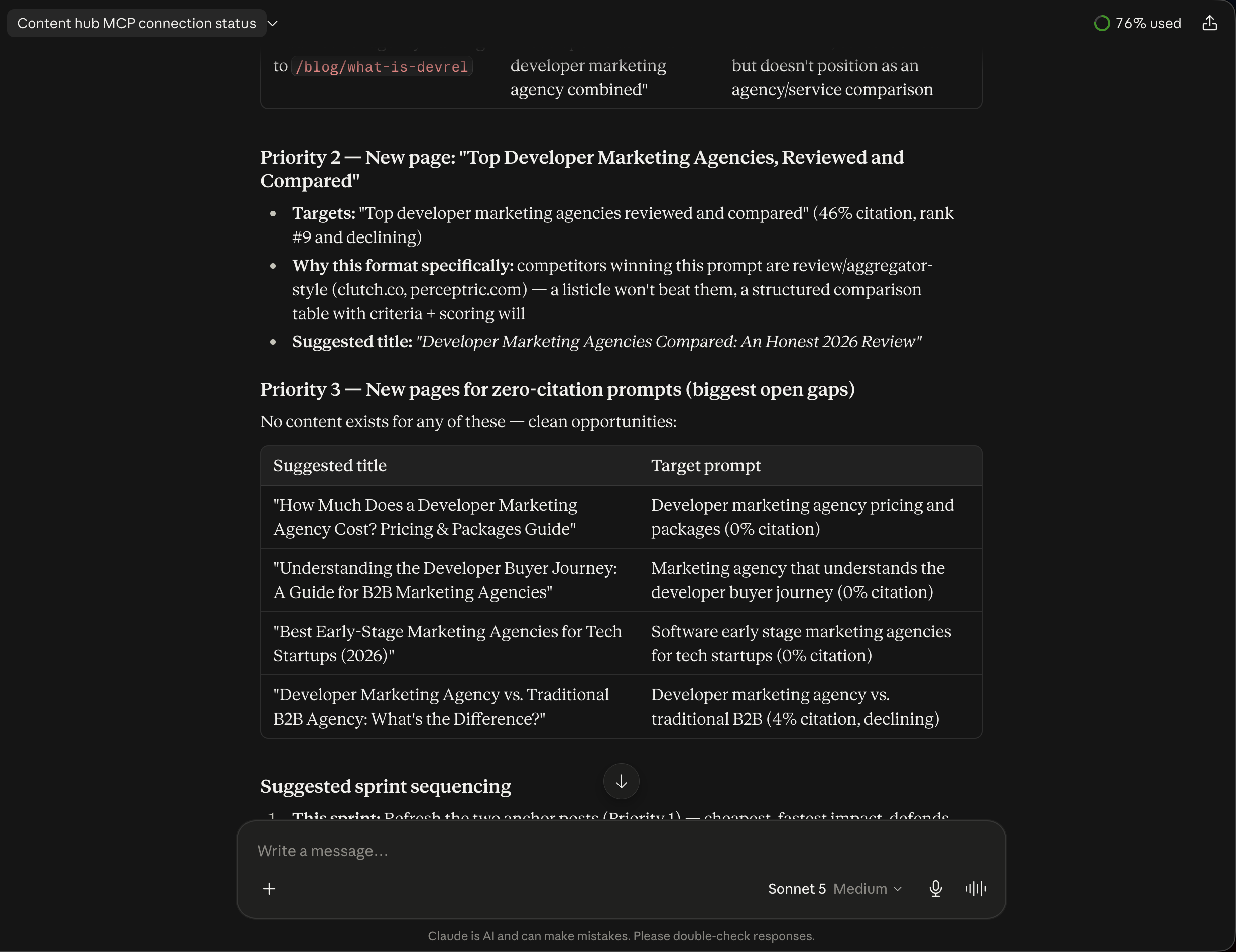
A raw GEO cluster becomes a prioritized, sequenced content backlog, all inside one Claude Desktop conversation, with every recommendation traceable back to a specific prompt, rank, and competitor.
Open app.infrasity.com and run this same comparison on your own cluster to turn your citation gaps into a backlog you can actually act on this sprint.
How to Run GEO/AEO Audits Using Content Hub MCP
Run a full GEO/AEO audit from a single chat message, on your own domain, a single page, or any company's docs, all over Content Hub MCP.
How to Know Who's Getting Cited Instead of You
Track exactly who's winning the citations you're not, prompt by prompt, over Content Hub MCP, instead of manually comparing domains one at a time.