How to Track AI Share of Voice Across LLMs Using Content Hub MCP
Pull AI share of voice data for any GEO cluster straight into a Claude Desktop chat, then have Claude turn it into a prioritized content plan.
Share of voice is the percentage of all citations handed out in a cluster, across every competing domain, that go to you. It's a different question from whether you get cited at all: it measures how much of the spotlight you're actually holding once you do. Once Claude Desktop is connected to Infrasity's Content Hub via MCP (see the Content Hub MCP setup guide if you haven't done that yet), you can pull that data for any GEO cluster straight into a chat, then have Claude turn it into a prioritized content plan instead of reading a raw citation table yourself.
Before you start, make sure a GEO cluster exists with prompts added to it, and that it has a few GEO runs completed across the models you care about.
Here's the flow, from a raw share of voice pull to a ranked list of next steps.
Ask Claude to fetch share of voice data for a GEO cluster
Name the cluster and the models you care about, for example:
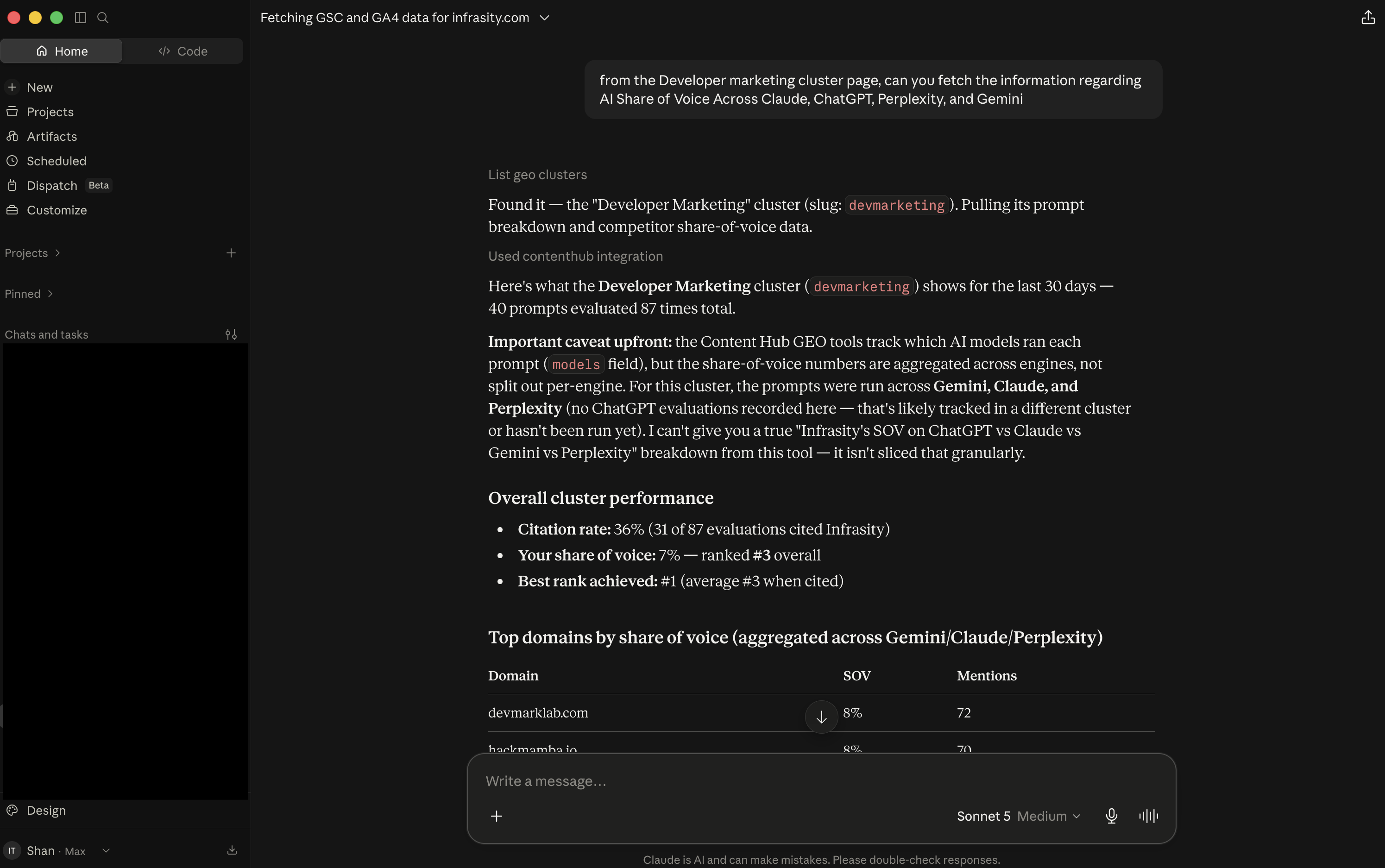
"from the Developer marketing cluster page, can you fetch the information regarding AI Share of Voice Across Claude, ChatGPT, Perplexity, and Gemini"
Claude finds the matching cluster and pulls its prompt breakdown and competitor data. It's worth reading the caveat it gives upfront: share of voice is aggregated across whichever models actually ran the prompts, not split out per engine, so a request for a per-model breakdown may come back as one combined number if the cluster wasn't evaluated on every model.
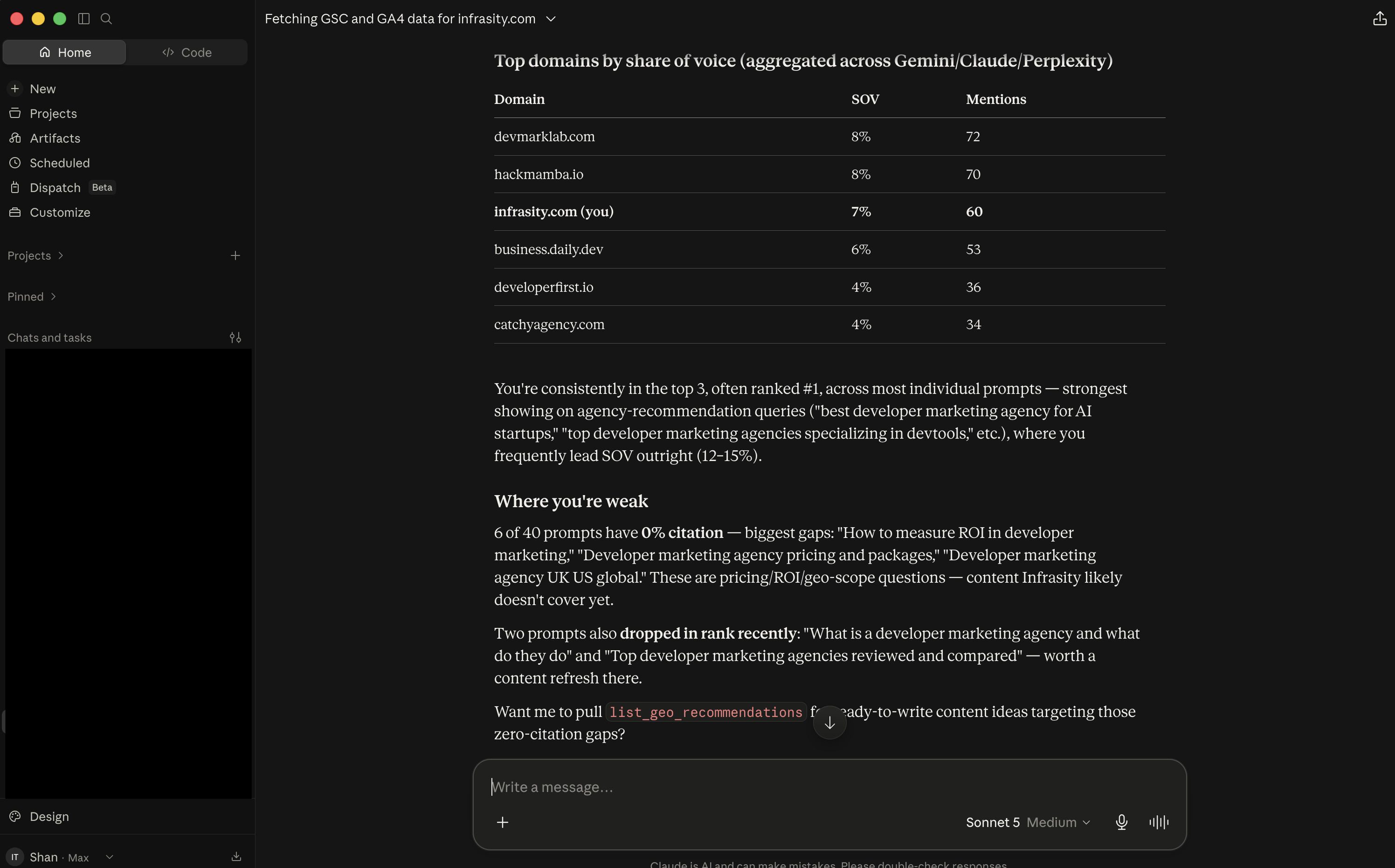
With that caveat in mind, Claude returns the cluster's overall citation rate and share of voice, plus a full table ranking every competing domain by share of voice and mention count.
It also flags where you're strong and where you're not before you even ask for analysis: consistently ranking in the top 3 on individual prompts, strongest on agency-recommendation queries, but with several prompts at 0% citation and a couple that recently dropped in rank.
Ask Claude to analyze the data
With the raw share of voice numbers already in the conversation, ask Claude to interpret them, for example:
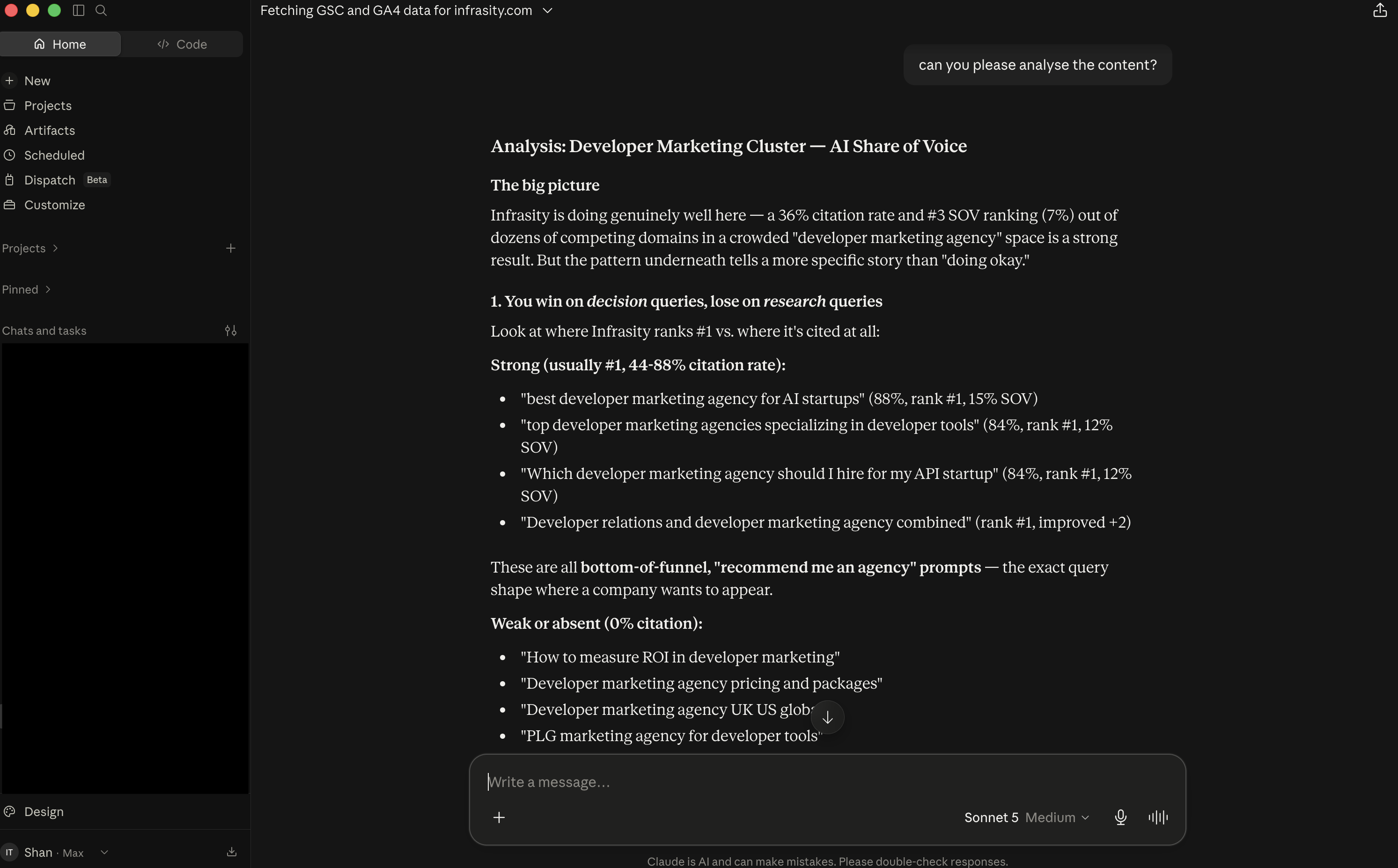
"can you please analyse the content?"
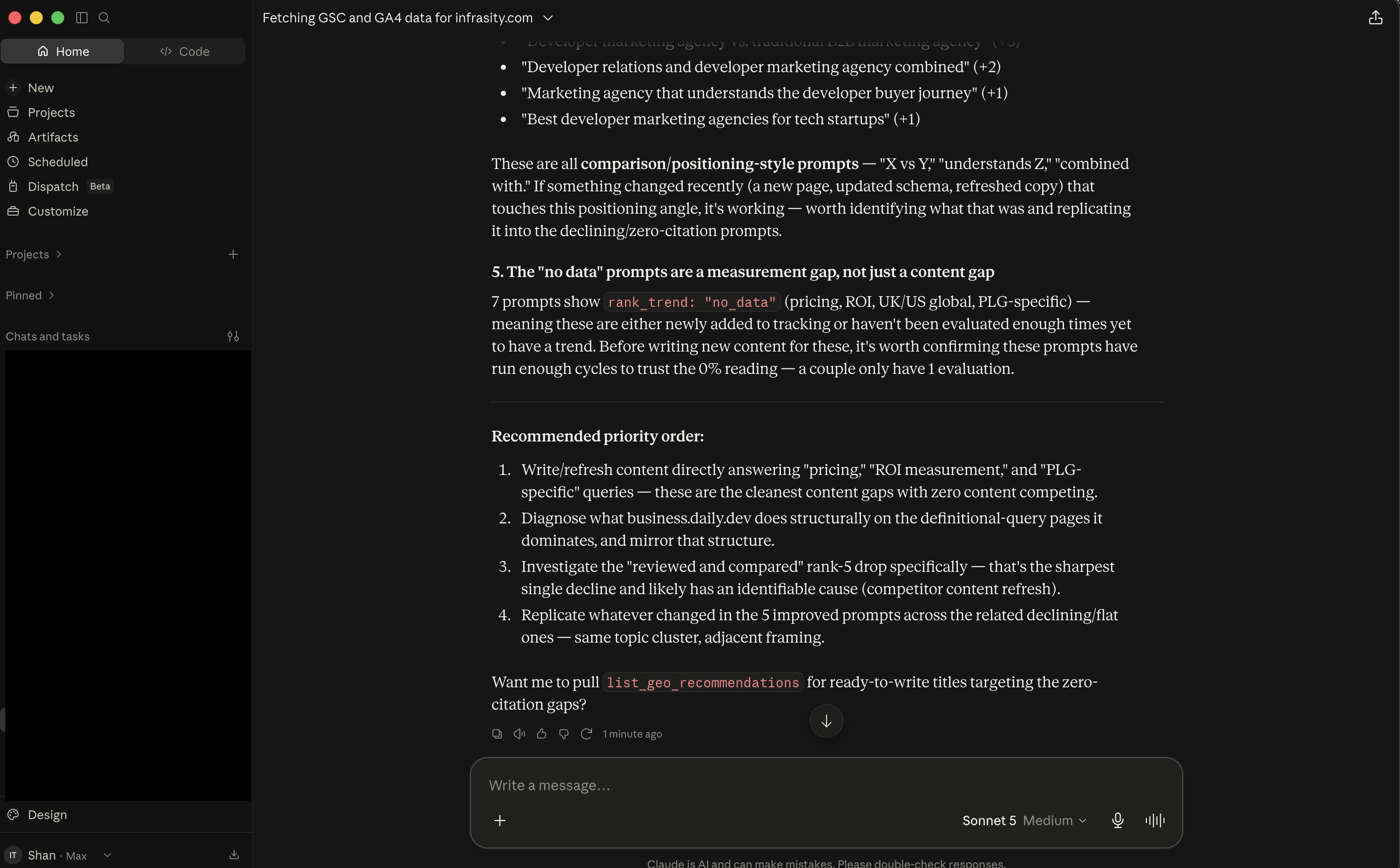
Claude opens with a one-line verdict, then separates the prompts where you're strong (usually bottom-of-funnel "recommend me an agency" queries) from the ones where you're weak or absent (educational or logistics queries, like pricing or ROI). The takeaway isn't a broad content gap, it's a specific funnel-stage gap.
It names the single competitor dominating share of voice across the most prompts (often not even a direct competitor, but a content or aggregator site), and walks through any prompts that declined in rank with a specific hypothesis for why.
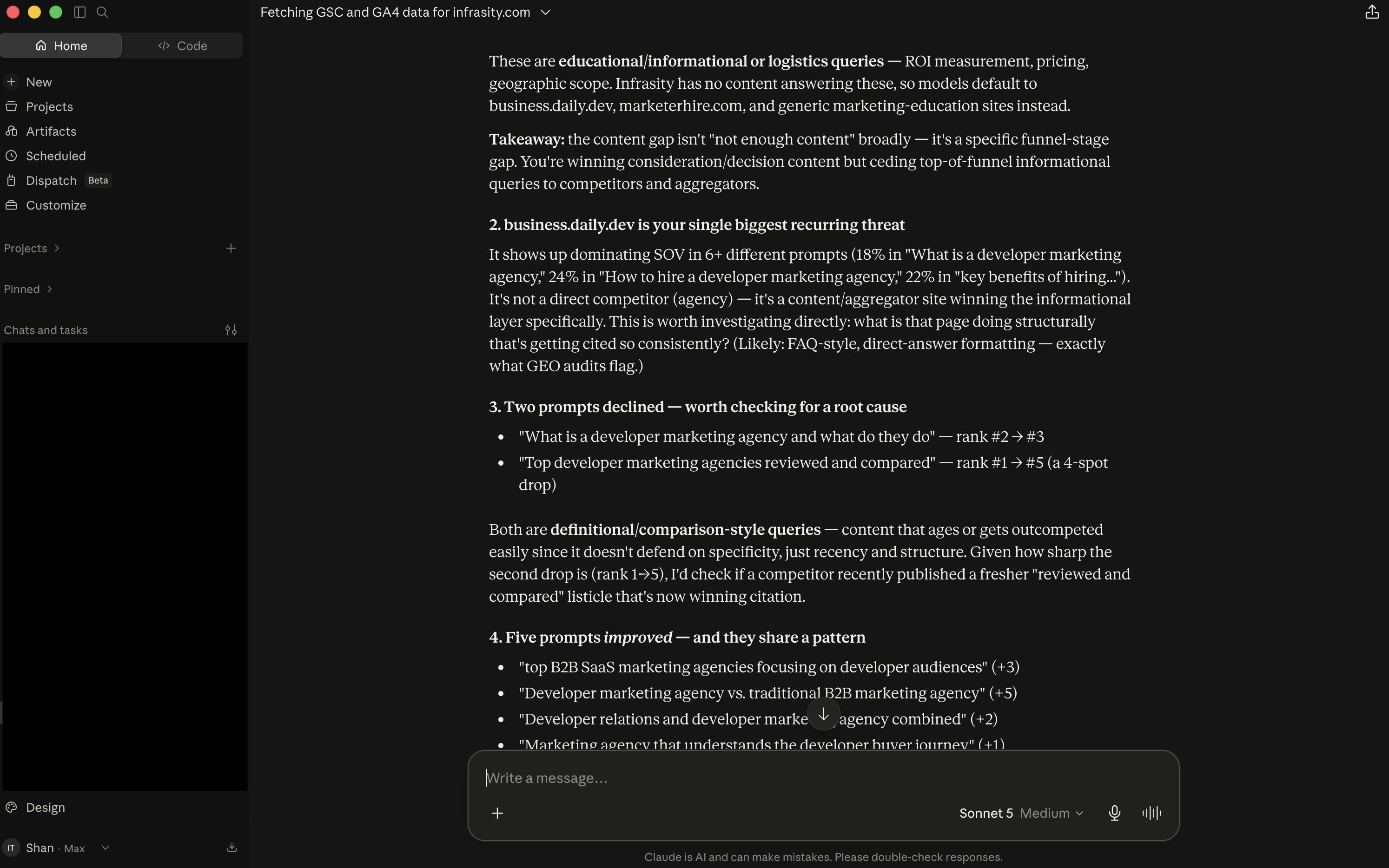
It closes by grouping the prompts that improved to spot the pattern worth repeating, flagging any zero-citation reading that's actually low-confidence rather than a confirmed gap, and ranking what to act on first.
Ask Claude for takeaways
If you want the analysis condensed into something scannable or shareable, just ask:
"please give me takeaways"
Claude returns a short numbered list, each takeaway paired with the specific data behind it: you dominate decision-stage queries, you're absent on informational queries (the fastest wins available), one recurring competitor is worth reverse-engineering, a couple of prompts are actively declining, several are improving and worth learning from, and a few zero-citation readings are still low-confidence.
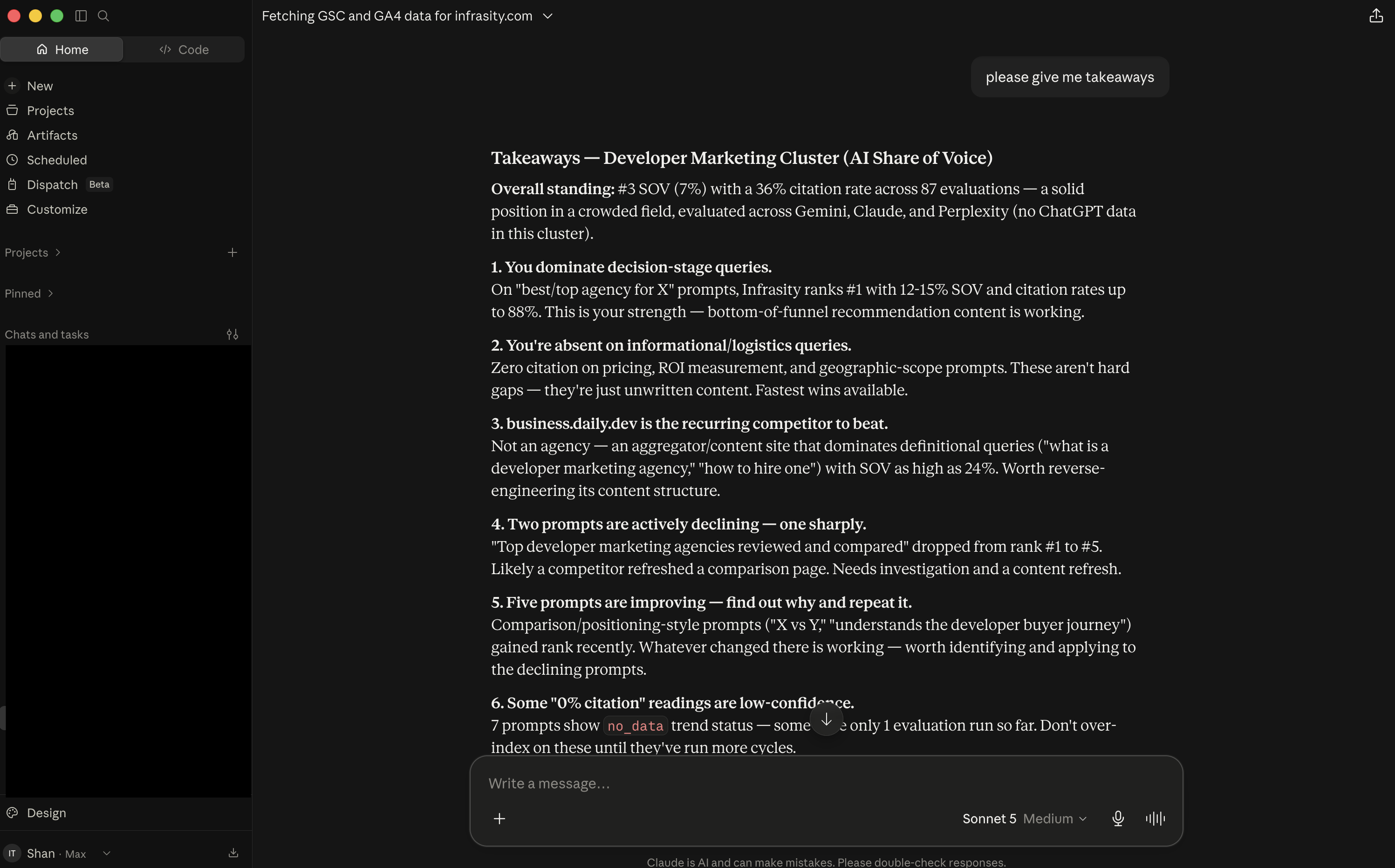
From a raw share of voice pull to a prioritized content plan, the entire analysis happens in one Claude Desktop conversation, with no manual cross-referencing across engines.
Head to app.infrasity.com and check your own cluster's share of voice to see exactly where you stand against your real competitors right now.
How to Create a GEO Cluster, Add Prompts, and Track Citations via MCP
Create a new GEO cluster, populate it with prompts either directly or by scanning your site, and read the resulting citation and visibility data, all from a Claude Desktop chat over Content Hub MCP.
How to Read the GEO Dashboard: Citation Rate vs. Share of Voice
Track AI visibility with Content Hub MCP, and understand the difference between citation rate and share of voice before looking at any numbers.