How to Run a Freshness Audit and Prioritize What to Update
Audit your whole published library for stale content in one message over Content Hub MCP, and get back a prioritized, reasoned list of what to fix first.
A freshness audit checks how long it's been since each post was published or last updated, and flags anything past a set threshold, usually 180 days, as stale. Published content doesn't stay accurate forever, and a blog that's grown for a year or more usually has a chunk of it quietly going stale without anyone noticing. Once Claude Desktop is connected to Infrasity's Content Hub via MCP, you can audit the whole library in one message and get back not just a stale/fresh count, but a prioritized, reasoned list of what to fix first.
Before you start, make sure your topics are published with real URLs and recorded publish dates, since freshness is calculated from post age. A library with some real history to it, not just a few weeks of posts, is what makes the audit worth running.
Here's the flow.
Fetch the freshness report and get the analysis
Ask for the freshness report and the analysis together, in one message, for example:
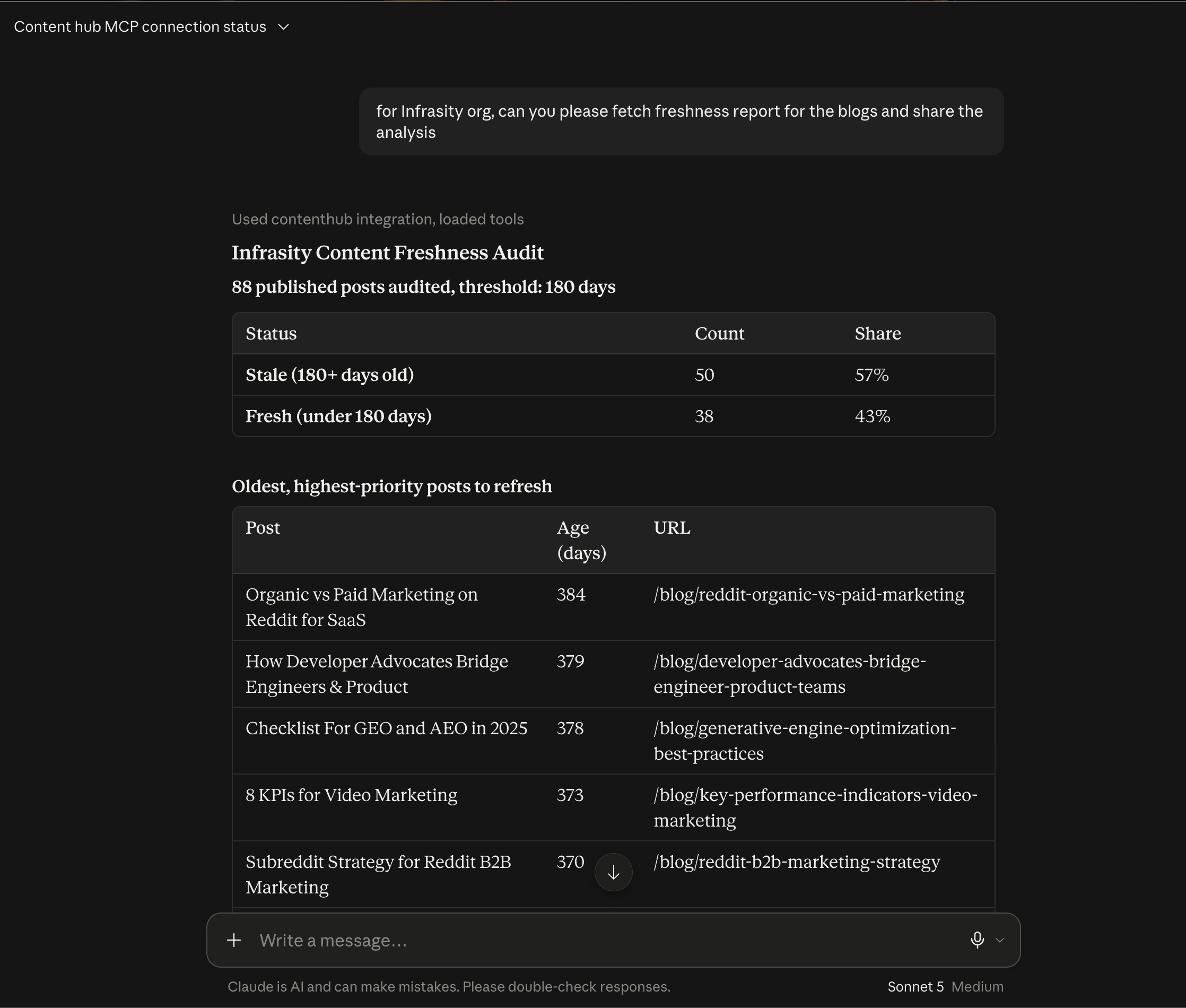
"for Infrasity org, can you please fetch freshness report for the blogs and share the analysis"
Claude returns a clear top-line summary first: 88 published posts audited against a 180-day threshold, 50 stale (57%) and 38 fresh (43%). It then lists the oldest, highest-priority posts to refresh, each one named individually with its exact age and URL rather than just a count, for example "Organic vs Paid Marketing on Reddit for SaaS" at 384 days old and "Checklist for GEO and AEO in 2025" at 378, so you have a concrete starting list instead of an abstract percentage. It also offers to go further, noting the full stale list spans publish dates from August 2025 to February 2026 and can be exported on request.
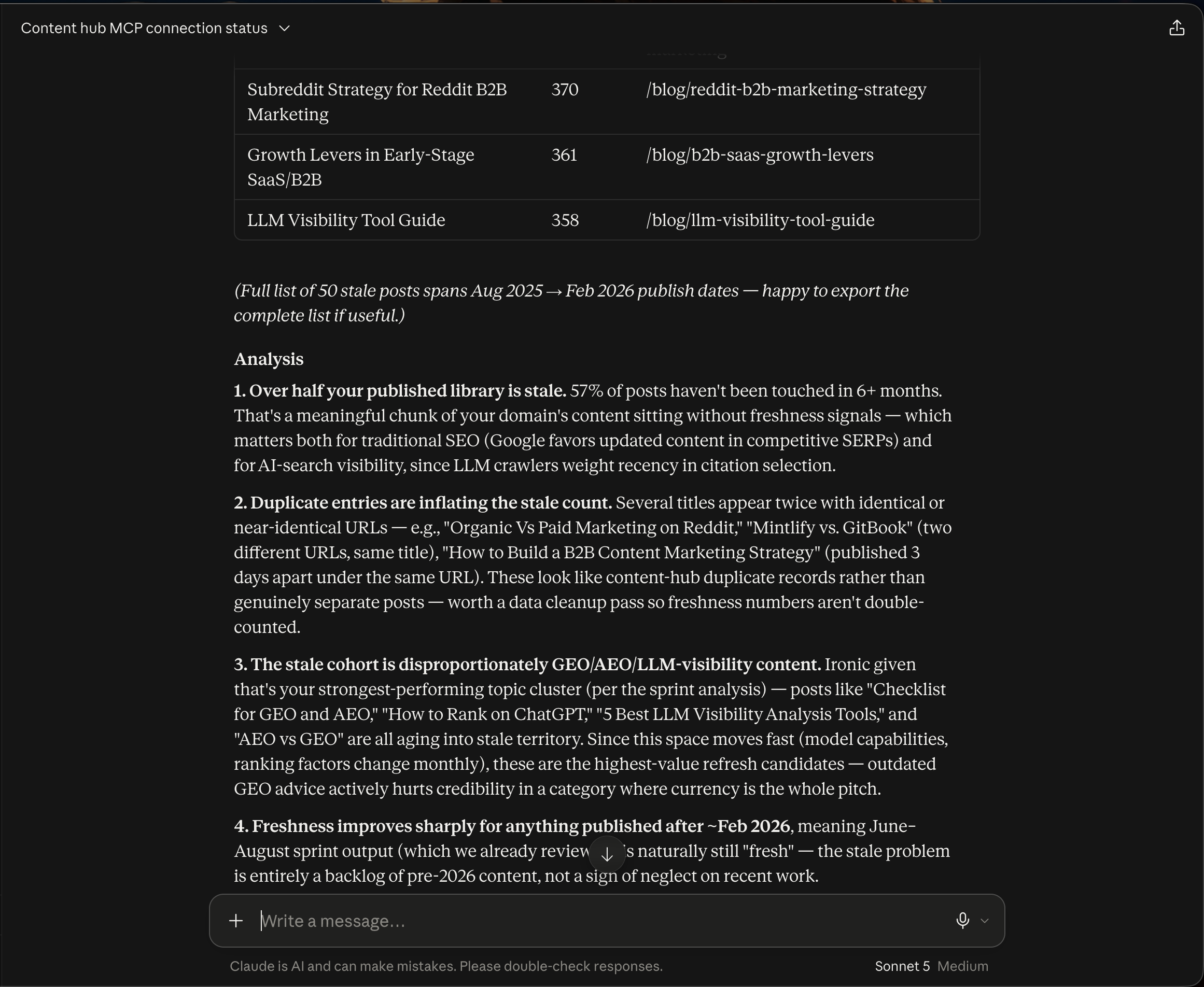
Claude then moves into analysis, and this is where the report earns its keep, four distinct findings rather than a restated table:
- Over half the published library is stale, with a note on why that actually matters: it affects both traditional SEO, since Google favors updated content in competitive results, and AI-search visibility, since LLM crawlers weight recency in citation selection.
- Duplicate entries are inflating the stale count. Claude names specific titles that appear twice under identical or near-identical URLs, for example the same "Mintlify vs. GitBook" comparison under two different URLs, and a B2B content marketing piece published three days apart under the same one, flags them as likely Content Hub duplicate records rather than genuinely separate posts, and recommends a data cleanup pass before treating the freshness numbers as fully accurate.
- The stale cohort is disproportionately GEO/AEO/LLM-visibility content, called out as ironic given that's the strongest-performing topic cluster overall. Titles like "Checklist for GEO and AEO," "How to Rank on ChatGPT," and "AEO vs GEO" are all aging into stale territory, and Claude explains why this specific staleness is higher stakes than the rest: the space moves fast, model capabilities and ranking factors change monthly, so outdated advice in this category actively hurts credibility rather than just looking neglected.
- Freshness improves sharply for anything published after roughly February 2026, meaning recent sprint output is naturally still fresh. The staleness problem is entirely a backlog of older content, not a sign of neglect on current work.
Ask for takeaways
If you want the analysis condensed into something you can act on directly, just ask:
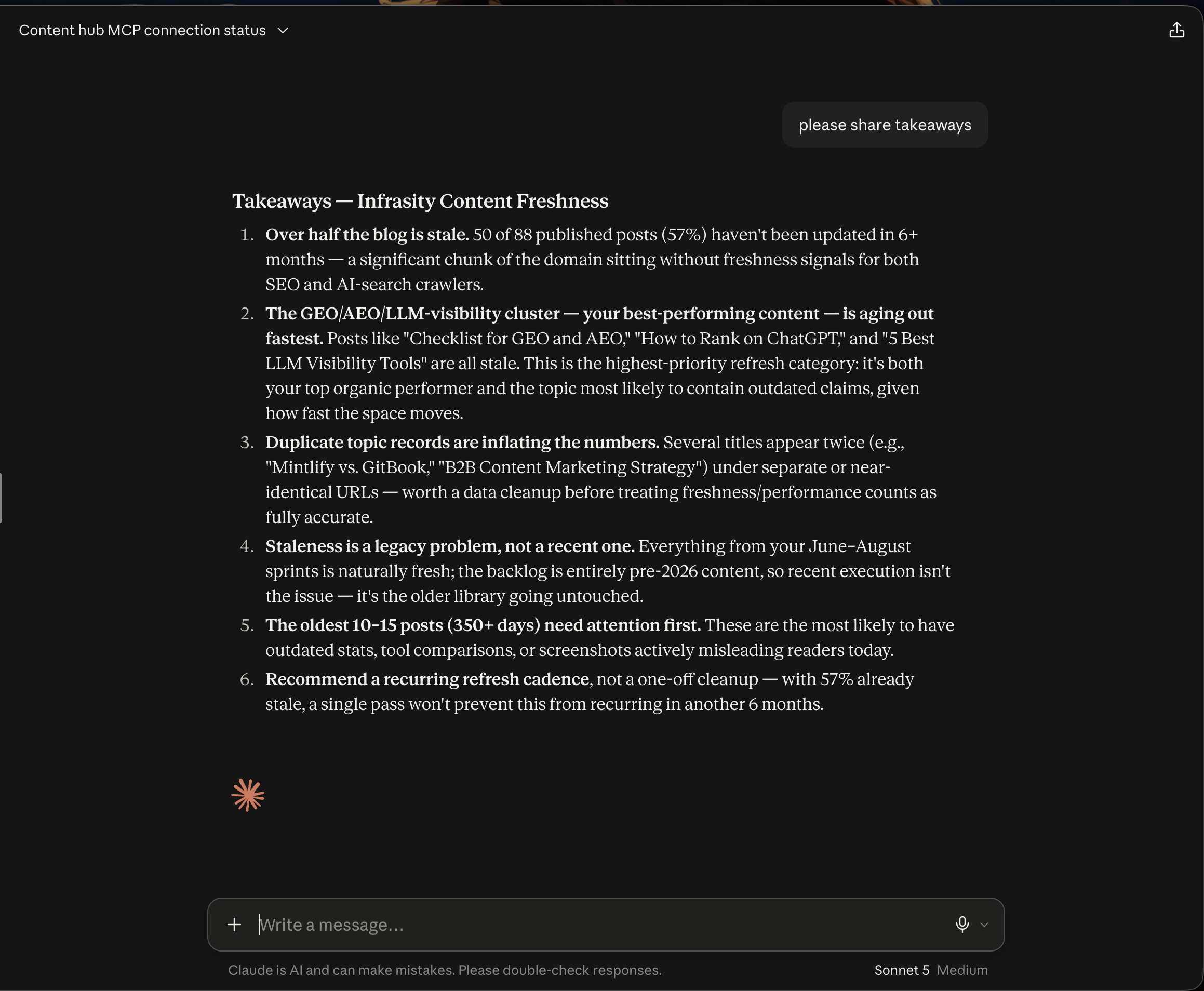
"please share takeaways"
Claude returns a short numbered list, each takeaway paired with the specific number or example behind it: over half the blog (50 of 88 posts) hasn't been updated in six or more months; the GEO/AEO/LLM-visibility cluster, the best-performing content on the whole site, is aging out fastest and should be the highest-priority refresh category; duplicate topic records are inflating the numbers and worth a cleanup pass; staleness is a legacy problem, not a recent one, since everything from the latest sprints is naturally fresh; the oldest 10 to 15 posts (350-plus days) need attention first, since they're the most likely to have outdated stats or screenshots actively misleading readers today; and the real fix is a recurring refresh cadence, not a one-off cleanup, since a single pass won't stop 57% of the library from going stale again in another six months.
A single freshness-report request turns into a prioritized, reasoned refresh list, all inside one Claude Desktop conversation, with every recommendation traceable back to a specific post and its age.
Head to app.infrasity.com and run a freshness audit on your own blog to see how much of your library is quietly going stale.
How to Check Published Blog Performance at a Glance
Pull blog performance across multiple sprints in one message over Content Hub MCP, complete with a chart, the full publish log, and Claude's takeaways.
How Reddit Scout Surfaces Threads Worth Engaging With
Pull every top-cited Reddit thread for a GEO cluster over Content Hub MCP, ranked by citation volume, with a clear yes/no on whether your brand is mentioned in each one.