
TL;DR
- Built on Next.js, Fumadocs harnesses the App Router to deliver fast build times, top-tier static site generation (SSG), and robust SEO right out of the box.
- Fumadocs Utilizes React Server Components (RSC) to fetch and display live API data, ensuring documentation is never stale.
- Fumadocs Supports OpenAPI/Swagger integration for automated, reliable API reference documentation.
- Fumadocs Highly composable architecture allows developers to easily embed custom React components for interactive, rapid feature demonstrations.
What is Fumadocs and how it Works for Products with Rapidly Evolving APIs and SDKs
FumaDocs is an open-source documentation system for React and Next.js that helps teams build developer docs, API references, and product guides and it’s already used by fast-moving B2B SaaS startups like Unkey, Orama Search, Shadcn UI, and Arktype, which need docs that update as quickly as their APIs ship.
Instead of a locked-in SaaS editor, it gives you a fully code-driven docs site with version control, theming, and UI components tailored for technical documentation.
How Fumadocs Works for Fast-Changing APIs
APIs that evolve quickly require documentation that can keep up with rapid releases, new endpoints, breaking changes, and frequent SDK updates. Traditional documentation systems like GitBook, Notion, Confluence, and older CMS-based doc sites fall behind because they rely heavily on manual edits, slow publishing cycles, and separate content management layers. Fumadocs solves this entire problem by making documentation a code-driven, automated part of your development workflow.
Example: How a Fast-Growing API Product Evolves
Imagine you’re building an early-stage B2B SaaS platform like Unkey, where developers depend on your API to generate and manage authentication keys. In the first 3-6 months, your product might be shipping updates like:
- Week 1: Add a new endpoint
/v1/keys/rotate - Week 3: Update the request body for
/v1/keys/create - Week 4: Deprecate the old
GET /keysmethod - Week 6: Release an SDK update for Node.js & Python
- Week 7: Change error codes to support new security validations
- Week 8: Add rate-limit metadata to all responses
In a rapidly growing SaaS product, where API changes occur constantly sometimes multiple times per sprint traditional documentation systems fail because they rely on slow manual page updates, leading to inevitable drift between the published guide and the actual API behavior. Fumadocs solves this critical problem by making documentation code-driven, automatically ensuring every schema change, SDK update, or API version bump syncs directly with the documentation; it keeps your docs fresh, accurate, and aligned with your product by combining three core principles: Live API Metadata, Code-Driven References, and a Composable React architecture.
Live API Metadata: Docs That Update Themselves
Using React Server Components, Fumadocs can query:
Internal API metadata
Example:
Your backend exposes a metadata route like:GET /internal/metadata/endpoints
This returns all active endpoints, authentication types, response fields, and status.
If a team adds a new endpoint or changes a parameter, the docs update instantly.
OpenAPI spec endpoints
Example:
Your CI/CD pipeline publishes a fresh openapi.json on every merge GET https://api.yourapp.com/openapi.json
Fumadocs reads this and automatically updates request/response schemas, examples, and tables.
No manual editing, no outdated fields.
Feature flag systems
Example:
A feature flag like beta-new-payments=true becomes active.
Fumadocs queries your flag service GET https://flags.yourapp.com/api/payment_v2
Then automatically shows/hides docs for beta features or marks them with “Early Access”.
Configuration services
Example:
Your config service exposes current rate limits:GET/config/rate-limits
If you change the rate limit from 100 requests/min to 150 requests/min, the docs update instantly without a writer touching anything.
Rate limit dashboards
Example:
If your rate-limit dashboard exposes analytics like:GET /internal/limits/stats
Fumadocs can pull this data to show updated quota tiers, burst limits, or usage thresholds, always in sync with backend reality.
Instead of manually copying values into Markdown, pages can show live values from your backend.
If your API introduces:
- New rate limits
- New error codes
- New permissions
- A new experimental flag
Your documentation updates automatically without a manual edit,as instead of manually copying values into Markdown, FumaDocs uses React Server Components to fetch live data from your backend at build-time or request-time.
This means every time your API changes, the docs read the new values directly from the source.
This eliminates the single biggest cause of stale developer documentation.
Real-Time Accuracy: Never Manually Update Rate Limits Again
Using React Server Components, Fumadocs can read live data sources, fetch API metadata, or pull from internal services at request time, so sections of your docs always reflect the latest state of your platform.
For example, rate limits, feature flags, or dynamic configuration can be displayed directly from your backend instead of being manually copied into markdown, reducing the risk of stale or broken documentation.
Code-Driven Docs: Automate API References with OpenAPI
Fumadocs supports OpenAPI/Swagger definitions, letting you generate or render accurate API references directly from your source of truth instead of hand-writing every endpoint.
When your API spec changes new routes, parameters, or error codes you update the OpenAPI file, and the docs stay in sync, which is essential for products that deploy multiple times a week.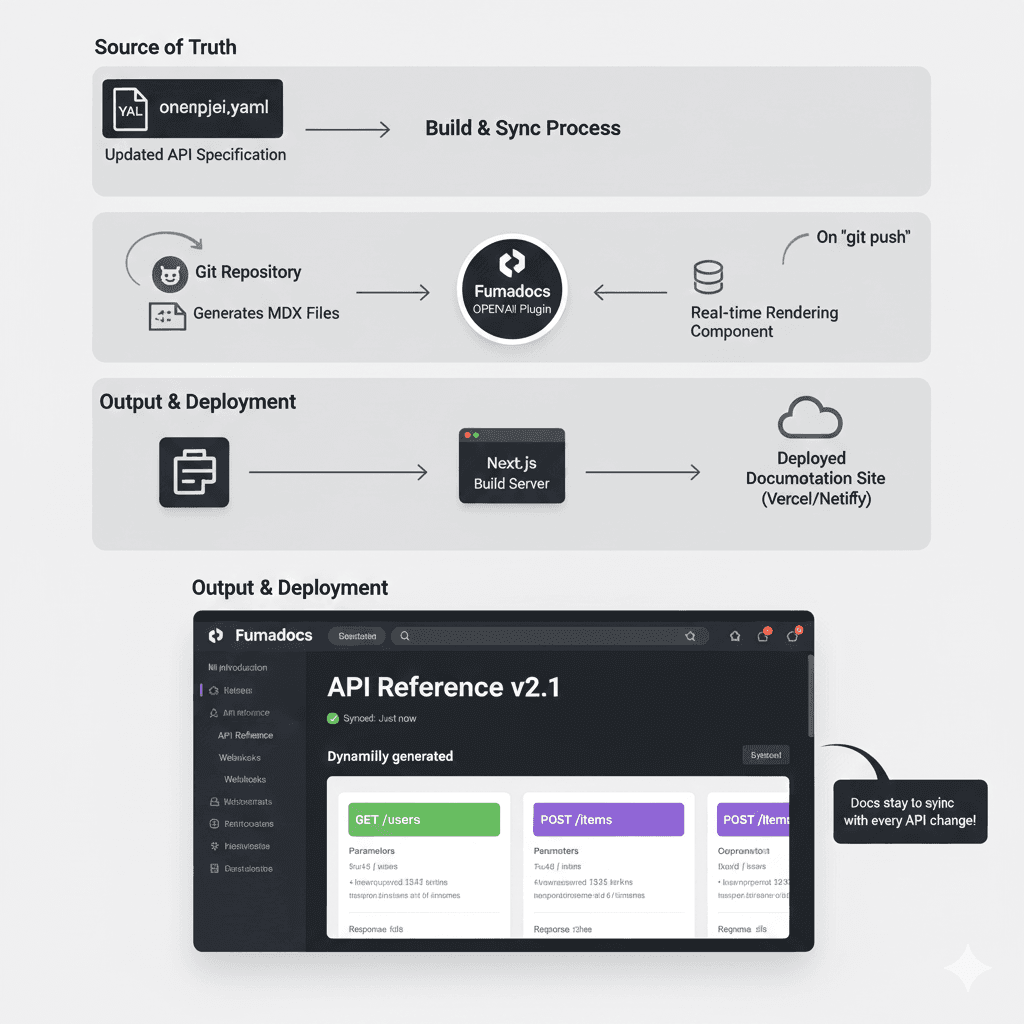
Flexible DX: Composable UX for SDK Playgrounds and Demos
Because Fumadocs is just React, you can embed interactive components, code playgrounds, SDK switchers, environment pickers, and live demos directly into your documentation pages.
This composability is ideal for fast-moving SDKs: you can show versioned examples, multi-language snippets, and feature flags in one place without fighting a rigid WYSIWYG editor.
A playground that actually works on the first try is one of the fastest ways to fix onboarding friction, see our walkthrough of the 5 Whys as a developer experience engineer for how to diagnose where that friction starts.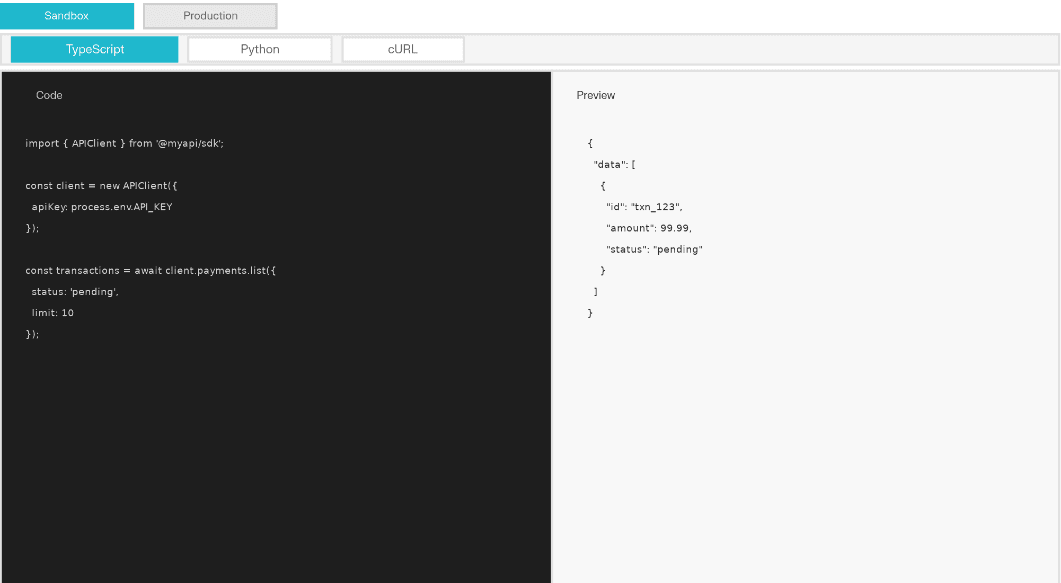
Engineered for Scale: Performance, SEO, and the Next.js Advantage
Leveraging Next.js App Router and static site generation, Fumadocs produces fast, production-ready documentation sites with good performance baselines and SEO out of the box.
This means even as you keep shipping new API versions, endpoints, and SDK updates, your docs remain fast to navigate, easy to discover, and scalable to large content libraries.
Use Case: A Fast-Growing SaaS Product Shipping API Updates Weekly
Imagine you're building a B2B SaaS platform like Unkey or Orama Search, where:
- You release new API versions every few weeks
- You add new endpoints like
/v1/search/vectoror/v2/auth/refresh - SDKs for JS, Python, Go get updated every sprint
- Dozens of docs pages need to be updated regularly
Here’s how Fumadocs + Next.js handles scale:
Performance at Scale -Even With 500+ Docs Pages
Because Fumadocs uses static site generation (SSG) and React Server Components, every doc page is pre-rendered and served from the CDN.
Result:
Even if you have huge documentation libraries, the pages stay extremely fast:
- Millisecond load times
- No client-side heavy JS
- No runtime bottlenecks on the server
Why it matters:
Developers exploring your APIs (especially new customers) won’t bounce due to slow docs. Docs like this are quietly one of your best growth channels, see how they fit into a broader developer marketing strategy for B2B SaaS and DevTools companies.
SEO That Grows With Each New Endpoint
Every new API endpoint automatically creates a crawlable, SEO-friendly static page.
Example:
When you add a new endpoint /v1/projects/usage, Fumadocs automatically generates:
- A standalone HTML page
- Metadata + canonical tags
- Structured layout
- Clean URL structure
This improves ranking on Google for developer searches like:
“project usage API” or “Unkey usage endpoint.”
From Install to Ship: Deploying High-Velocity Docs
For a startup, time is money. Fumadocs is built to minimize setup friction, allowing you to go from zero to a deployed, production-ready documentation site in minutes. Since Fumadocs is a Next.js application, it benefits from the framework's stability and enterprise-grade deployment features.
Below, we’re outlining the exact steps you follow from installing the framework, configuring your docs, pulling live API metadata, and deploying to production. These steps show how a startup can literally go from “pnpm create fumadocs” to a fully-functional, auto-updating documentation site without heavy tooling or dev-ops overhead.
Step 1: Initialize the Project

- Select Next.js: Choose the Next.js option for the framework.
- Select Content Source: Choose the recommended Fumadocs MDX for maximum flexibility and component integration.
This process handles the installation of all dependencies, including Next.js, React, Tailwind CSS, and the core Fumadocs packages
Step 2: Content Structure and Organization
Your documentation lives primarily in the /content/docs directory. Fumadocs uses a file-system-based routing and organization system, making it intuitive and version-control friendly.
- Content Files: Write your guides, tutorials, and concepts using Markdown (.md) or MDX (.mdx).
- Routing:The file path determines the URL (e.g.,
/content/docs/api/quickstart.mdxbecomes/api/quickstart). - Sidebar Navigation: Organize your sidebar using a simple
meta.jsonfile within each directory. This defines the title, order, and icon for each section, keeping your sidebar in sync with your content structure without complex configuration.
Step 3: Integrating Custom React Components
The real power for SDKs comes here. To embed your interactive code playgrounds or version switchers, you simply import them into your MDX files.
- Create Component: Develop your component in the standard
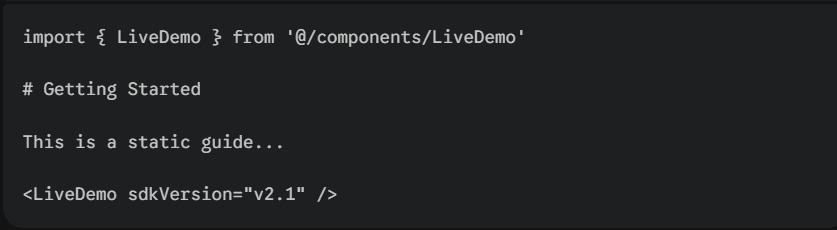
/componentsdirectory (e.g.,components/LiveDemo.jsx). - Import in MDX: Use the standard import syntax at the top of your documentation file:
Step 4: Local Development and Preview
Start your development server to instantly see changes via Hot Module Replacement (HMR). This allows for rapid iteration on both code and documentation content simultaneously.

Step 5: Deployment to Production (Shipping Docs)
Because Fumadocs is a standard Next.js application, deployment is straightforward and extremely fast, leveraging cloud build tools for optimized performance.
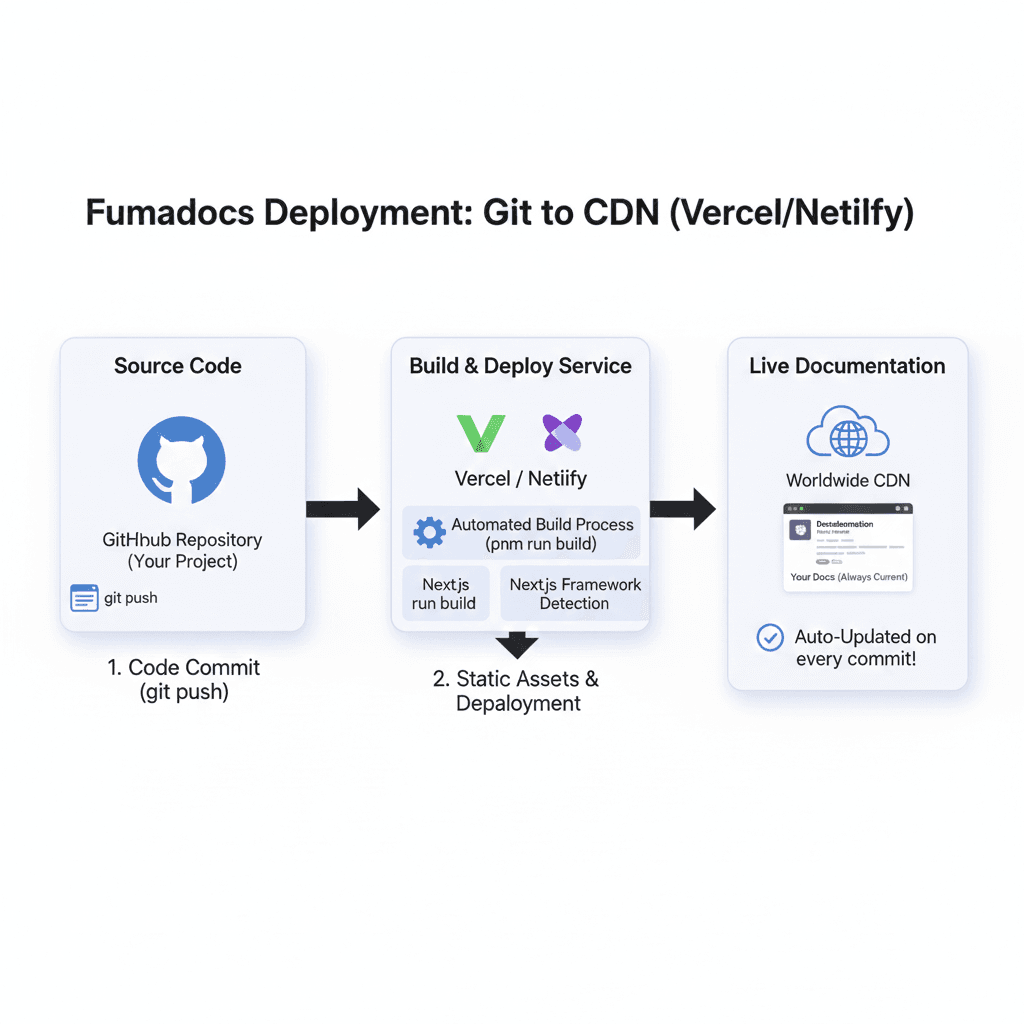
A. Vercel / Netlify
This is the fastest path to production for a startup.
- Connect Git: Push your project to a Git repository (GitHub/GitLab).
- Automated Build: Connect your repository to Vercel or Netlify. They automatically detect the Next.js framework.
- Deployment: On every
git pushto your main branch, the CI/CD pipeline runspnpm run build, generates optimized static assets, and deploys the new documentation. Your docs are updated automatically with every code commit.
B. Self-Hosting / Docker
If you need a custom environment, you simply build and serve the standard Next.js output:
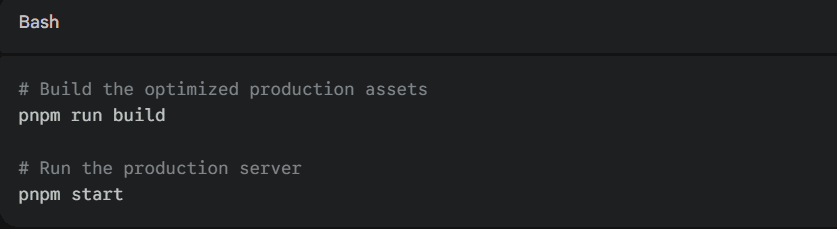
The optimized output benefits from Static Site Generation (SSG) wherever possible, meaning your docs are served as lightning-fast static assets from a CDN.
Why This Deployment Model Works for Fast-Moving Teams
Startups and devtools companies need documentation that evolves as rapidly as their product. Fumadocs’ build system, paired with Git-driven workflows and static exports, ensures:
- Zero friction when updating docs
- Zero downtime during deploys
- Zero risk of stale content
- Zero dependency on external CMS editors
Your documentation grows as your product grows without extra overhead.
FumaDocs: The Preferred Choice for High-Growth, Agile Startups
FumaDocs is especially popular among early-stage and growth-stage startups that ship product changes fast. These companies typically have:
- Rapidly evolving API schemas and SDK versions
- Small engineering teams who need auto-updating documentation
- CI/CD workflows where documentation must update automatically
- Constant iteration based on user feedback
- Limited bandwidth to manually rewrite docs every week
Startups building developer tools, authentication platforms, fintech APIs, and cloud SaaS platforms prefer FumaDocs because it keeps documentation in sync with code without extra effort.
FumaDocs' credibility is reinforced by its growing adoption. The official site claims use by teams at notable companies like Unkey, Vercel, and Orama.
Vercel: Teams within the Next.js platform leader use FumaDocs, validating its performance and composability.
Shadcn UI: Used as the official documentation framework for the massively popular component collection.
Million.js: The fast and tiny virtual DOM library relies on FumaDocs for its documentation.
Arktype: The creator of this highly-rated type validation library publicly credits FumaDocs for the quality of their docs.
Unkey & Orama: These innovative startups leverage FumaDocs, proving its suitability for high-growth, API-focused products.
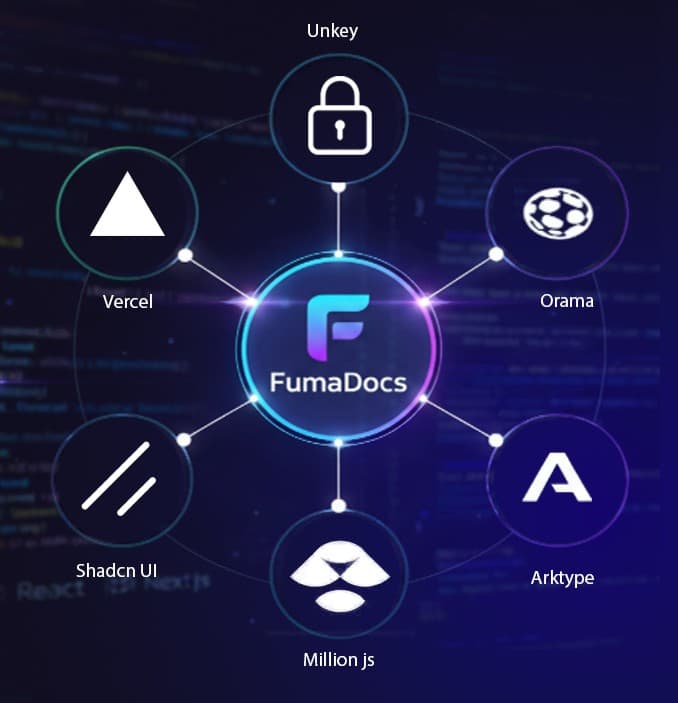
Furthermore, FumaDocs is the credited documentation framework behind major open-source projects, including Shadcn UI, Million.js, and Arktype. This widespread community adoption solidifies its reputation as the ideal solution for developers, startups, and companies building products with React and Next.js.
Conclusion: Documentation as Your Competitive Advantage
For a developer startup operating at high velocity, documentation cannot be an afterthought; it must be treated as a core feature of your product. If your API evolves weekly, your docs must update instantly or your adoption rates will suffer.
Fumadocs solves this fundamental problem by unifying your documentation with your engineering workflow. By leveraging the power of Next.js, React Server Components (RSC), and OpenAPI automation, you eliminate manual processes, guarantee accuracy, and drastically reduce the friction for new developers adopting your SDK.
The strategic takeaway for your startup is clear:
- Focus on Features, Not Fixes: Stop diverting engineering time to manually fix stale documentation.
- Accelerate Adoption: Deliver documentation that is fast, searchable, and always correct, leading to quicker Time-to-First-Hello-World (TTFHW).
- Future-Proof Your DX: Build on an open-source, scalable foundation that grows with your product, not against it.
Shift your documentation from being a costly maintenance burden to a powerful engine for developer enablement and predictable growth.
Fumadocs is a strong fit for API-heavy products, but it's one of several options, see our comparison of frameworks for scalable documentation sites if you're weighing it against MkDocs, Docusaurus, VuePress, or Antora.
Frequently Asked Questions
Q: What problem does FumaDocs primarily solve?
A: FumaDocs solves the problem of documentation drift for fast-moving startups. It ensures that technical documentation, especially for APIs and SDKs, remains perfectly in sync with the actual code without requiring manual updates or extra developer bandwidth.
Q: Is FumaDocs only for Next.js projects?
A: FumaDocs is heavily optimized for the React and Next.js ecosystem, making it the ideal choice for modern web development companies. Its features and integrations work best within the Next.js framework (particularly the App Router).
Q: How does FumaDocs handle rapid API changes?
A: FumaDocs is built to integrate directly into Continuous Integration/Continuous Deployment (CI/CD) workflows. It supports auto-updating documentation based on code changes, meaning every time your code ships, your documentation updates automatically.
Q: What kind of companies or projects use FumaDocs?
A: FumaDocs is popular among early-stage and growth-stage startups that ship product changes fast. Notable users include teams from Vercel, Unkey, and major open-source projects like Shadcn UI and Million.js.